
 info@apexautoparts.co.uk
 +44 203 915 7535
 Safe & Fast Shipping
 Whish List
 Compare
 Sign In

Piston damage is where the problem shows itself, not where it starts.
By the time a piston fails, something else in the engine has already gone out of balance. Heat, lubrication, or combustion one of these has been off long enough for damage to build.
That’s why focusing only on the piston is where most repairs go wrong.
You’re not dealing with an isolated failure; you’re dealing with the result of something that’s already been happening.
Where It Begins
A piston operates at the center of everything the engine does.
It’s exposed to constant combustion pressure, extreme heat cycles, and high-speed movement within tight tolerances. For it to function properly, the systems around it fuel delivery, timing, lubrication, and cooling all need to work in sync.
When they don’t, the piston is often where the imbalance becomes visible first.
Not because it’s weak, but because it’s exposed to all of it.
What Leads to Failure
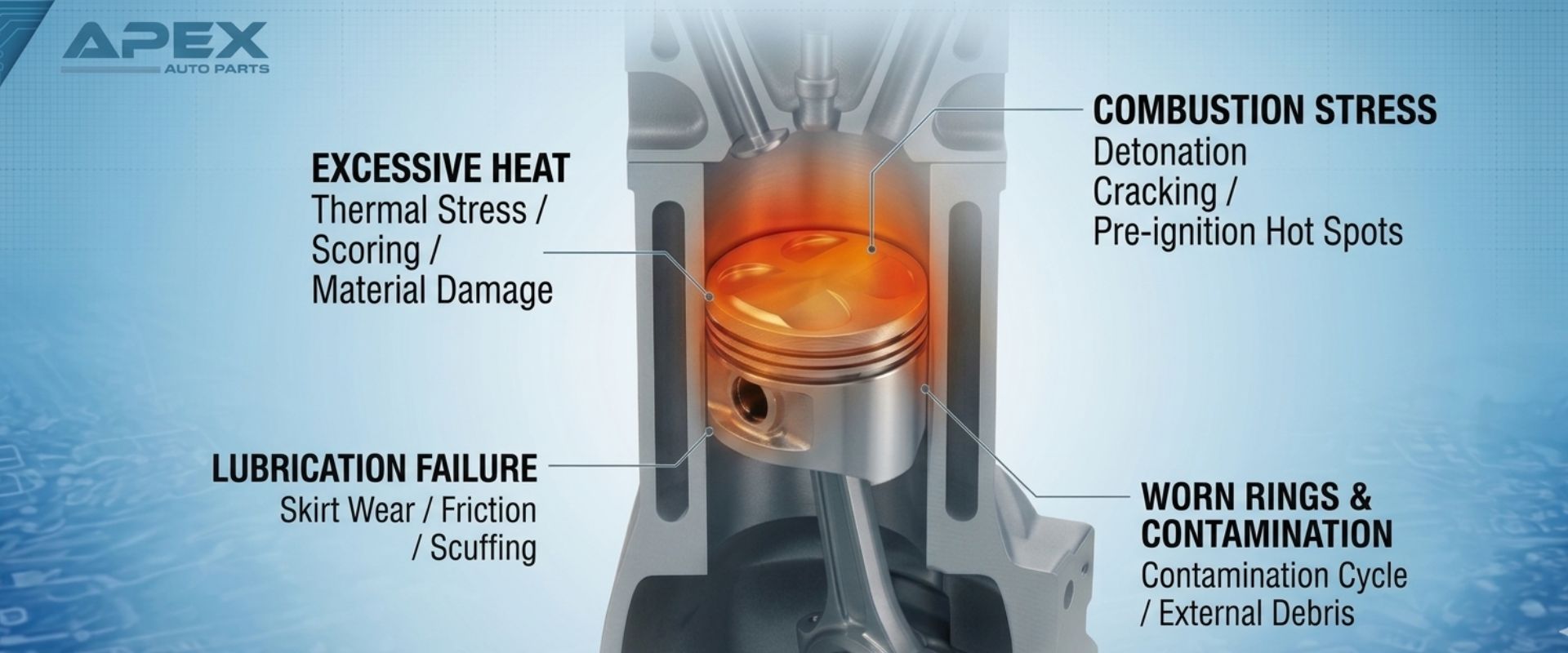
In real-world cases, piston damage follows a pattern.
Excessive heat is one of the most common starting points. Whether caused by cooling inefficiencies, incorrect combustion conditions, or underlying engine stress, rising temperatures push the piston beyond its designed limits. As it expands, tolerances tighten, contact with the cylinder wall increases, and what begins as light scuffing quickly develops into material damage.
Lubrication issues are just as critical, and often less obvious. It’s not always a simple lack of oil, but a failure in how oil is delivered. Problems with oil pumps, restricted oil flow, or incorrect oil specification reduce the effectiveness of the lubricating film. Without it, friction rises, heat builds, and wear accelerates in key areas like the piston skirt.
Combustion-related faults introduce a different kind of stress. When detonation or pre-ignition occurs, the piston is subjected to uncontrolled pressure spikes rather than smooth combustion. Over time, this leads to cracking, weakening, or failure around the crown and ring lands.
In other cases, the issue develops more gradually. Worn piston rings reduce compression and allow oil into the combustion chamber, increasing heat and contamination. This creates a cycle where conditions continue to deteriorate, and the piston wears at an accelerated rate.
And occasionally, the cause is external. Debris entering the cylinder, whether from upstream failure or poor rebuild practices, can result in immediate and severe damage. It doesn’t take much to turn a contained issue into widespread internal wear.
Recognizing the Signs
Piston-related issues don’t always present themselves clearly.
Instead, they show up as changes in how the engine behaves. Increased oil consumption, a loss of performance, or smoke under load are often the first indicators. In some cases, there’s a subtle mechanical noise, not quite a typical bottom-end knock, but enough to suggest something isn’t right.
Individually, these signs are easy to overlook. Together, they point to a deeper issue developing inside the engine.
Why It Escalates
Piston-related issues don’t always present themselves clearly.
Instead, they show up as changes in how the engine behaves. Increased oil consumption, a loss of performance, or smoke under load are often the first indicators. In some cases, there’s a subtle mechanical noise, not quite a typical bottom-end knock, but enough to suggest something isn’t right.
Individually, these signs are easy to overlook. Together, they point to a deeper issue developing inside the engine.
Getting the Repair Right
Replacing a piston without addressing the cause is where problems return.
The same conditions that caused the failure are still present, and the new component faces them from the start. Without correcting oil supply, cooling performance, or combustion issues, the outcome doesn’t change, only the timeline does.
A proper repair means stepping back and understanding why the failure occurred in the first place, not just what failed.
The Apex Approach
Piston damage isn’t solved by fitting a part, it’s solved by fitting the right components within the right conditions.
At Apex Auto Parts, the focus isn’t just on supplying pistons but on supporting the job as a whole. That means ensuring the correct parts are matched to the engine and that the wider requirements of the repair are considered.
In practice, it’s not just about what failed; it’s about what must be right when it goes back together.
Need Help?
If you’re dealing with piston-related issues or planning a rebuild, getting clarity early makes the difference.
Because when it comes to engine work, getting it right the first time isn’t optional, it’s essential.
Replacing a piston? Get it right the first time explore the right piston.