
 info@apexautoparts.co.uk
 +44 203 915 7535
 Safe & Fast Shipping
 Whish List
 Compare
 Sign In



Mercedes cars are known for comfort, strong performance, and a solid driving feel. Many older models are still used every day, showing that a well-cared-for Mercedes Engine can last a long time. However, that does not mean every engine is perfect or that every Mercedes will have the same repair needs.
The honest answer is that Mercedes-Benz engine reliability depends on the exact engine, its age, its service history, and how the car has been driven. A Mercedes badge does not tell you enough. The engine code, model year, fuel type, and previous repairs matter much more.
Some owners enjoy years of trouble-free driving. Others face timing chain noise, oil leaks, coolant faults, turbo problems, diesel filter warnings, or injector issues. Many expensive Mercedes Engine problems begin with a small warning that was ignored. A short rattle, a slow coolant leak, or a warning light can lead to a much larger repair when the driver keeps using the car without finding the cause.
This guide explains the main faults in simple terms. It also covers popular searches such as the Mercedes 2.1 diesel engine, the Mercedes C200 engine, the Mercedes A200 engine, the Mercedes V-Class engine, and even the Mercedes F1 engine. The aim is not to scare buyers. It is to help owners make better choices and fix faults before more damage is done.
Is Mercedes Engine Reliability Good?
Yes, many Mercedes engines can be reliable, but there is no single answer for every model.
Mercedes has made a large number of petrol, diesel, hybrid, and performance engines. Two cars with the same model badge may use different engines because they were built in different years or sold in different countries. This is why statements such as “all C200 engines are reliable” or “all Mercedes diesels are bad” are not useful.
For example, the current UK C200 uses a 1,496 cc four-cylinder petrol engine with mild-hybrid support. It produces 204 hp from the petrol engine, with extra electrical support. An older C200 may use a very different petrol engine with different parts and known faults.
The same rule applies to the A200. Mercedes listed the 2018 A200 with 163 PS and 250 Nm, but earlier and later A200 models may have different engine designs. The badge shows the power level and your place in the range. It does not always tell you the exact engine family.
A good Mercedes engine typically has a clear service record, clean oil, a stable coolant level, smooth starting, and no ignored warning lights. A poorly maintained engine can become expensive even if the basic design is strong.
What Affects Mercedes Engine Reliability?
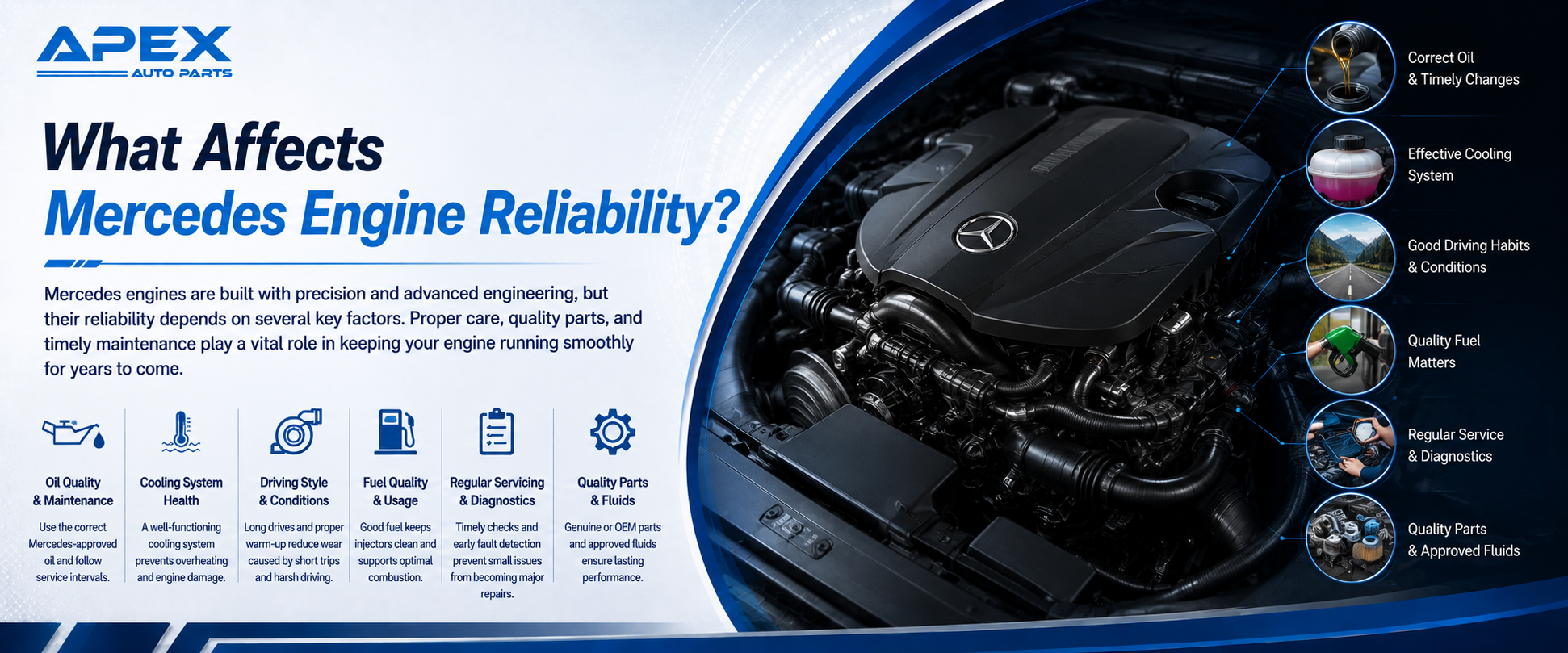
Oil care is one of the biggest factors. Modern Mercedes engines use turbochargers, small oil passages, timing control parts, and other systems that depend on clean oil. The correct oil is not chosen by thickness alone. It must also meet the Mercedes-approved requirements for that engine.
Mercedes publishes different approved oil sheets, including specifications such as MB 229.3, MB 229.31, MB 229.71, and MB 229.72. The correct specification depends on the vehicle and engine. This is why using any bottle labelled 5W-30 or 0W-20 is not enough.
Driving style also matters. An engine used for regular longer trips usually reaches full working temperature. An engine used only for short journeys may spend more time running cold. This can affect oil condition, battery charge, fuel use, and diesel exhaust cleaning.
Heat is another major factor. Coolant leaks, a weak thermostat, a damaged water pump, or a blocked radiator can cause poor temperature control. Even a strong engine can suffer serious damage if it is driven while overheating.
Good Mercedes Engine Reliability is therefore not based on luck alone. It comes from correct servicing, early diagnosis, quality parts, and an owner who pays attention when the car starts acting differently.
Common Mercedes Engine problems
The following issues do not affect every Mercedes. They are common areas that mechanics check when a car arrives with poor performance, unusual noise, fluid loss, or an engine warning light.
Timing Chain Noise and Camshaft Timing Faults
A timing chain keeps the crankshaft and camshafts moving together. This allows the valves to open and close at the correct time. When a chain, guide, tensioner, or camshaft timing part wears, the engine may rattle after starting.
Mercedes issued a technical bulletin for certain M271.8 EVO engines in which a rattling sound could be heard from the timing chain area for about 2 to 5 seconds after starting. The bulletin tells technicians to use Mercedes XENTRY diagnostics and follow a guided chain and oil level test before choosing a repair.
This is important because a starting rattle should be tested rather than guessed. A mechanic should not fit a complete timing chain kit simply because the owner heard one noise. The sound may come from the chain, tensioner, camshaft adjuster, belt system, or another moving part.
The mechanic should start the engine when it is fully cold, listen to the area of the noise, scan the engine control unit, and check the timing values. If the chain is worn, delaying repair may allow the valve timing to drift further from its correct position.
Warning signs can include a brief metal rattle, rough idle, weak power, difficult starting, an engine warning light, or camshaft and crankshaft timing fault codes. These signs should be checked quickly.
Timing Chain Concerns on the Mercedes 2.1 diesel engine
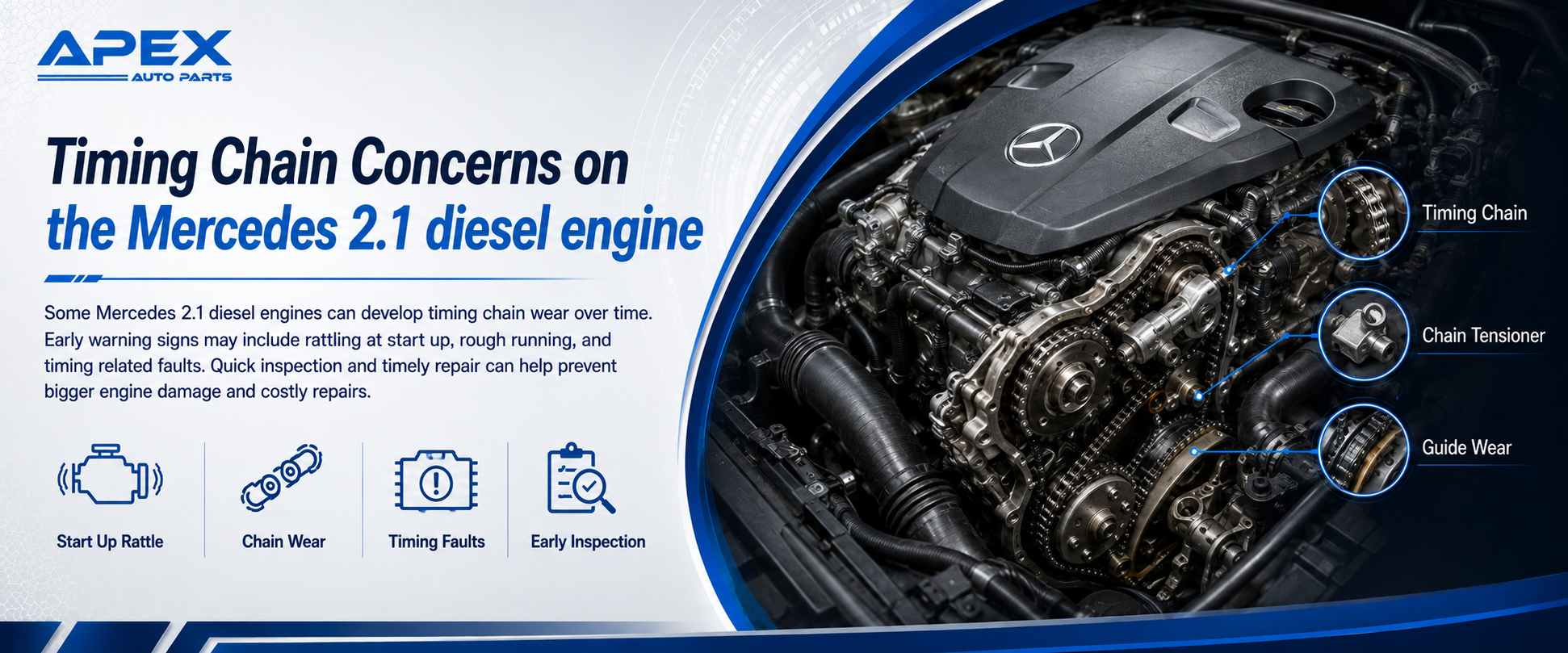
The Mercedes 2.1 diesel engine is commonly linked with the OM651 engine family. Depending on the model, this engine has been used in the C-Class, E-Class, Vito, Viano, Sprinter, and other vehicles.
Official Mercedes archive records show that many OM651 versions have a displacement of 2,143 cc, four cylinders, common-rail fuel injection, and a single-roller timing chain. Different versions were produced with different power outputs and vehicle layouts.
Mercedes also issued a technical bulletin for certain OM651 applications in which a rattling or knocking noise could be heard for about 2 to 5 seconds after starting. The document says the timing chain may be stretched and that the chain tensioner may be involved. Mercedes provided a measuring process to decide whether the tensioner or the chain needed replacement.
This does not mean every Mercedes 2.1 diesel engine will suffer timing chain failure. It means that a cold-start rattle on an affected engine should not be dismissed as normal diesel noise.
A useful first step is to record the sound during the first cold start of the day. The mechanic can then compare the sound, inspect the timing system, and check whether the engine falls within the applications covered by Mercedes service information.
Oil Leaks and Oil Seepage
Oil leaks are among the most visible Mercedes Engine problems. Some are small and easy to repair. Others are harder to reach and involve many hours of labour.
Oil can leak from a rocker cover, timing cover, oil filter housing, oil cooler seal, sump, turbo oil pipe, or another sealing point. The exact leak areas depend on the engine design.
Mercedes issued a service bulletin for M276, M278, and M176 engines covering minor oil leaks or seepage around the timing case cover, water pump, coolant thermostat, oil pan, and other sealing surfaces. The repair process included cleaning, tracing the source, documenting the area, and sealing or repairing the confirmed leak.
That process is good practice for any engine. Oil often spreads as the car moves, so the wettest area is not always the source. Replacing the first seal that looks dirty may not solve the fault.
A mechanic should clean the area, inspect it again after the engine has run, and use tracing powder or leak dye when needed. The oil level should also be measured correctly. A small stain is different from a leak that lowers the engine oil level between checks.
Do not ignore a burning oil smell. Oil can reach hot exhaust parts and create smoke. A falling oil level can also reduce lubrication and damage internal parts or the turbocharger.
Coolant Leaks and Thermostat Faults
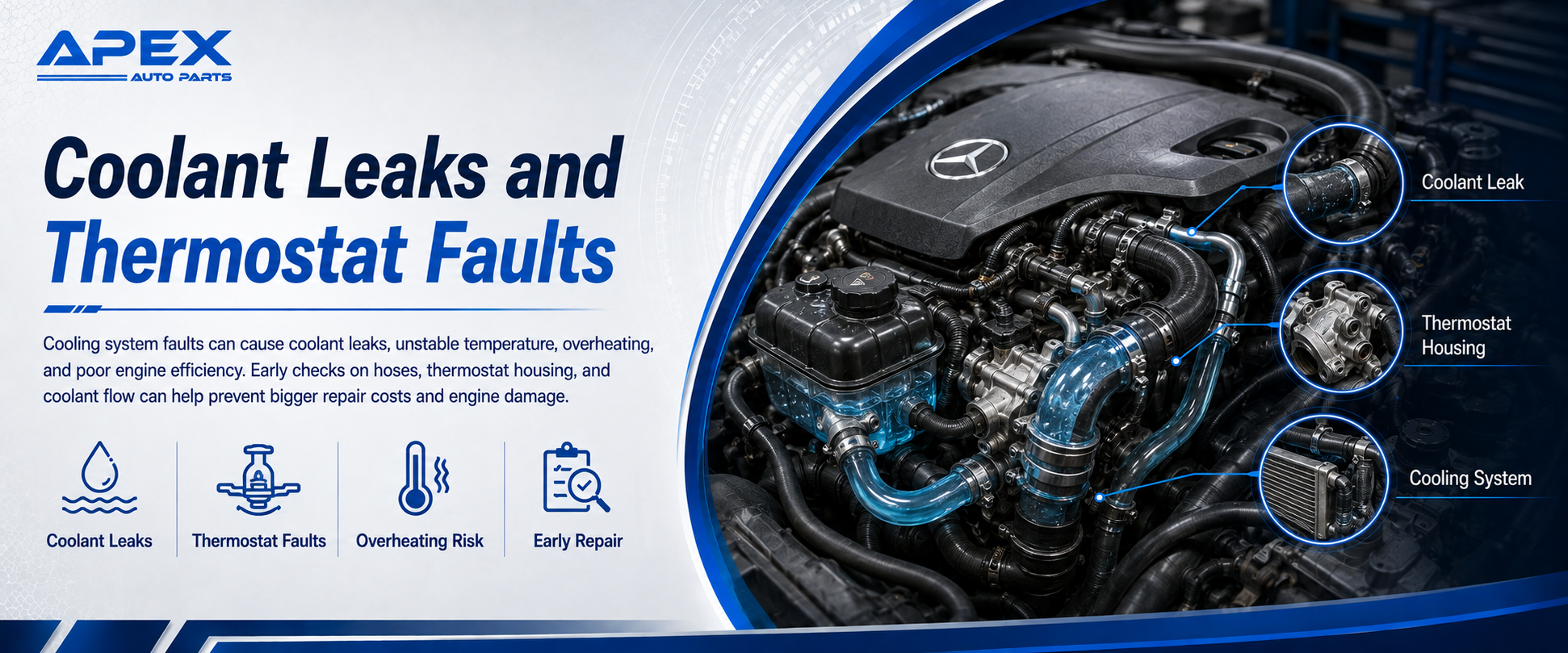
A Mercedes engine should reach its normal temperature and stay there. If it runs too cold, fuel use may increase, and cabin heating may feel weak. If it runs too hot, serious engine damage can occur.
Mercedes issued a bulletin for the M270 and M274 engines, noting that the engine warning light may appear with fault code P012800. The code meant the coolant was warming more slowly than expected. Mercedes told technicians to check for a software update, test the thermostat heating element, and replace the thermostat if required.
This shows why a fault code does not always mean one part must be replaced. Software, wiring, a thermostat, trapped air, a temperature sensor, or an actual coolant leak may produce similar symptoms.
A proper check should include the coolant level, cooling system pressure, live temperature data, thermostat operation, fan operation, and signs of dried coolant around hoses and housings.
Never open the coolant cap while the engine is hot. If the warning shows that the engine is overheating, stop safely and allow the vehicle to cool. Continuing to drive may turn a small cooling fault into a damaged cylinder head or failed head gasket.
Turbocharger and Boost Problems
Many modern Mercedes petrol and diesel engines use a turbocharger. The turbo pushes more air into the engine, helping it make more power from a smaller size.
When a driver feels poor acceleration, it is easy to blame the turbo. However, the turbo itself may not be the problem. A split air hose, a leaking intercooler, a weak actuator, a sensor fault, a blocked exhaust system, or a vacuum leak can also reduce boost.
A good mechanic compares requested boost pressure with actual boost pressure while the engine is under load. The air pipes should be checked for splits, loose clips, and oil marks. A small amount of oil mist can be normal in some intake systems, but heavy oil, smoke, or fast oil loss requires further checks.
A whistling sound also needs careful testing. Some healthy turbochargers make a light whistle. A new siren sound, grinding noise, blue smoke, or heavy oil use is more serious.
Replacing a turbo before checking the air, oil, and exhaust systems can be a waste of money. The cause of the old turbo failure must also be found before a new unit is fitted.
Diesel Filter, EGR, AdBlue, and Sensor Faults
Modern diesel engines have several systems that reduce harmful exhaust gases. Depending on the model, these may include exhaust gas recirculation, a diesel particulate filter, pressure sensors, temperature sensors, a selective reduction catalyst, and AdBlue dosing parts.
Mercedes describes modern diesel exhaust treatment as a system that can include EGR routes, a diesel particulate filter, SCR catalysts, and AdBlue injection. These parts help control emissions, but they also add more components that require proper diagnosis when a warning light appears.
A blocked diesel filter should not be replaced without checking why it became blocked. The cause may be repeated short trips, a temperature sensor fault, an air leak, an injector problem, a pressure sensor fault, or an engine that is not reaching the correct temperature.
The mechanic should check soot load data, exhaust pressure, temperature readings, stored codes, and the vehicle’s recent driving pattern. Forced cleaning should only be carried out when the engine and exhaust system are safe to proceed.
An AdBlue warning should also be taken seriously. Some vehicles may limit starting after the warning reaches a certain stage. Topping up the tank may not solve the issue if the real cause is a fault in the pump, heater, injector, sensor, wiring, or software.
Rough Running, Misfires, and Injector Problems
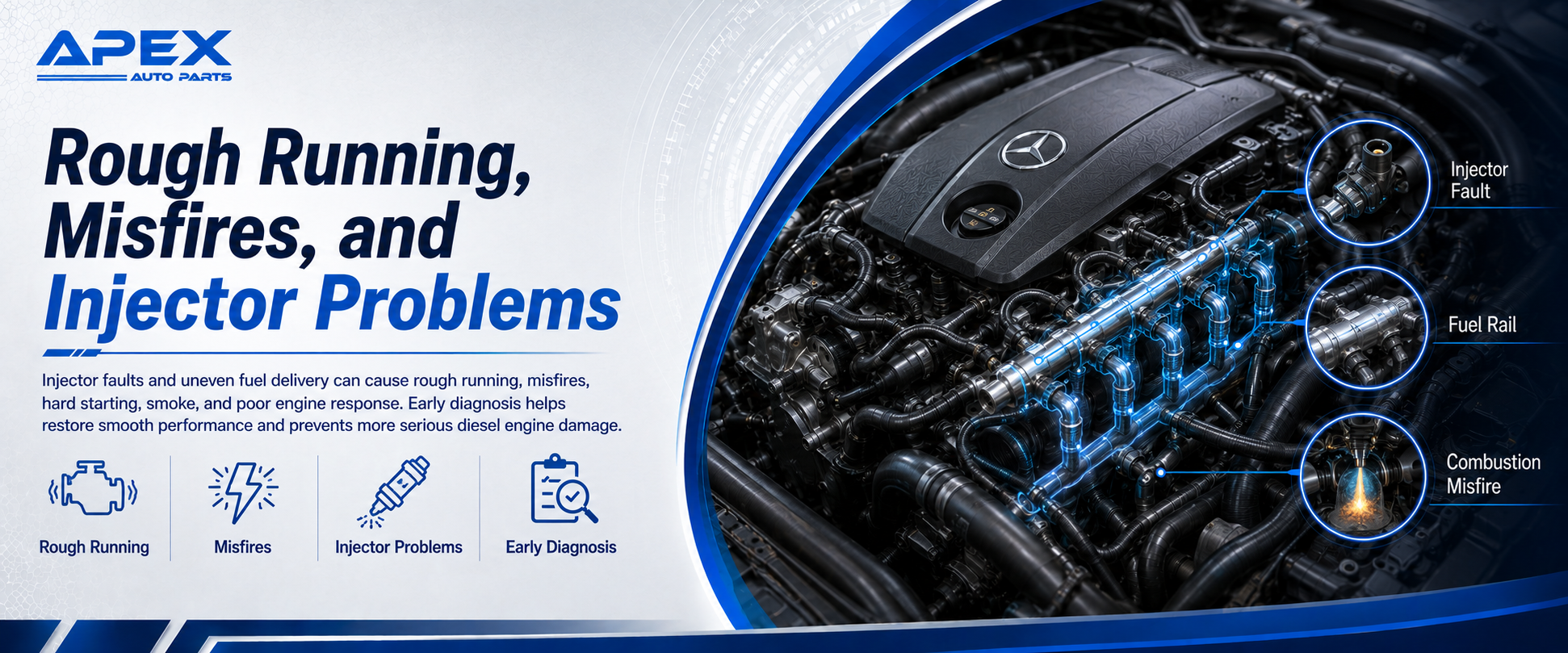
A rough idle does not always mean the engine is worn out. Petrol engines may misfire due to faulty spark plugs, ignition coils, or injectors; air leaks; fuel pressure issues; timing faults; or low compression.
Diesel engines may run roughly due to injector issues, fuel pressure, air entering the fuel system, EGR flow, boost leaks, or compression differences. The fault should be found through testing rather than replacing several parts at once.
A mechanic can check fault codes, fuel correction values, rail pressure, injector return flow, ignition patterns, and cylinder balance. A compression test may be needed when the basic checks do not explain the problem.
The aim is to find the failed system first. Fitting injectors to an engine with a timing problem will not repair it. Fitting ignition coils to a petrol engine with a vacuum leak may only hide the symptom for a short time.
Is the Mercedes 2.1 diesel engine reliable?
The OM651-based Mercedes 2.1 diesel engine can deliver strong mileage with proper care. It offers good torque and has been used in cars, people carriers, and commercial vehicles.
Its reliability depends heavily on oil service history, timing chain condition, fuel system health, turbo lubrication, and exhaust system use. Cars that cover regular longer journeys may suit a diesel better than vehicles used only for short local trips.
The main buying mistake is judging the engine only by mileage. A high-mileage OM651 with regular servicing and clear repair records may be a better purchase than a lower-mileage example with missing history and a cold-start rattle.
Before buying, listen for any cold-start issues, scan the vehicle, inspect for oil and coolant leaks, and check whether the diesel filter completes its normal cleaning process. Ask for proof of oil changes rather than accepting a verbal promise.
What Should You Know About the Mercedes C200 Engine?
The Mercedes C200Mercedes C200 engine is not a single fixed engine. Mercedes has used the C200 badge across several generations, with different petrol engines, diesel options in some markets, and newer mild hybrid systems.
The current UK C200 is a 1.5-litre four-cylinder mild hybrid petrol model. Older C200 cars can have very different engines, so buying parts or researching faults by the C200 badge alone can lead to mistakes.
When checking a used Mercedes C200 engine, identify the engine code from the VIN or vehicle records. Then look for faults linked to that specific engine and production period.
On an older petrol model, pay close attention to timing noise, oil leaks, coolant control, and smooth idle. On a newer model, also check the mild-hybrid system, software history, sensors, and any battery-related warnings.
A clean engine bay is not proof that the car has no leaks. It may have been cleaned before sale. Check again after a long road test and look underneath the vehicle.
What Should You Check on a 200 Mercedes Engine?
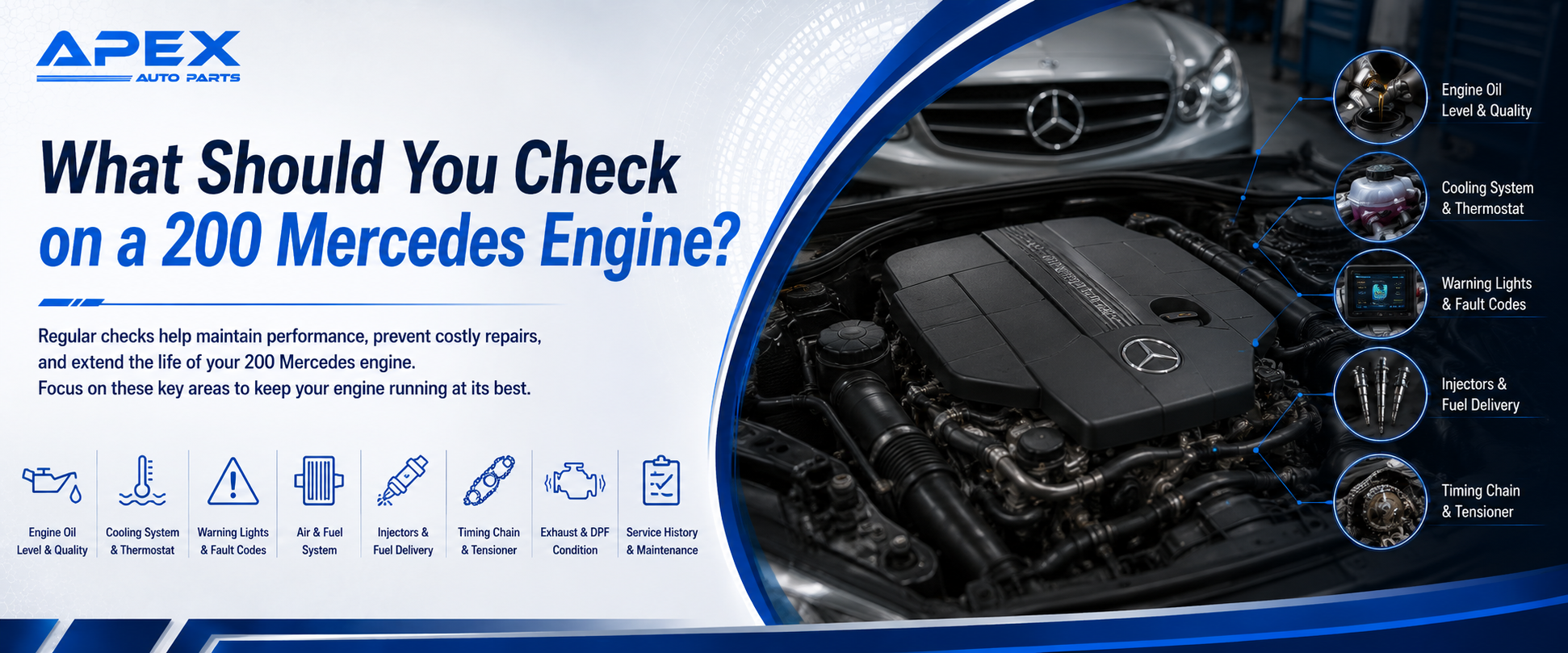
The A200 MercedesA200 Mercedes engine is fitted in a compact car, where the engine bay can be tightly packed. This can increase labour time for some jobs because covers, pipes, or nearby parts may need to be removed for access.
Mercedes listed the 2018 A200 at 163 PS and 250 Nm, but the exact engine and support systems vary by year. Always confirm the engine code before ordering parts or comparing reliability reports.
During a used car inspection, check for a steady idle, smooth gear changes, correct coolant temperature, clean acceleration, and no warning lights. Listen for noise when the engine is cold.
A thermostat code on an M270-poweredM270-powered model should be diagnosed using the correct Mercedes process. The official M270 and M274 bulletin shows that software checks and guided testing may be needed before thermostat replacement.
Service records are especially important. A compact Mercedes may have spent much of its town life, where the engine experiences frequent cold starts and stop-and-start use.
Is the Mercedes V-Class engine reliable?
The Mercedes V-Class engine must move a large, often heavily loaded vehicle. Many V-Class models are used for family trips, airport transfers, business travel, or private hire. Their engines may cover high mileage, spend long periods idling, and carry more weight than a normal car.
The current UK V-Class range lists 1,950 cc diesel engines in V 220 d and V 300 d forms, producing 163 PS and 237 PS, respectively. Earlier vehicles may use the 2,143 cc OM651 family.
The OM651 timing chain bulletin included engine 651 applications in model series 447, which is associated with the V-Class generation. This makes a cold start rattle worth checking carefully on relevant vehicles.
For a used Mercedes V-Class engine, ask how the vehicle was used. A high-mileage motorway vehicle may have had an easier engine life than a lower-mileage vehicle that spent years idling and making short urban trips.
Check the cooling system, turbo response, injector balance, diesel filter data, oil leaks, and service records. A commercial-use vehicle should also be inspected for signs of missed servicing during busy periods.
Does the Mercedes F1 engine prove road engines are reliable?
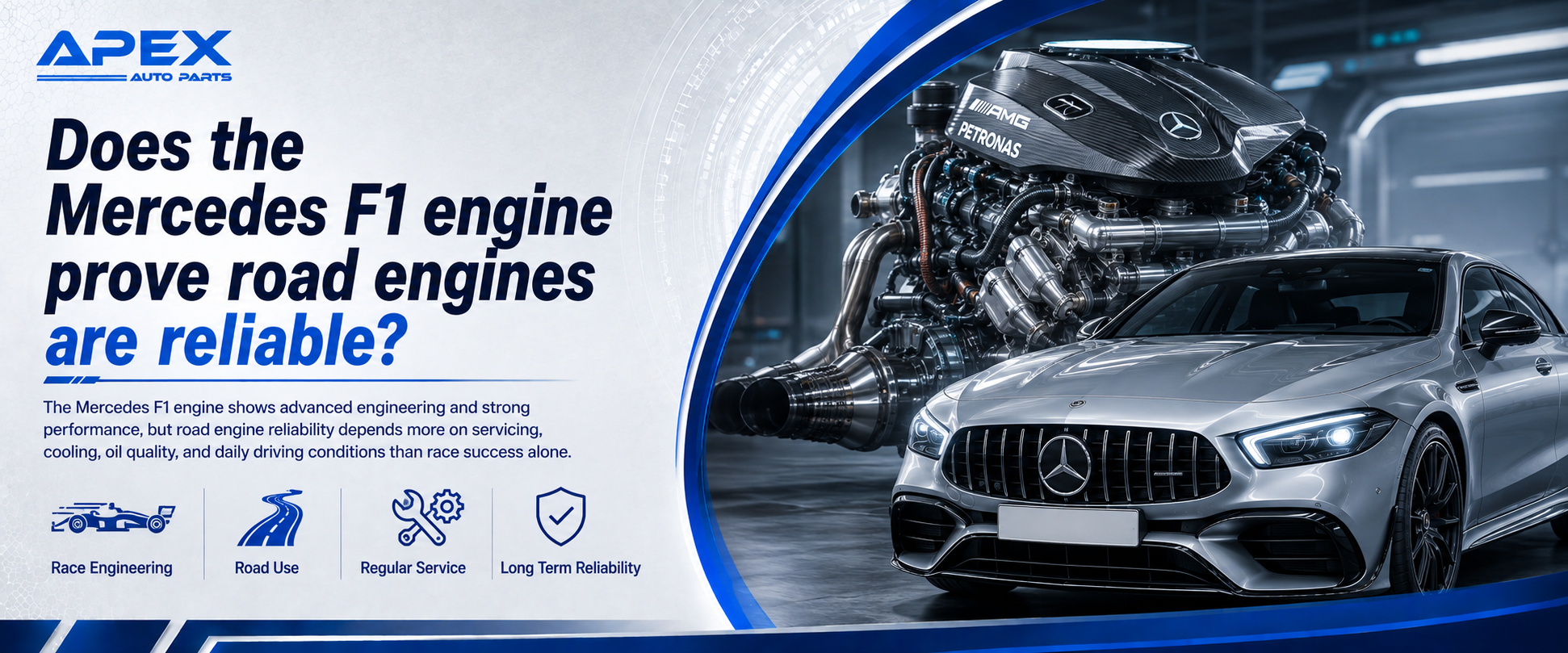
The Mercedes F1 engine is a racing power unit built for a very different job. It should not be used as direct proof that a normal road engine will last for hundreds of thousands of miles.
For the 2026 season, the official Mercedes-AMG F1 W17 uses a 1.6-litre, six-cylinder hybrid power unit. The electric motor-generator can produce up to 350 kW, and Mercedes describes the power split as close to half combustion and half electric output.
An F1 engine works under extreme load and is managed by a racing team with constant data checks. A road Mercedes Engine is designed for cold starts, traffic, long motorway trips, weather changes, and years of daily use.
Some racing ideas may help later road technology, but the two engines have different targets. The Mercedes F1 engine is about maximum race performance within strict rules. A road engine must balance comfort, fuel use, emissions, cost, and service life.
Warning Signs That Need Fast Attention
Some symptoms can wait for a planned workshop visit.
Others should be checked as soon as possible.
- A metal rattle during a cold start
- A red oil pressure or temperature warning
- Fast coolant loss or repeated overheating
- Heavy blue, white, or black exhaust smoke
- Strong knocking that rises with engine speed
- Sudden power loss or limp mode
- Oil leaking onto hot exhaust parts
- A warning light that returns after being cleared
A red oil pressure warning is not the same as a normal service reminder. Stop the engine safely and investigate the cause. Running an engine without sufficient oil pressure can cause serious internal damage in a short time.
How a Mechanic Should Diagnose Mercedes Engine Problems?
Diagnosis should begin with the owner’s description. The mechanic needs to know when the fault happens, whether the engine is hot or cold, what warning appeared, and whether any fluid level has changed.
The first step in the workshop should normally be a full visual inspection. Check the oil, coolant, air pipes, wiring, battery voltage, leaks, loose connections, and obvious damage. A diagnostic scan should then read all related control units, not only the basic engine codes.
Live data is often more useful than the fault code alone. It can show coolant temperature, fuel pressure, boost pressure, camshaft position, sensor readings, cylinder balance, and diesel filter load.
A code tells the mechanic where the car noticed a problem. It does not always name the failed part. For example, a low boost code does not automatically prove the turbo has failed. A thermostat code may involve software or testing before replacement, as shown in the Mercedes M270 and M274 service information.
The repair should be based on test results. Replacing parts without proof is expensive and can leave the original fault untouched.
What to Check Before Buying a Used Mercedes?

A used Mercedes should be inspected from the cold. Ask the seller not to start it before you arrive. A warm engine can hide starting noise, smoke, rough idle, or slow oil pressure build-up.
Check the following points:
- Full service invoices, not only stamps
- Correct engine oil and filter records
- Cold start timing noise
- Oil and coolant levels
- Warning lights before and after starting
- Diagnostic fault code scan
- Smooth acceleration under load
- Exhaust smoke and unusual smells
- Signs of recent engine cleaning
- VIN check for recalls and service measures
Mercedes provides an online UK recall checker that uses the VIN. This can help owners see whether a vehicle has an active recall or safety measure.
A pre-purchase inspection costs money, but it can reveal a repair that would cost far more. The inspection should be completed by someone familiar with the exact Mercedes engine and diagnostic system.
How to Improve Mercedes Engine Reliability?
Use the correct Mercedes-approved Mercedes-approved oil, and do not choose oil solely by price or viscosity. Check the owner’s manual or Mercedes operating fluid information for the required approval.
Keep the oil level correct. Too little oil can reduce lubrication. Too much oil can also cause problems, especially on some diesel engines where fuel may enter the oil during interrupted exhaust cleaning.
Check the coolant level when the engine is cold. A slow loss should be tested even if there is no puddle. Coolant can leak only when the system is hot and under pressure.
Allow the engine to warm through normal driving before using full power. There is no need to leave it idling for long. Drive gently until the oil and coolant have warmed.
Do not ignore small changes in sound. An early timing chain check may cost far less than repairing damaged valves. A small oil leak may be simple to fix before it spreads to other parts.
Diesel owners should consider whether their driving pattern suits a diesel. Regular longer runs can help the engine and exhaust system reach normal working temperature.
Follow the correct service schedule and adjust maintenance based on how the vehicle is used. Mercedes notes that regular maintenance can reduce unplanned downtime and help find worn parts before they cause larger repairs.
Choosing the Right Replacement Parts
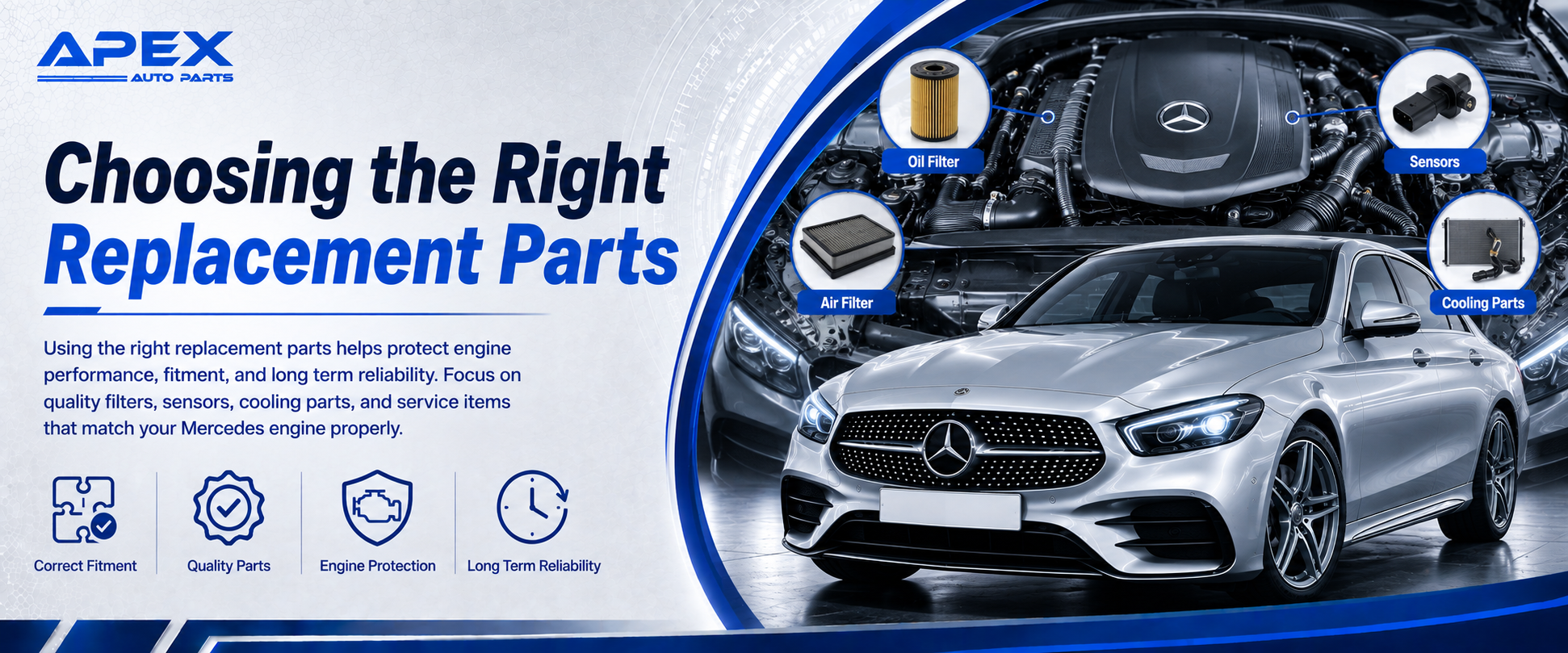
Correct part matching is important because Mercedes engines can use different parts even when the vehicle badges look the same.
At Apex Auto Parts, the best starting details are the VIN, registration, model year, engine code, and part number from the old component. These details reduce the chance of receiving the wrong timing part, gasket, sensor, pump, or turbo component.
Mercedes also states that parts should be matched to the vehicle and that VIN-based systems help ensure accurate identification.
Cheap parts can become expensive when the job involves many hours of labour. A seal, chain guide, filter, or sensor should meet the correct quality and fit requirements.
The mechanic should also replace related single-use seals, bolts, fluids, and filters as required by the repair procedure. Reusing a damaged seal to save a small amount can create another leak soon after the job.
Final Thoughts
A Mercedes engine can be a strong long-term choice, but the badge alone is not enough to judge it.
The best examples have correct oil, clear service records, stable coolant levels, smooth cold starts, and no ignored warning lights. The riskiest examples have missing history, fresh engine bay cleaning, repeated fault codes, timing noise, and sellers who say every warning is normal.
Known Mercedes Engine problems should be viewed as inspection points, not proof that every car will fail. Timing chain concerns affect certain engines and applications. Oil leaks vary by engine family. Diesel exhaust faults depend on parts, use, and maintenance. Cooling problems should be tested before components are replaced.
Buy on condition, engine code, and service history. Diagnose before replacing parts. Repair small faults before they damage other systems. That approach gives any Mercedes Engine the best chance of providing reliable service.
FAQs
1. Are Mercedes engines reliable?
Many Mercedes engines are reliable when they receive the correct oil, regular servicing, and early repairs. Mercedes Engine Reliability varies by engine code and model year. A well-maintained, high-mileage engine can be safer to buy than a lower-mileage engine with missing service records and warning lights.
2. What are the most common Mercedes Engine problems?
Common Mercedes Engine problems include timing chain noise, oil leaks, coolant loss, thermostat faults, turbo or boost issues, diesel filter warnings, and rough running. These faults do not affect every model. A diagnostic scan and physical inspection are needed before deciding which part has failed.
3. Is the Mercedes 2.1 diesel engine reliable?
The Mercedes 2.1 diesel engine, often associated with the OM651 family, can handle high mileage with proper maintenance. Owners should watch for cold-start chain noise, diesel filter warnings, oil leaks, and injector-related symptoms. Service history and correct oil matter more than mileage alone.
4. Does the Mercedes C200 engine have problems?
The Mercedes C200 engine has changed across several generations, so problems depend on the engine code. Older versions may need timing, oil leak, and cooling checks. Newer mild hybrid models have different systems. Confirm the year and engine before using online fault reports or ordering parts.
5. Is the A200 Mercedes engine reliable?
The A200 MercedesA200 Mercedes engine can be reliable when properly serviced, but the exact engine varies by year. Check cold start noise, coolant temperature, oil history, warning lights, and smooth acceleration. A diagnostic scan is valuable because a fault code may indicate a software issue, a wiring problem, or a mechanical component issue.
6. What problems affect the Mercedes V-Class engine?
The Mercedes V-Class engine may experience timing noise, diesel filter issues, injector wear, oil leaks, or turbo faults, especially after heavy commercial use. Check how the vehicle was driven, how often it was serviced, and whether it spent long periods idling or carrying heavy loads.
7. Is the Mercedes F1 engine used in road cars?
No. The Mercedes F1 engine is a specialized racing power unit. The 2026 unit uses a 1.6-litre six-cylinder engine with a powerful hybrid system. Road cars may benefit from ideas developed in racing, but their engines are designed for daily use, comfort, emissions, and longer service life.
8. How long can a Mercedes Engine last?
There is no fixed life for a Mercedes Engine. Many can reach high mileage when serviced correctly, while neglected engines may fail much earlier. Oil quality, temperature control, driving style, repair history, and the speed at which warning signs are addressed all affect engine life.
9. Are Mercedes engine repairs expensive?
Mercedes repairs can be expensive when access is difficult or when a fault damages several related parts. Timing work, internal engine repairs, turbo replacement, and diesel exhaust faults can involve high labour costs. Early diagnosis often lowers the bill because the mechanic can repair the first fault before it spreads.
10. How can I improve Mercedes Engine Reliability?
Improve Mercedes Engine Reliability by using the correct, approved oil, servicing on time, checking oil and coolant levels, allowing the engine to warm up gently, and promptly investigating warning lights. Keep full invoices and use the VIN and engine code when ordering parts to avoid fitting the wrong component.
References:
mercedes benz
mercedes benz public archive
static nhtsa gov