 info@apexautoparts.co.uk
 +44 203 915 7535
 Safe & Fast Shipping
 Whish List
 Compare
 Sign In


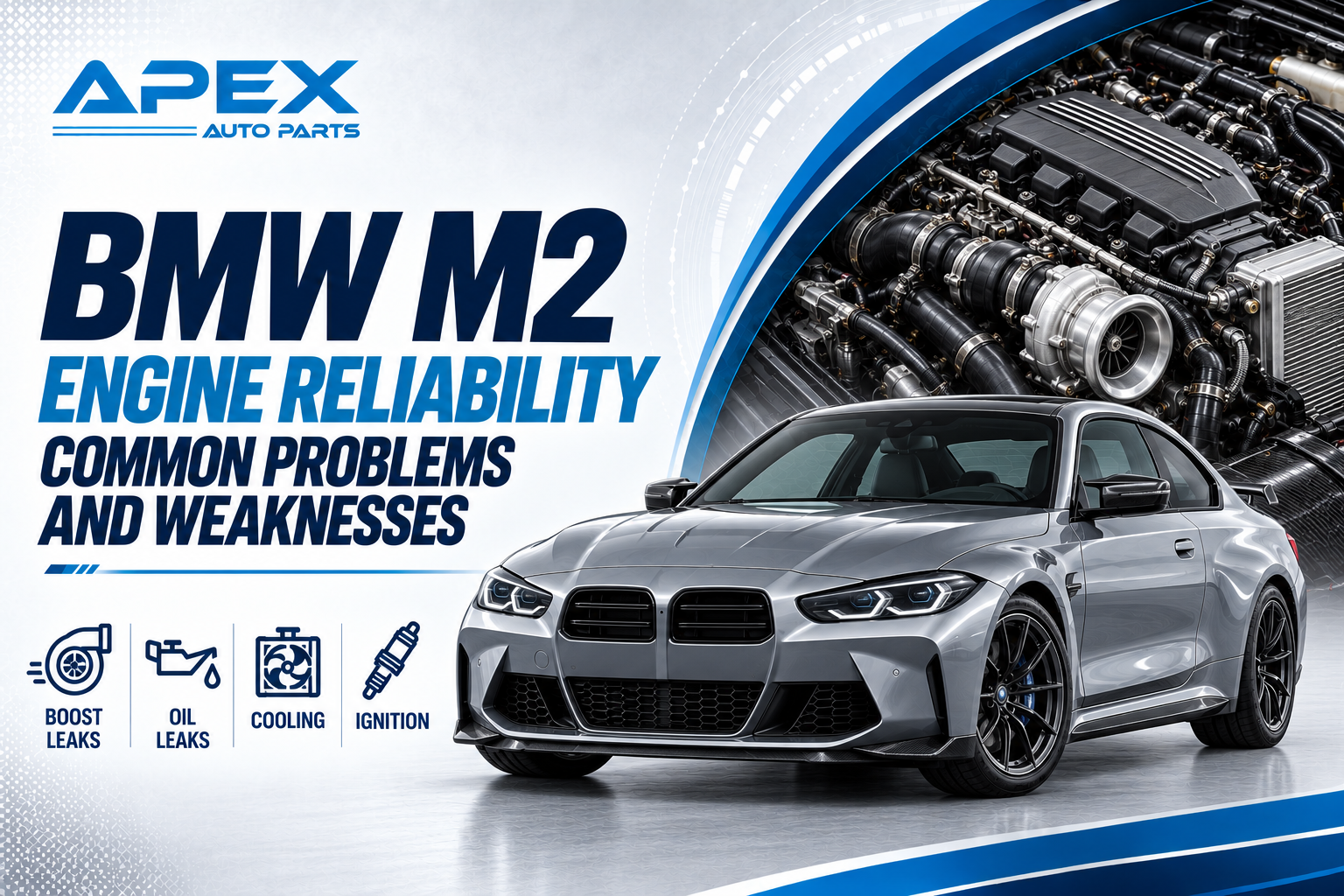
The BMW M2 is one of the most exciting compact performance cars BMW has produced. It offers strong straight-line speed, sharp handling, and enough comfort for daily driving. However, not every M2 uses the same engine, and each version has its own repair risks.
The original F87 M2 uses a modified N55 engine. The later BMW M2 Competition uses the stronger S55 engine, while the current BMW M2 G87 uses the newer S58 engine. All three are turbocharged six-cylinder petrol units, but their parts, cooling systems, power levels, and maintenance needs differ.
That is why you can't judge BMW M2 reliability with one simple answer. A standard car with regular servicing can be dependable. A poorly tuned example with missed oil changes may develop expensive faults even at modest mileage.
This guide explains the main BMW M2 engine problems, warning signs, and weaknesses. It also covers what to check before buying, how modifications affect the engine, and why correct diagnosis matters before ordering replacement parts.
Which Engine Does the BMW M2 Use?
The BMW M2 engine depends on the generation and model. The first F87 M2 arrived with a 3.0-liter N55 turbocharged six-cylinder engine. It produced 370 hp, with up to 500 Nm available through its overboost function.
BMW then introduced the BMW M2 Competition with the S55 engine. This was based on the engine used in the F80 M3 and F82 M4. It uses two turbochargers and produces 410 hp and 550 Nm in UK and European specification.
The second-generation BMW M2 G87 arrived with the S58 engine. This newer 3.0-liter twin-turbo six-cylinder unit is related to the engine used in current M3 and M4 models. The early G87 produced 460 hp, while the updated UK model produced 480 hp. BMW currently lists up to 600 Nm for the automatic version.
These engines share a basic layout, but you shouldn't treat them as interchangeable. Their turbochargers, fuel systems, cooling parts, software, and internal components can differ.
BMW M2 Specs Across the Main Generations
BMW launched the original F87 M2 in 2016. Its N55 engine produced 370 hp and 465 Nm, with 500 Nm available during overboost. BMW quoted a 0-62 mph time of 4.3 seconds with the dual-clutch gearbox.
The BMW M2 Competition replaced the original model with the S55 engine. Power increased to 410 hp, while torque rose to 550 Nm. This gave the car stronger performance at higher engine speeds and made it better suited to hard track use.
Current BMW M2 specs are much stronger. The updated Rear Wheel Drive BMW M2 G87 produces 480 hp. The automatic model develops 600 Nm, while the manual version produces 550 Nm. BMW lists a 0 to 62 mph time of 4.0 seconds for the automatic Rear Wheel Drive model and 4.2 seconds for the manual.
These figures show why repair advice must match the exact model. Don't order an N55 part for an S55 or S58 just because all three engines have six cylinders and a 3.0-liter capacity.
Is the BMW M2 Reliable?
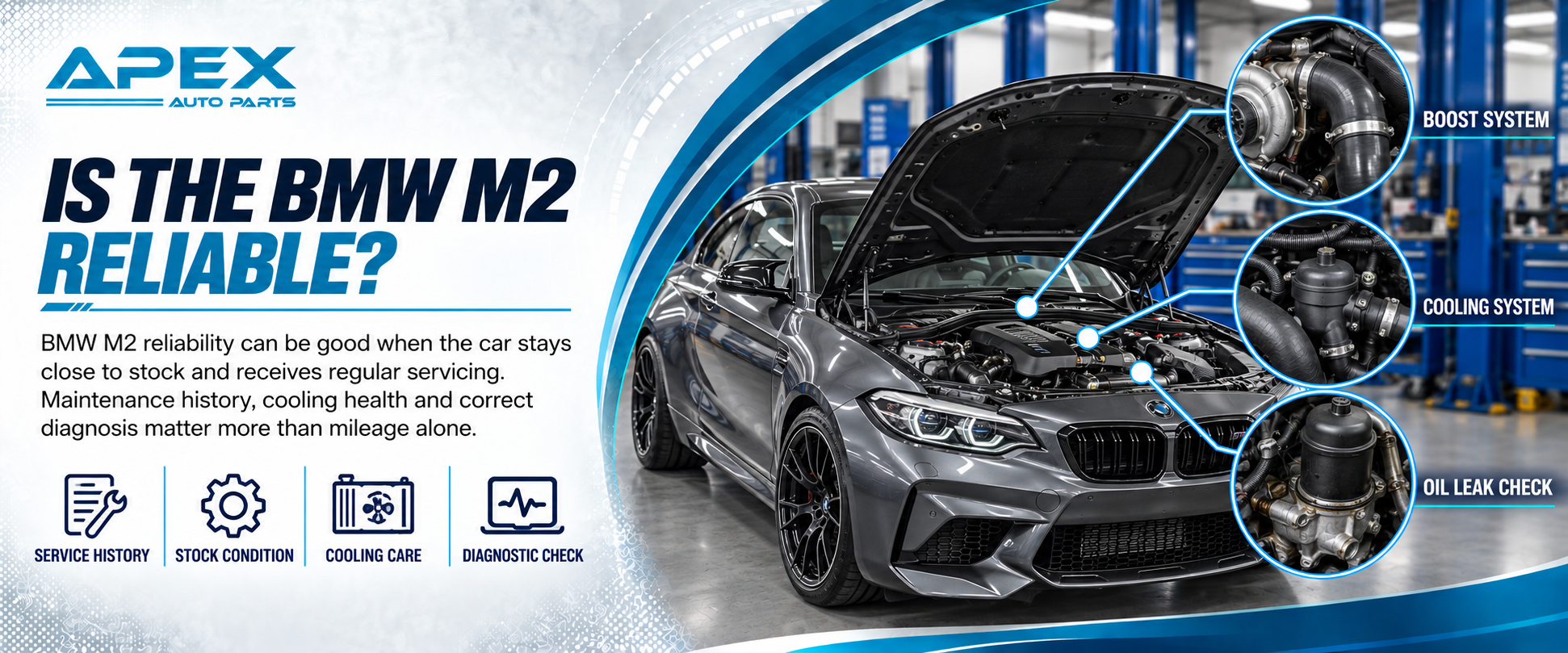
Overall, BMW M2 reliability can be good when the car stays close to stock and gets sensible maintenance. The engines are strong enough for road and track use, but they create a great deal of heat and cylinder pressure.
Oil quality, cooling performance, and proper warm-up habits matter a lot. Regular hard driving on cold oil can increase wear. Switching the engine off immediately after repeated hard acceleration can also leave excessive heat around the turbochargers.
Some faults come from the engine itself, while others involve hoses, pumps, sensors, ignition parts, or software. A warning light doesn't automatically mean the engine has failed.
Maintenance history is normally more useful than mileage alone. A 60,000-mile car with detailed invoices may be safer than a 30,000-mile car with unknown modifications and long gaps between services.
Common N55 Problems in the Original BMW M2
The N55 BMW M2 engine is generally respected, but age and heat can affect surrounding components. Many original F87 cars are now old enough to develop oil leaks, cooling faults, and worn plastic parts.
One common concern is the charge pipe. The original plastic pipe carries pressurized air from the turbo system towards the engine. Heat, age and increased boost pressure can cause it to crack or separate.
When this happens, the driver may hear a pop, lose power, and see an engine warning light. The car may still run, but it will not produce normal boost. A smoke test or pressure test can confirm the leak.
The N55 can also develop oil leaks from its valve cover area and oil filter housing gasket. Don't ignore oil around the front of the engine, as it can reach belts, hoses, and other rubber parts.
Charge Pipe Failure and Boost Leaks
Charge pipe failure is one of the most recognized BMW M2 engine problems on N55-powered cars. It can happen on a standard car, but aggressive tuning increases the risk because the pipe must hold higher pressure.
A small crack can cause hesitation and an occasional warning light. A complete split can create sudden power loss. The engine may enter a reduced power mode to protect itself.
Other parts of the boost system can leak as well. Check connections, seals, vacuum lines, and the intercooler before blaming the turbocharger.
A mechanic should test the whole intake system under pressure. Replacing the turbo without finding a simple air leak can waste a large amount of money.
Oil Filter Housing Gasket Leaks
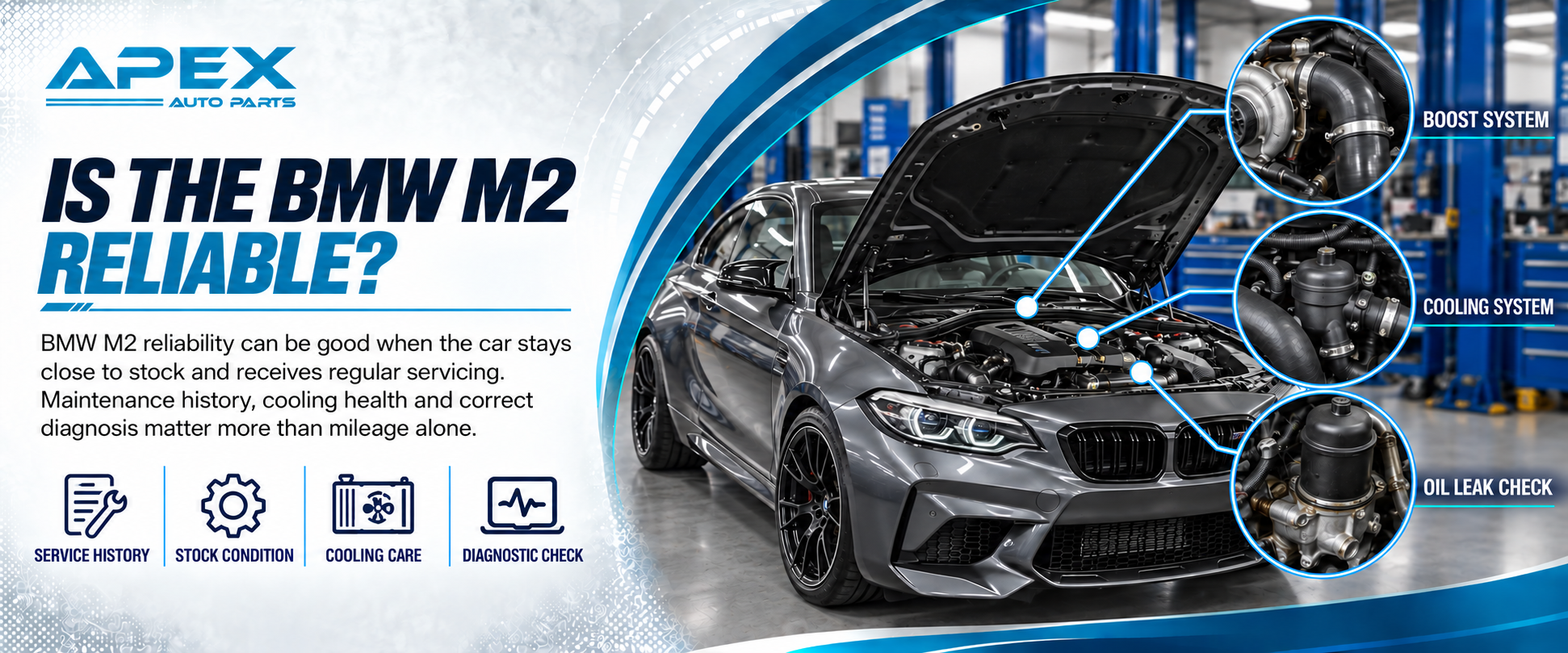
The oil filter housing gasket seals the housing against the engine. As the gasket ages, it can harden and allow oil to escape.
Early signs may include fresh oil near the housing, a burning oil smell, or stains around the front of the engine. A serious leak can allow oil to reach the drive belt.
This deserves quick attention. If an oil-soaked belt slips or breaks, it can damage nearby parts. In some BMW engines, a damaged belt can be pulled towards the front crankshaft seal, leading to a much larger repair.
Clean the area before repair so you can confirm the true source. Oil may travel across the engine and make the leak look as though it comes from another seal.
Valve Cover and Crankcase Ventilation Faults
The N55 valve cover contains parts of the crankcase ventilation system. Heat can affect the plastic cover, internal diaphragm, and sealing gasket.
A problem may cause a rough idle, whistling noise, increased oil use, or oil leakage. Excess pressure inside the engine can also force oil past other seals.
Replacing only the visible gasket may not solve the fault if the cover is cracked or the ventilation system has failed. Inspect the complete assembly before ordering parts.
Also check the exhaust smoke carefully. Oil can enter the intake through a ventilation problem, but worn turbo seals or internal engine wear can create similar symptoms.
BMW M2 Water Pump and Cooling Problems
The cooling system is an important part of BMW M2 reliability. These turbocharged engines generate a lot of heat, especially during fast driving or track use.
The electric water pump used on the N55 can weaken or fail. Warning signs may include rising temperature, reduced power, a cooling fan running at high speed, or an overheating message.
A thermostat fault can create similar symptoms. The engine may take too long to warm up, or coolant flow may not be controlled correctly.
Do not continue driving an overheating M2. Excessive heat can distort an aluminum cylinder head. A cooling fault that starts with a pump or hose can become a head gasket or engine repair if you ignore the warning.
S55 Problems in the BMW M2 Competition
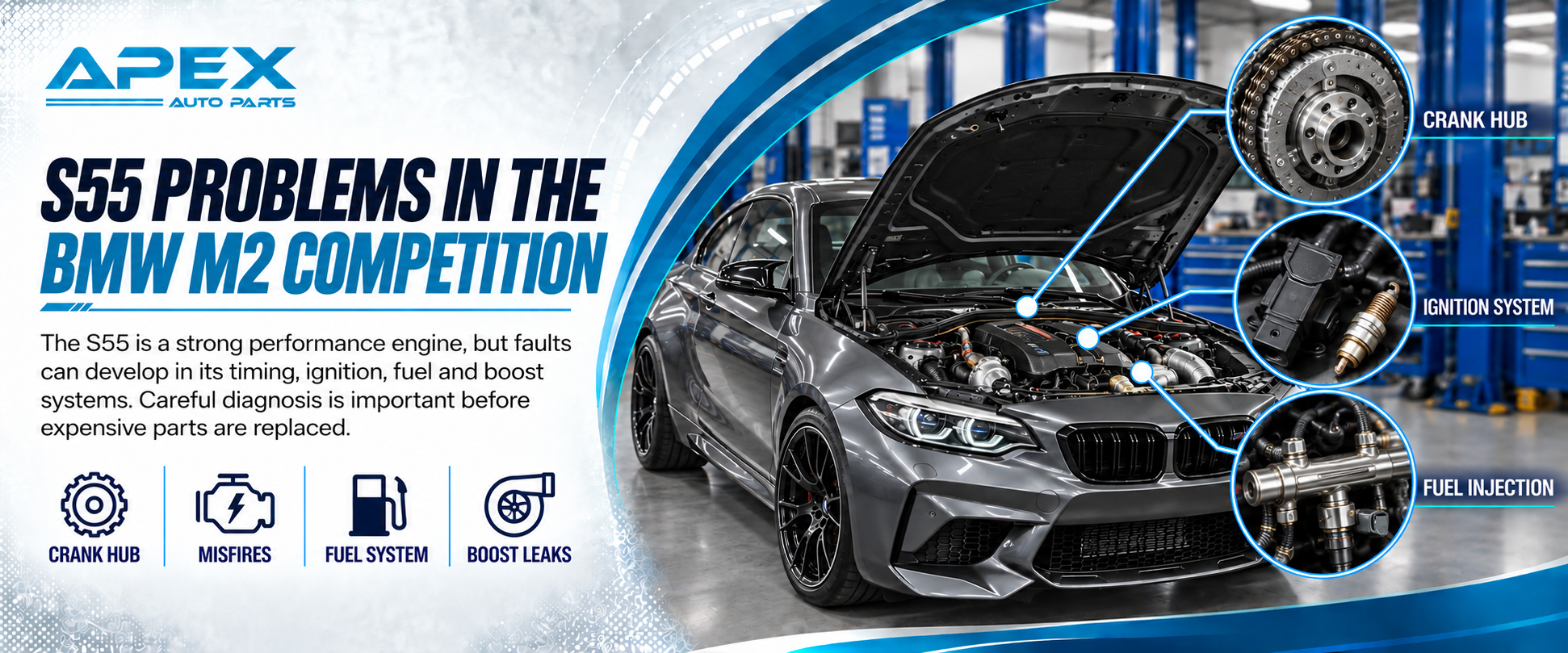
The S55 in the BMW M2 Competition is a powerful engine with robust internal components. It was designed to handle demanding performance use, but it still depends on correct oil, cooling, and software control.
Spark plugs and ignition coils can wear more quickly on tuned cars. Misfires under load may appear before the engine runs badly at idle. Fuel injectors and high-pressure fuel equipment can also cause starting, performance, or mixture faults.
Boost leaks can occur around pipes, connections, and charge-cooling parts. A leak may reduce power without producing obvious smoke.
The S55 also has a widely discussed crank hub concern. This subject needs a balanced explanation because not every engine experiences a failure.
S55 Crank Hub Concerns
The crank hub helps keep the crankshaft and engine timing components in the correct position. If it moves, camshaft timing may shift. This can cause warning lights, poor running, or a failure to start.
In severe cases, incorrect timing may cause internal engine damage. However, owners should not assume every S55 will suffer this problem.
Risk may depend on engine output, aggressive software, repeated hard launches, gearbox behavior, and the quality of previous repairs. Standard road cars with sensible maintenance may never experience it.
If timing-related fault codes appear, stop the engine and inspect it. Clearing the warning repeatedly without finding the cause can turn a repairable timing problem into serious damage.
Ignition Coil and Spark Plug Problems
Spark plugs work under high pressure and temperature in every turbocharged BMW M2 engine. Worn plugs may cause hesitation, rough running, and misfires during acceleration.
Ignition coils can create similar symptoms. A weak coil may work at idle but fail when boost and cylinder pressure increase.
A diagnostic scan can identify the cylinder recording the misfire. The mechanic can then compare the plug, coil, injector, and compression instead of replacing a full set of expensive parts without testing.
Modified engines may require a different plug gap or shorter replacement interval. The correct setup should match the software and the tuner's advice.
Fuel Injector and High Pressure Pump Problems
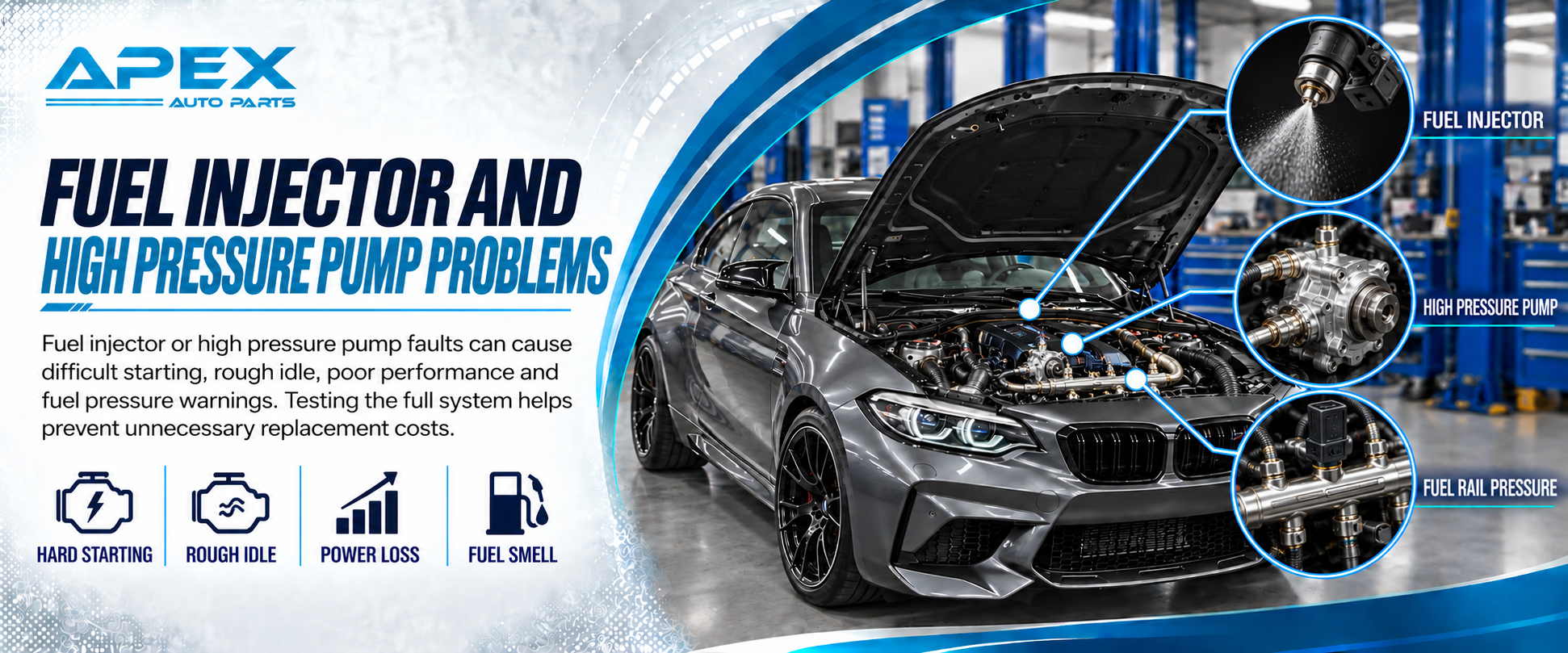
Direct petrol injection lets the engine deliver strong performance, but it puts heavy pressure on the fuel system.
A faulty injector may cause difficult starting, a fuel smell, an uneven idle, smoke, or poor fuel economy. A leaking injector after the engine is switched off can allow too much fuel into a cylinder.
The high-pressure fuel pump can also cause power loss, difficult starting, or rail pressure fault codes. Low pressure supply problems can produce similar symptoms.
Measure fuel pressure before replacing the pump. You should also check the wiring, sensors, fuel quality, and tank supply system.
Carbon Build-Up on Intake Valves
Direct injection sprays fuel directly into the cylinders. This means petrol does not wash over the back of the intake valves in the same way it does in some older injection systems.
Oil vapor from the crankcase ventilation system can collect around the intake valves. Over time, deposits may affect airflow.
Possible symptoms include rough cold starts, uneven idle, hesitation, and reduced performance. However, these signs can also come from plugs, coils, injectors, or air leaks.
An intake inspection can confirm whether cleaning is needed. Don't sell cleaning as an automatic cure without checking the actual condition.
Turbocharger Problems
Turbocharger failure is possible, but many apparent turbo faults come from air leaks, control problems, or poor oil supply.
A worn turbo may create unusual whining, smoke, oil consumption or weak boost. However, a damaged pipe can produce the same loss of power for a much lower repair cost.
The mechanic should inspect boost pressure, wastegate operation, pipes, seals, and intercooler connections. Also check the oil feed and return lines.
The S55 and S58 use two turbochargers, which makes diagnosis more involved. Test both sides rather than replacing the first component that seems suspicious.
BMW M2 G87 and S58 Reliability
The BMW M2 G87 uses the S58 engine, which is newer than the N55 and S55. It has a strong block, advanced cooling, and two turbochargers. It was designed for high-performance applications and produces up to 480 hp in the current UK M2.
Because the BMW M2 G87 is still relatively new, less long-term information is available than for the F87. It is too early to claim that every weakness has already been identified.
Current owners should watch coolant levels, oil leaks, warning lights, misfires, and unusual boost behavior. Check software updates and recall work through BMW using the vehicle identification number.
A newer engine does not remove the need for regular maintenance. High output, heat, and hard driving can still shorten the life of fluids, plugs, tires, and surrounding components.
Does Tuning Reduce BMW M2 Reliability?
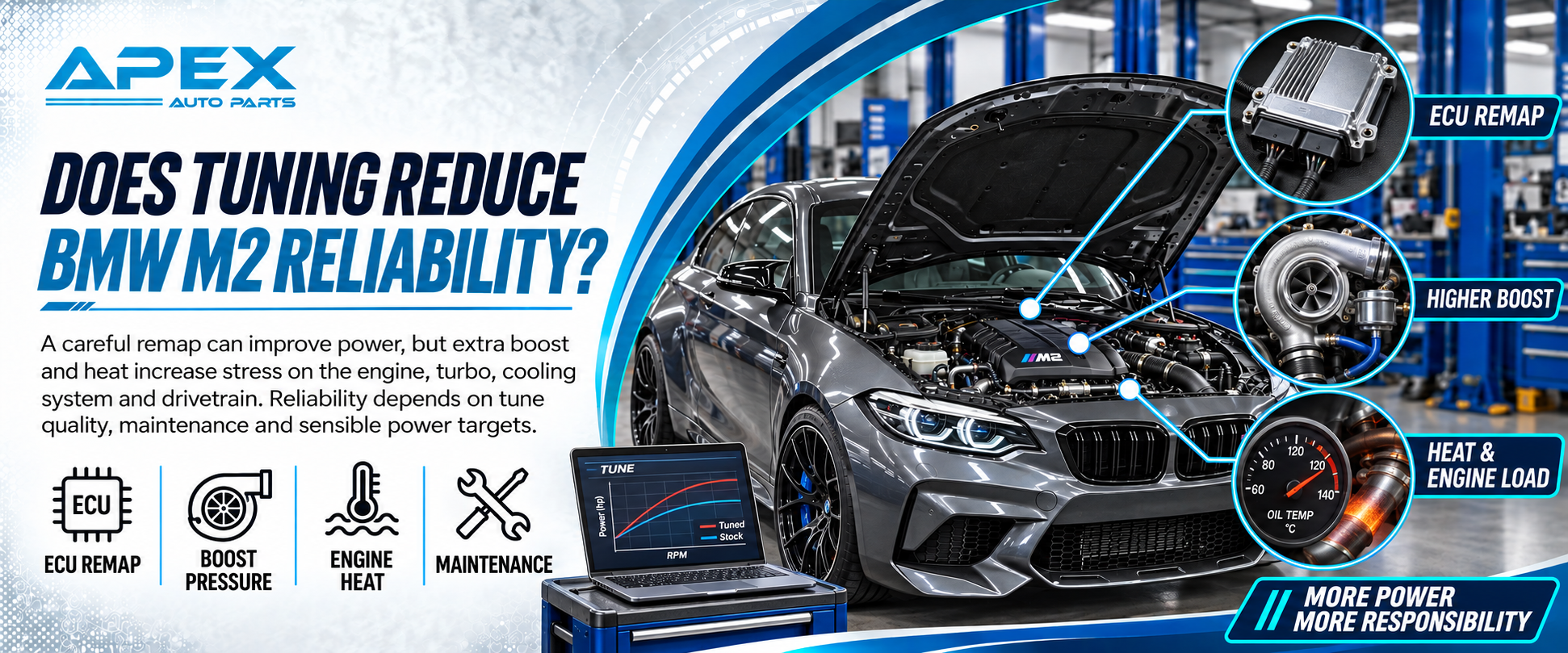
Tuning can provide large power gains, especially on the S55 and S58. However, more power creates additional heat and pressure.
The engine may cope with the increase, but the turbochargers, cooling system, gearbox, clutch, driveshafts, and differential must also handle the extra load.
An aggressive tune on poor fuel can cause ignition correction, knock, or excessive exhaust temperature. A poorly written file may also turn off useful safety limits.
Before tuning, the car should receive a full health check. Inspect compression, fuel pressure, ignition components, boost leaks, and cooling performance. A tune cannot repair an engine that already has a mechanical fault.
What Does BMW M2 Sport Mean?
The search phrase BMW M2 Sport can create confusion. BMW sells regular 2 Series models with M Sport styling, but these are not the same as a true M2.
An M Sport 220i, 230i, or diesel model may have sportier bumpers, seats, wheels, and suspension. It does not use the same complete engine and chassis package as the M2.
Some sellers also use BMW M2 Sport as a general description for an M2 with optional styling parts.
Buyers should rely on the registration, chassis number, and official model details rather than the advert title.
This is especially important when ordering engine parts. A component for a 2 Series M Sport may not fit an F87 or G87 M2.
Does Color Affect Reliability?
A search for BMW M2 black usually relates to paint color, styling, or cars for sale. The color itself doesn't affect engine strength.
However, a black BMW M2 can hide certain marks, repairs, and panel differences in poor light. Always inspect the vehicle in daylight.
Look for mismatched paint, uneven panel gaps, overspray and signs of accident repair. A crash-damaged car may have suffered damage to the radiator, cooling pipes, intercooler, or front suspension even if the engine appears to run correctly.
A clean body does not prove the engine is healthy, and a detailed mechanical inspection is still required.
Warning Signs You Should Never Ignore
Most serious BMW M2 engine problems begin with smaller warning signs. Acting early can reduce the chance of major damage.
Important signs include:
- An overheating or low coolant warning
- Misfires during strong acceleration
- Sudden loss of boost or reduced power
- Fresh oil around the engine or beneath the car
- Blue, black, or persistent white exhaust smoke
- Metallic knocking, rattling, or grinding
- Fuel smell around the engine
- Regular need to add oil or coolant
Stop driving if oil pressure falls, temperature rises sharply, or the engine develops a heavy mechanical knock.
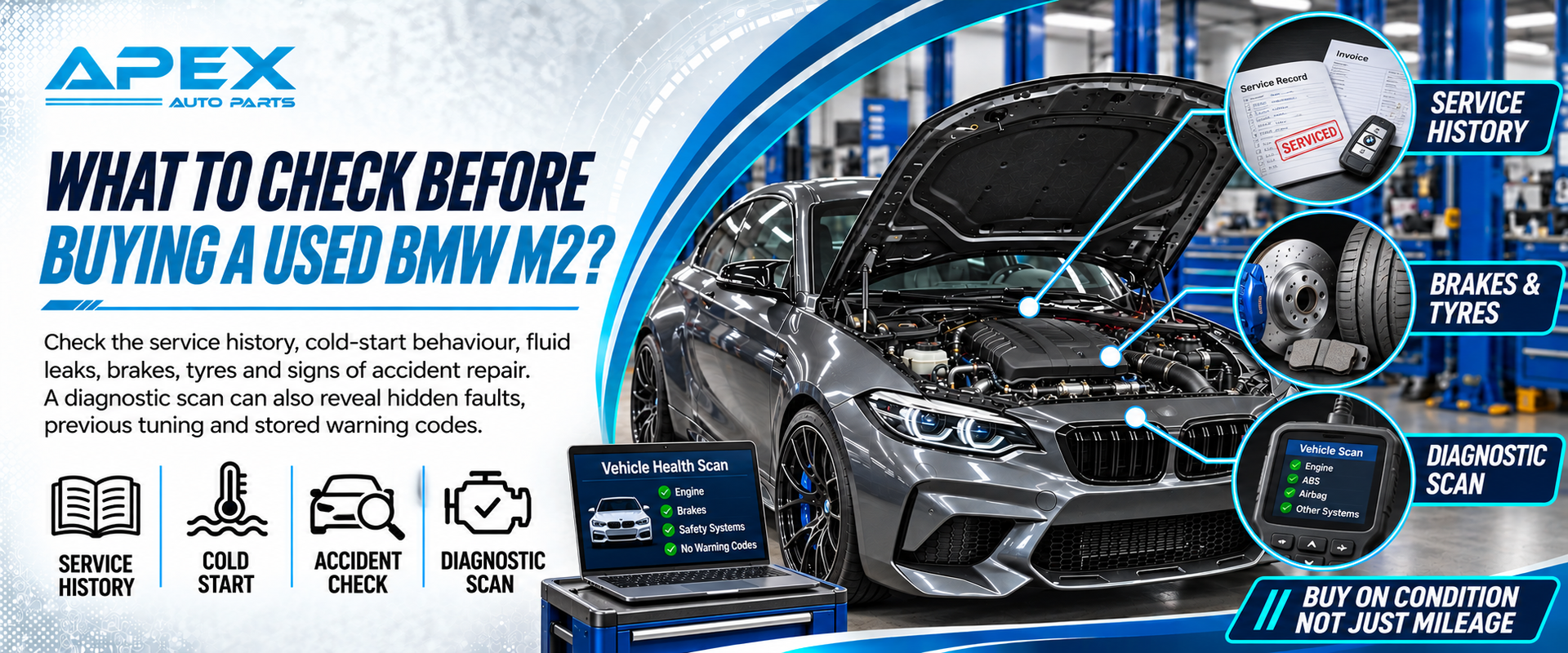
What to Check Before Buying a Used BMW M2?
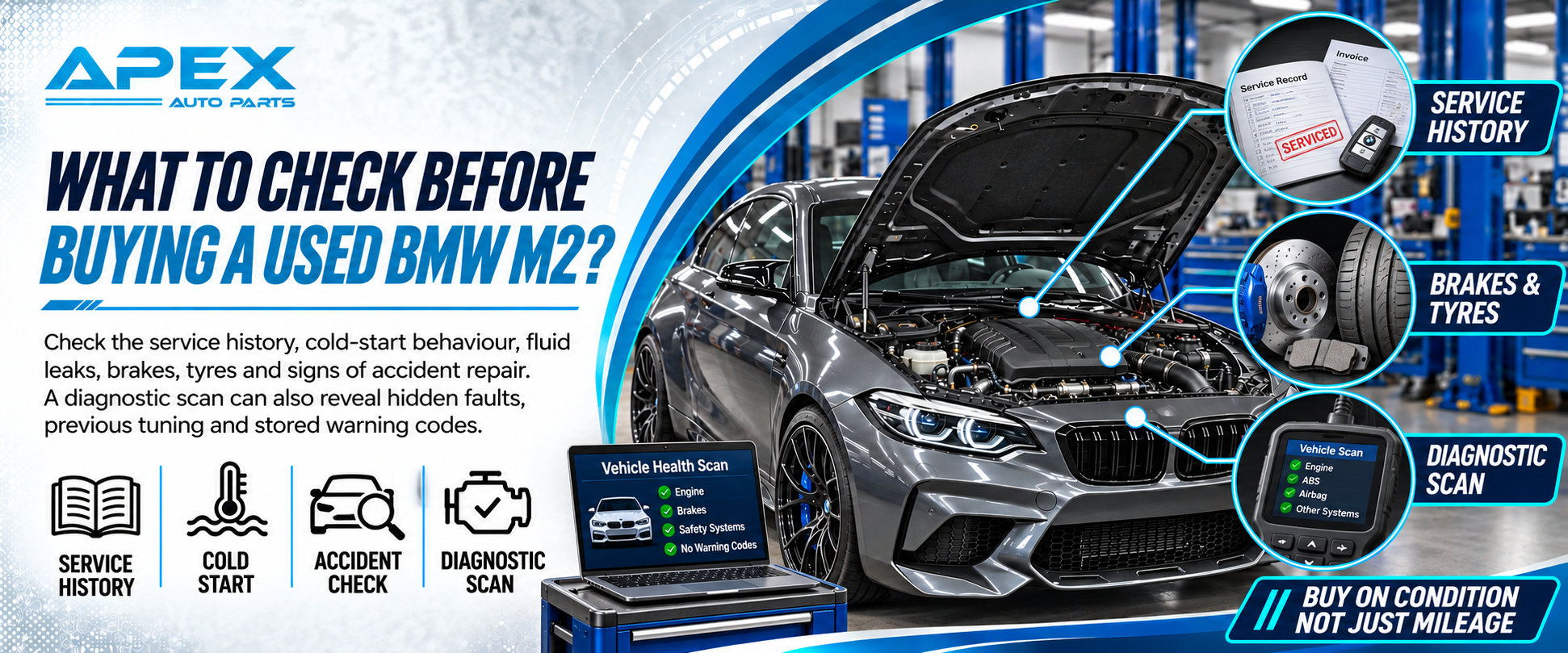
Start the car from completely cold. A seller who warms the engine before you arrive may be hiding poor starting, smoke, or mechanical noise.
Check the service history and compare invoices with the mileage. Look for evidence of oil changes, plugs, coolant work, water pump replacement, and repairs to common leak points.
Ask whether the car has been tuned. If it has, ask for details on the software, supporting parts, and the company that did the work. Treat a tuned car with no paperwork carefully.
Inspect the tires and brakes. Heavy wear, heat cracks, or very different tire brands may suggest hard track use or poor maintenance.
Complete a diagnostic scan before purchase. Stored faults, misfire counters and temperature data can reveal problems that do not appear during a short road test.
Why Must Diagnosis Come Before Buying Parts?
A reduced power warning does not prove that the turbocharger has failed. A split pipe, weak sensor, or fuel pressure problem can create the same result.
A misfire does not automatically mean the ignition coil is faulty. The real cause may be a worn plug, a leaking injector, low compression, or wiring damage.
Good diagnosis begins with the symptoms and fault codes. The mechanic should then take measurements and test the related system.
This is especially important on an M car because guessing can become expensive very quickly. Replacing the wrong part wastes money and may leave the original fault untouched.
Choosing Correct BMW M2 Engine Parts
Confirm the exact generation, production date, and engine code before ordering parts. An N55-powered F87 does not use the same components as an S55-powered BMW M2 Competition.
The BMW M2 G87 uses the S58, which has different fuel, turbo, cooling, and electronic systems again.
Use the vehicle identification number, original part number, and engine information to check compatibility. Do not order from a title that only says BMW M2 Sport.
Apex Auto Parts can help customers identify suitable engine components when they provide accurate vehicle details. Correct matching is particularly important for pumps, gaskets, sensors, ignition parts, turbo components, and internal engine parts.
How to Improve BMW M2 Reliability?
Good BMW M2 reliability begins with sensible servicing and careful driving habits. Let the engine oil warm up before using high boost or high engine speed.
Check the oil and coolant regularly. These engines should not repeatedly lose fluid. Find a small leak before it becomes a bigger problem.
Use the correct oil specification and good quality filters. Cars used on track may need shorter service intervals because the oil experiences much higher temperatures.
Keep the cooling system healthy, replace worn plugs, and investigate warning lights quickly. If the vehicle is modified, servicing should match the extra load created by the tune.
Most importantly, use a workshop that understands BMW M engines. The right test can save more money than guessing and fitting the wrong parts.
Final Thoughts
The M2 can be a reliable performance car, but the exact engine matters. The original N55 is known for charge pipe failure, cooling faults, and oil leaks around gaskets and covers.
The S55 in the BMW M2 Competition brings more power, but buyers should consider its ignition, fuel, boost, and crank hub history.
The S58 in the BMW M2 G87 is the newest and most powerful choice. It benefits from newer engineering, but it still requires correct oil, cooling, and software care.
Don't judge BMW M2 reliability by mileage alone. Look at service records, modifications, previous use, and the quality of earlier repairs.
A standard car with clear history is normally the safest purchase. A modified car can still be good, but it needs stronger evidence that the work was completed properly.
When you need replacement BMW M2 engine parts, confirm the VIN, engine code, and original component number. Accurate matching and proper diagnosis will always provide better value than ordering parts based only on an advert description.
FAQS
1. Is the BMW M2 engine reliable?
The BMW M2 engine can be reliable with regular oil changes, proper warm-up, and quick repairs when leaks appear. Reliability differs between the N55, S55, and S58. Service history and modification quality usually matter more than mileage alone when judging a used example.
2. What are the most common BMW M2 engine problems?
Common BMW M2 engine problems include oil leaks, cooling faults, charge pipe failure, worn spark plugs, ignition coil problems, boost leaks, and fuel pressure faults. The exact risks depend on whether the car uses an N55, S55, or S58 engine, so diagnosis and correct engine identification are important.
3. Is the BMW M2 Competition reliable?
The BMW M2 Competition can be dependable when kept near standard and serviced correctly. Its S55 engine is strong, but owners should watch for oil leaks, misfires, boost faults, and timing-related warnings. Modified cars require extra care because increased torque and heat can place more load on several systems.
4. Which engine is used in the BMW M2 Competition?
The BMW M2 Competition uses the 3.0-liter S55 twin-turbo six-cylinder twin-turbo six-cylinder engine. In UK and European specification, it produces 410 hp and 550 Nm. This engine is related to the unit used in the F80 M3 and F82 M4, but you should still check parts by VIN.
5. Is the BMW M2 G87 reliable?
The BMW M2 G87 uses the newer S58 engine and currently has a promising reliability record. However, it has not been on the road as long as the F87. Owners should monitor coolant, oil leaks, misfires, boost behavior, and software updates, and follow the correct service schedule.
6. What are the main BMW M2 specs?
Important BMW M2 specs depend on generation. The original F87 produced 370 hp, while the BMW M2 Competition produced 410 hp. The updated BMW M2 G87 produces 480 hp in the UK. Every version uses a turbocharged 3.0-liter six-cylinder petrol engine.
7. Does the BMW M2 have water pump problems?
Electric water pump failure is mainly associated with the N55 version of the BMW M2 engine. Symptoms can include overheating messages, high fan speed, and reduced power. Thermostat faults, leaks, and sensors can cause similar signs, so test the cooling system before ordering a pump.
8. Is a tuned BMW M2 reliable?
A tuned M2 can remain reliable when the engine is healthy, the software is sensible, and supporting systems are maintained. Aggressive tuning increases heat and load on the turbo, cooling system, gearbox, and drivetrain. Inspect the car carefully and ask for tuning invoices before buying a modified example.
9. What is the difference between BMW M2 and BMW M2 Sport?
The phrase BMW M2 Sport is not normally the official name of a separate M2 model. People often confuse it with regular BMW 2 Series cars fitted with an M Sport package. Check the VIN and full model description because the engine, brakes, suspension, and replacement parts can be completely different.
10. Is a black BMW M2 harder to inspect?
A black BMW M2 isn't less reliable, but dark paint may hide light scratches, paint differences, and some repair marks in poor lighting. Inspect it outside during daylight. Mechanical condition still matters most, so check the service history, cooling system, oil leaks, diagnostics, and any signs of previous tuning.