 info@apexautoparts.co.uk
 +44 203 915 7535
 Safe & Fast Shipping
 Whish List
 Compare
 Sign In


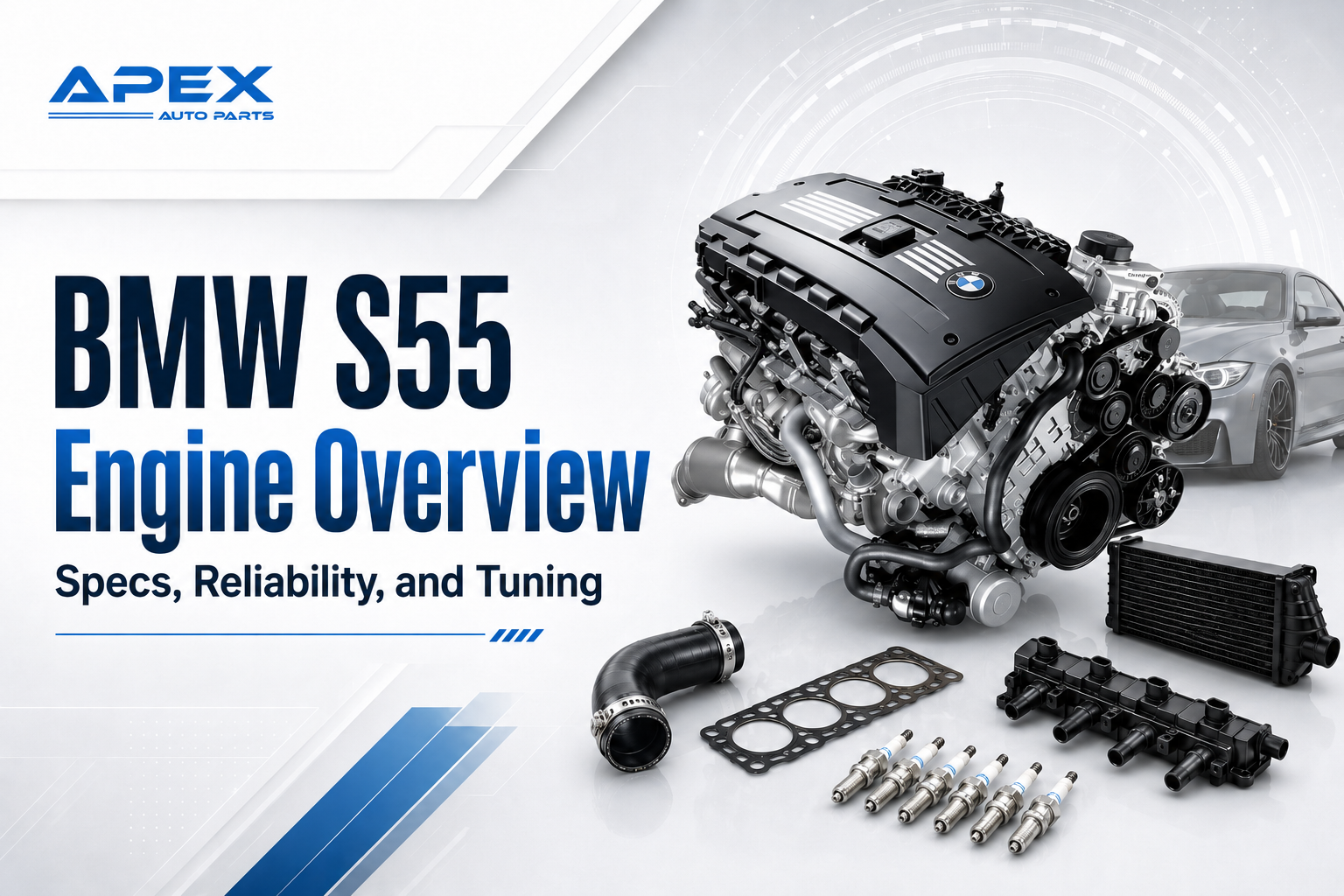
The BMW S55 engine sits at an important point in BMW M history. It replaced the high-revving S65 V8 in the M3, brought turbo power into the main M3 and M4 range, and later found its way into the M2 Competition and M2 CS. It is fast in standard form, strong enough for track use, and very responsive to tuning.
That does not mean every S55 is trouble-free. These engines are now old enough for poor servicing, hard driving, and careless modifications to matter. A healthy standard engine can feel completely different from a badly tuned car with hidden faults. The safest way to own one is to understand how it works, know the warning signs, and diagnose the real cause before ordering parts.
This guide looks at the main specifications, the cars that use it, BMW S55 reliability, the main repair concerns, safe tuning, and what is involved in a proper BMW S55 engine rebuild. Written from a practical workshop point of view, it does more than name faults. It helps you make the right repair decision.
What Is the BMW S55 Engine?
The S55 is a 3.0-litre, six-cylinder inline petrol engine developed by BMW M. It first appeared in the F80 M3 Saloon and F82 M4 Coupe. In UK form, the standard engine produced 431 hp and 550 Nm, with peak torque arriving from only 1,850 rpm. BMW also gave it a high 7,600 rpm limit, which helped it keep some of the lively character expected from an M engine.
The basic layout came from the N55 family, but the S55 was not simply an N55 with more boost. BMW training material explains that major areas were changed for M use. These included a closed deck block, two mono scroll turbochargers, a stronger oil system, extra cooling, a forged steel crankshaft, and revised pistons, bearings, and cylinder head parts. BMW stated that about 75 per cent of the components came from the N55 base, while the remaining 25 per cent were new developments for the S55.
The closed deck block is important because it gives the top of the cylinders more support. The cylinder walls use a sprayed metal coating rather than normal cast iron liners. The forged crankshaft is built to handle high engine speed and torque, while the oil system uses extra control inside the sump to keep oil around the pickup during hard acceleration, braking, and cornering. These are serious changes, not just marketing details.
BMW S55 Engine Specifications
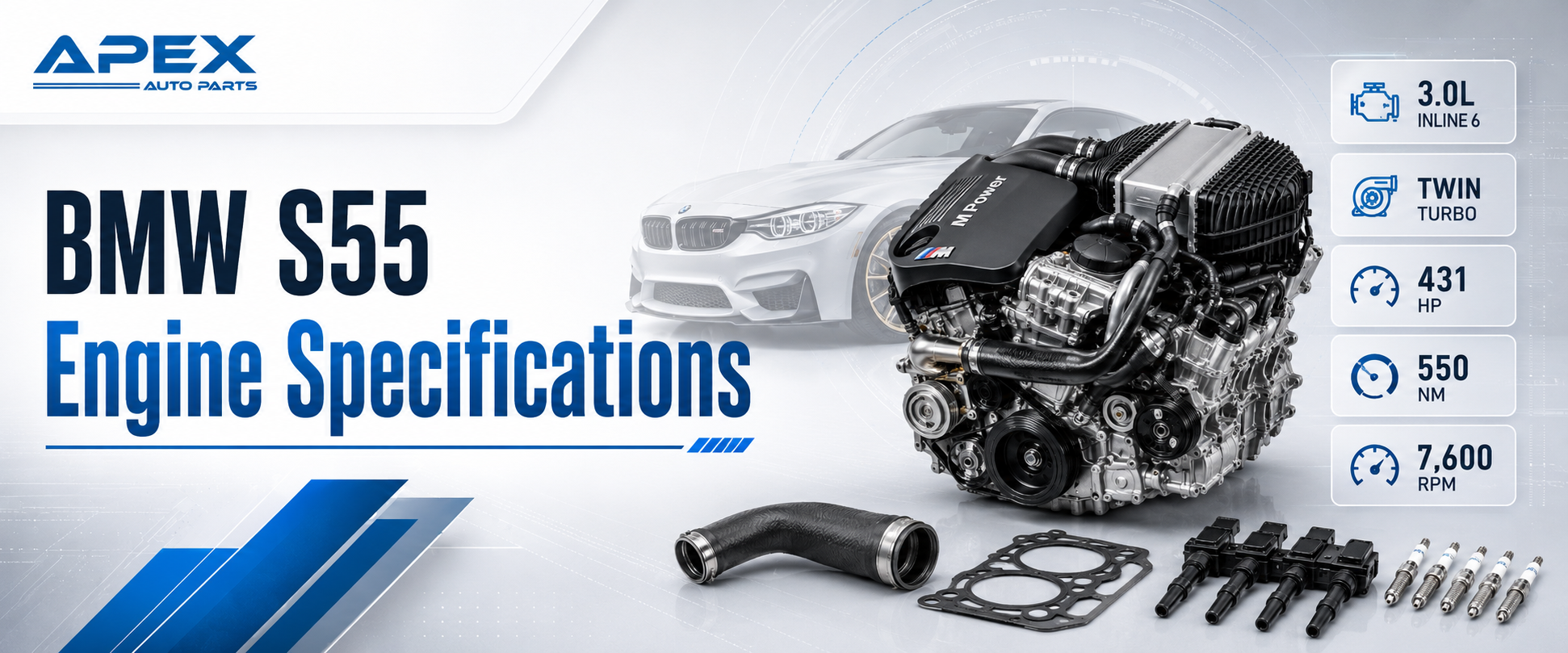
The main standard S55 specifications are the following:
- Engine code: S55B30T0
- Engine type: Six-cylinder inline petrol engine
- Capacity: 2,979 cc
- Bore: 84.0 mm
- Stroke: 89.6 mm
- Compression ratio: 10.2 to 1
- Turbo system: Two mono-scroll turbochargers
- Fuel system: Direct injection with two high-pressure fuel pumps
- Valve control: Valvetronic and Double VANOS
- Standard UK power: 431 hp
- Standard torque: 550 Nm
- Maximum engine speed: 7,600 rpm
- Gearbox options: Six-speed manual or seven-speed M double-clutch transmission
BMW designed the standard engine to make its power across a wide range rather than giving one sudden hit. The 550 Nm torque figure is available from 1,850 to 5,500 rpm, while maximum power continues from 5,500 to 7,300 rpm. That is why the engine can pull hard from low speed but still feels strong near the top of the rev range.
Power changed across different models. The M2 Competition used a 410 hp version with 550 Nm. The M3 and M4 Competition Package raised output to 450 hp. The M3 CS and M4 CS reached 460 hp and 600 Nm. The M2 CS produced 450 hp, while the M4 GTS used water injection and special engine control to reach 500 hp and 600 Nm. These factory versions show the engine had room for more power, but they also used model-specific software, cooling, and supporting parts.
Which BMW Has an S55 Engine?
People often search which BMW has the S55 engine because not every M badge from this period used the same motor.
The main road cars fitted with the S55 were
- F80 BMW M3 Saloon
- F82 BMW M4 Coupe
- F83 BMW M4 Convertible
- F87 BMW M2 Competition
- F87 BMW M2 CS
The engine was also used in special versions of the M3 and M4, including Competition Package cars, the M3 CS, M4 CS, M3 30 Jahre and M4 GTS. The M4 Convertible used the same 431 hp engine as the M3 Saloon and M4 Coupe when launched.
One point causes a lot of confusion. The first F87 M2 did not use the S55. The S55 arrived in the M2 range with the M2 Competition, followed by the M2 CS. When buying parts, do not order by the words “BMW M2” alone. Check the exact model, engine code, production date, and part number.
How Does the S55 Feel on the Road?
A standard S55 feels strong almost everywhere. There is useful torque at low engine speed, and then the power keeps building as the revs rise. This makes the car easy to drive in traffic but also very quick when the road opens up. The twin-turbo layout helps the engine respond quickly, while the wide torque band reduces the need to keep changing gear.
The manual gearbox gives the driver more involvement, but it places more responsibility on the clutch and on smooth gear changes. The seven-speed M double-clutch gearbox changes quickly and keeps the engine in the strongest part of the power band. Both can be reliable, but hard launches, poor software, and excessive torque can increase wear.
One thing owners sometimes dislike is the sound. The S55 does not have the natural V8 note of the older S65. It has a harder, more mechanical tone. Exhaust changes can make it louder, but louder does not always mean better. A badly chosen exhaust can create drone, harsh cold starts, and attention without improving the way the car drives.
BMW S55 Reliability in Real Life
BMW S55 reliability is generally good when the engine is standard, correctly serviced, and allowed to warm up before hard use. The block, crankshaft, oil control, and cooling systems were designed for serious performance. BMW developed the oil supply to remain stable during strong acceleration, braking, and cornering, and the cooling system includes separate high-temperature and low-temperature circuits.
The problem is that many used cars are no longer standard. Some have had several owners, unknown software, repeated launches, track days, or cheap bolt-on parts. A car can look clean and still have poor fuel trims, weak spark plugs, hidden boost leaks, or a tune that asks for more torque than the rest of the car can handle.
Mileage is only one part of the story. A higher-mileage car with clear service records and sensible modifications may be a better buy than a lower-mileage car with no proof of maintenance. Oil condition, warm-up habits, cooling health, fuel quality, and the standard of previous work all affect how long the engine lasts.
A strong engine should start cleanly, idle evenly, pull without hesitation, and hold stable coolant and oil levels. Small noises and stored faults should not be ignored, but they should not lead to random part replacement either. The correct approach is to read the fault memory, look at live data, and test the system connected to the symptom.
BMW S55 Engine Common Problems
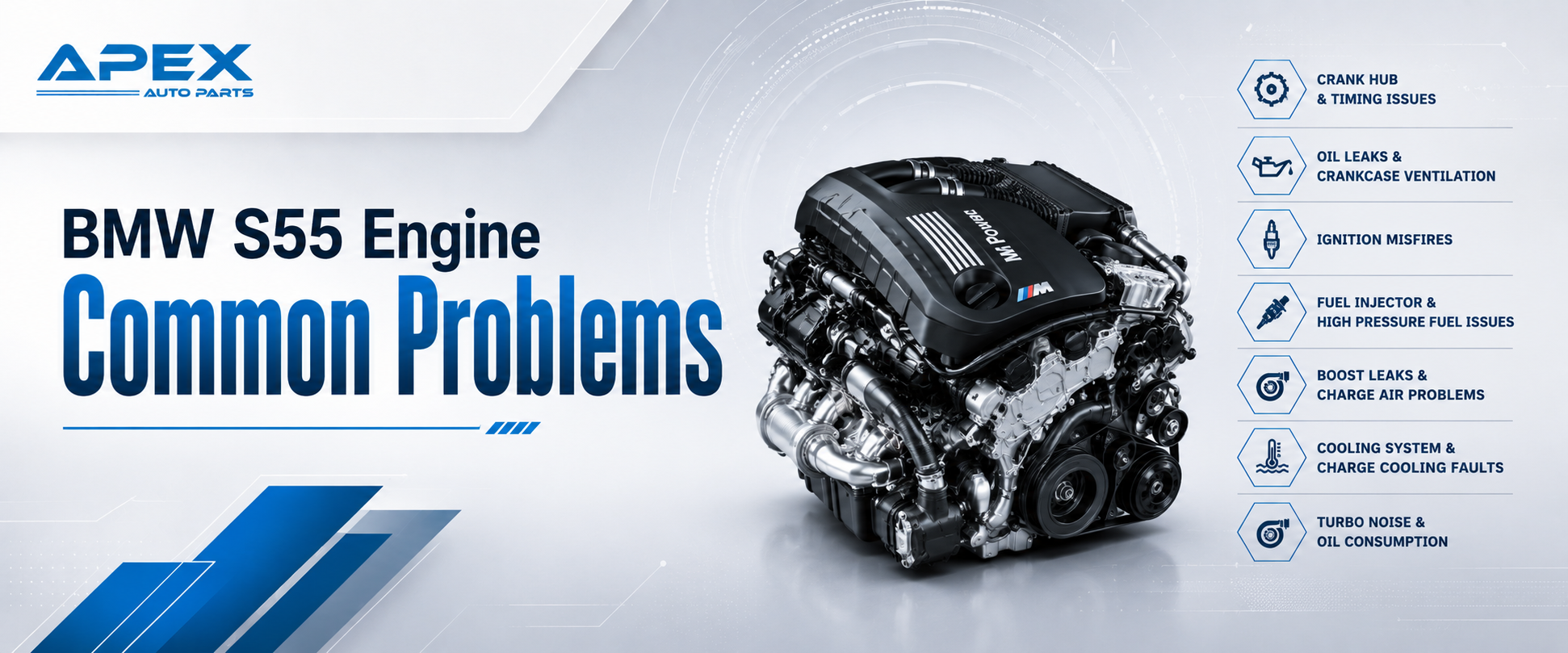
The phrase 'BMW S55 engine common problems' can make the engine sound worse than it is. The takeaway is that not every car suffers every fault. The areas below are the ones owners and garages should understand, especially on tuned or high-mileage cars.
Crank Hub and Timing Concerns
The S55 timing drive is clamped at the front of the crankshaft by a central bolt. In the repair world, movement in this area is usually called crank hub slip. If the timing moves far enough, the engine can run badly, show camshaft timing faults, enter reduced power mode, or suffer internal damage.
This does not mean every S55 needs the engine opened immediately. Many cars never suffer from this issue. It also matters that BMW issued service guidance showing that some VANOS faults could appear while the engine was mechanically sound because of software settings. That is why a garage should check fault details, software level, actual camshaft positions, and mechanical timing before giving a final answer.
On a tuned car, especially one used for hard launches or track work, it is sensible to discuss the crank hub with an experienced S55 specialist. The decision should be based on power level, use, budget, and the condition of the engine. A warning light alone is not enough proof.
Oil Leaks and Crankcase Ventilation Faults
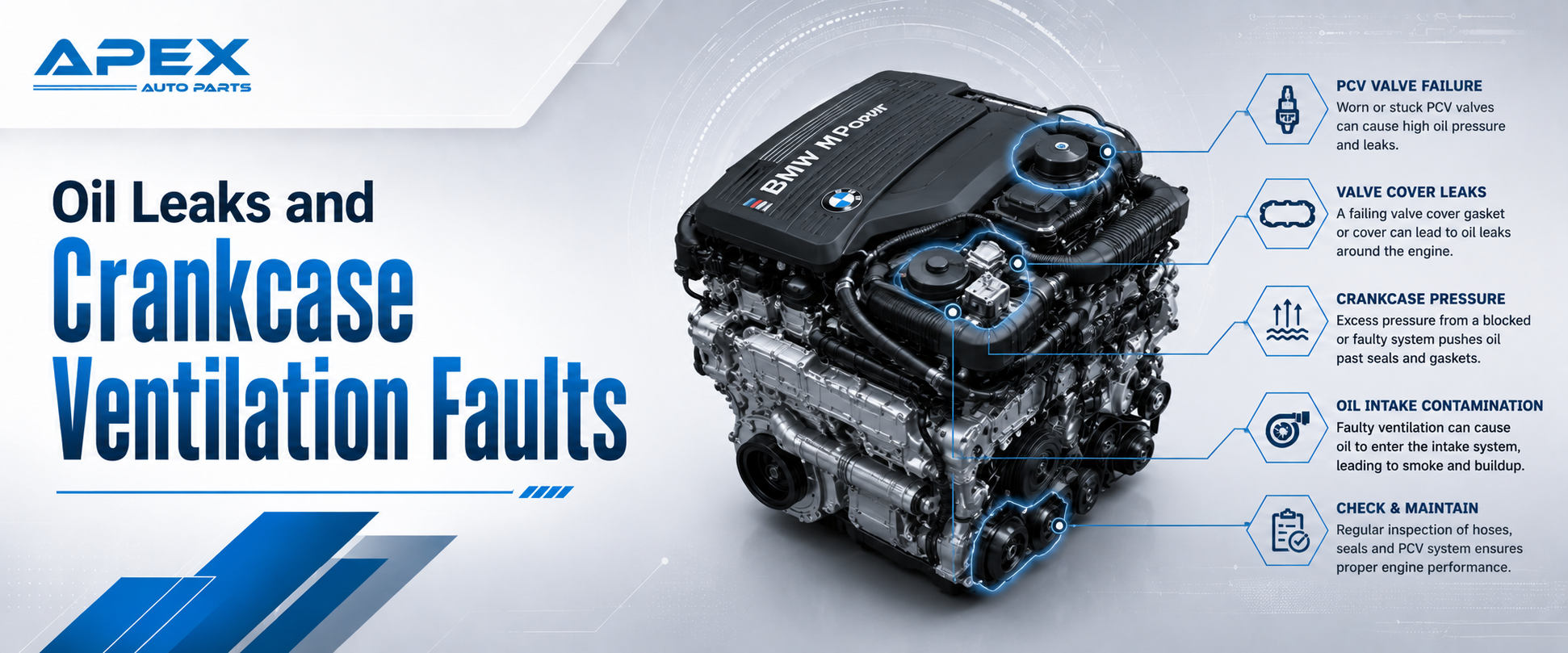
The crankcase ventilation system is built into the cylinder head cover. As the engine ages, the cover, gasket, hoses, and pressure control parts can develop faults. Possible signs include oil smell, smoke, a rough idle, whistling, high oil use, or oil found in the intake system.
Do not assume oil near a turbo means the turbo has failed. BMW training information warns that oil in the fresh air pipe can come from excess blow-by, seals or crankcase ventilation faults. A mechanic should inspect the full breathing system, check for leaks, and measure crankcase pressure where needed.
External oil leaks also need cleaning before diagnosis. Old oil spreads across undertrays and engine covers, making the source hard to see. Clean the area, add leak detection dye if needed, run the engine, and inspect again. Replacing the first wet gasket you see can waste time and money.
Spark Plugs, Ignition Coils, and Misfires
Turbo engines place heavy demand on the ignition system. A worn spark plug may seem fine at idle but misfires when boost and cylinder pressure rise. A weak coil can do the same. The driver may feel a shake, hesitation, or sudden loss of power during hard acceleration.
The correct test starts with fault codes and misfire counters. The plugs should be removed and compared, not just changed without inspection. Their color, gap and condition can show whether one cylinder is running rich, burning oil or struggling with ignition. Coils can be moved between cylinders to see whether the fault follows.
If the misfire stays on the same cylinder, the next checks may include the injector, wiring, compression, leak-down, and fuel pressure. Changing all six coils and injectors without testing is expensive and can hide the real fault.
Fuel Injector and High-Pressure Fuel Problems
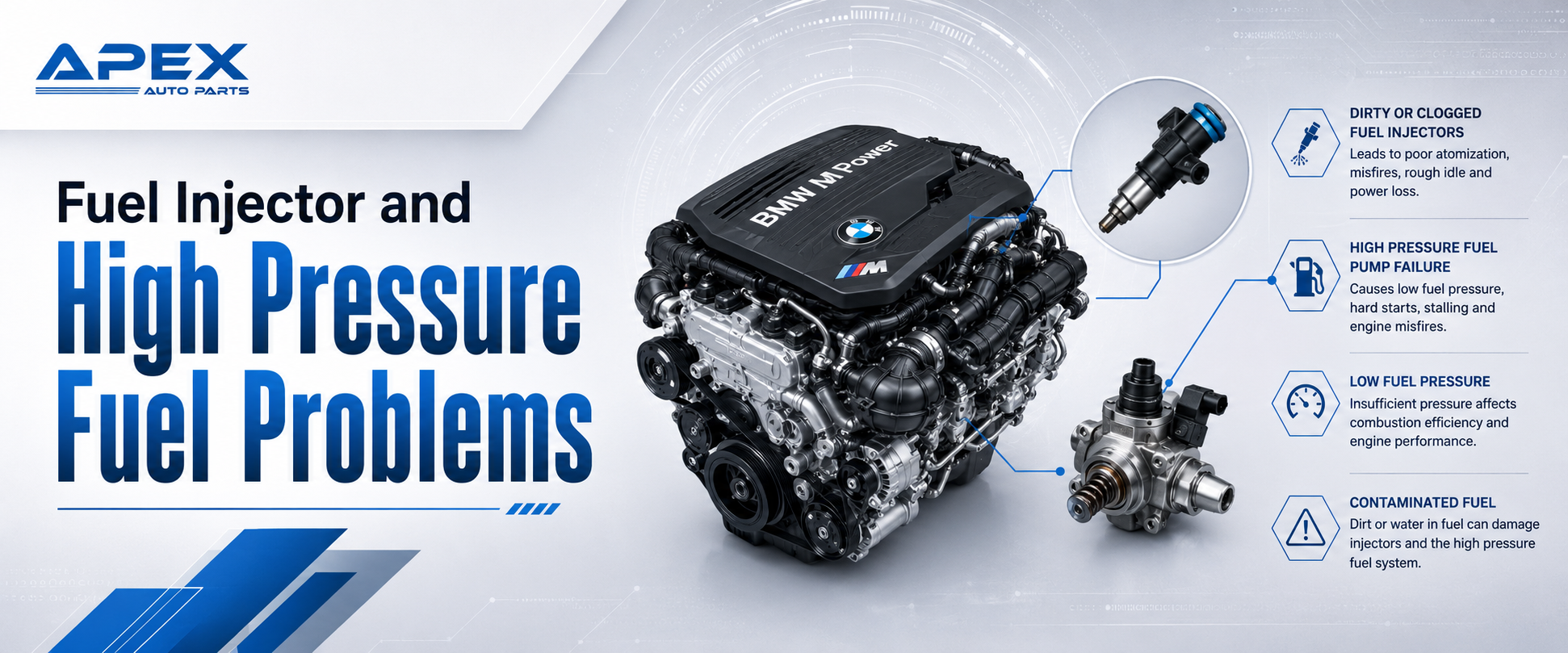
The S55 uses direct injection and two high-pressure fuel pumps. This system supports strong power, but it must deliver the right pressure and fuel amount under load. A weak pump, a leaking injector, or a wiring problem can cause long starting times, rough running, fuel smell, misfires, or reduced power.
Injector fitment matters. BMW issued service information after incorrect injector part numbers could be selected in its parts system, and the repair process required the installed injector type to be identified correctly. That is a useful lesson for any repair: match injectors by the correct engine and part data, not by appearance alone.
Before ordering injectors, check rail pressure, injector corrections, spark plug condition, and whether fuel pressure falls after the engine is switched off. A leaking injector can wash oil from the cylinder wall, so a repeated fuel smell or hard starting should not be ignored.
Boost Leaks and Charge Air Faults
A boost leak can make a healthy engine feel weak. Common signs include a rushing air noise, poor acceleration, unstable boost, rich or lean mixture faults, and oily mist around a split joint. Loose clamps, damaged seals, cracked pipes, or a leaking connection can all cause similar symptoms.
A visual check is useful, but a smoke test or controlled pressure test is better. The intake system should be tested as one complete path. Replacing a turbo because the car shows low boost is a costly mistake when the real cause is a hose, seals or control fault.
Tuned cars place more pressure on charge pipes and joints. Any part fitted in this area should be suitable for the expected boost, installed without strain, and checked after a few heat cycles.
Cooling System and Charge Cooling Faults

The S55 has more than one cooling circuit. The main circuit manages the engine, while a separate low-temperature circuit supports charge air cooling. It also uses electric pumps and several heat exchangers. This helps performance, but it gives the garage more areas to inspect when a warning appears.
Do not replace a coolant pump based on a fault code alone. BMW released service information for some S55 cars where charge cooling and turbo coolant pump faults were caused by engine control software rather than failed hardware. The stated correction was updated programming, and the bulletin clearly said parts replacement would not solve that condition.
A proper check includes coolant level in each circuit, pressure testing, pump operation, temperature data, and signs of external leakage. If the coolant keeps dropping with no visible leak, the car needs deeper testing before it is driven hard.
Turbo Noise and Oil Consumption
The S55 turbos work hard, but strange noise or oil use does not automatically mean both units need replacement. Air leaks, exhaust leaks, wastegate control problems, crankcase pressure, and oil drain problems can mimic turbo failure symptoms.
Check whether the noise changes with boost, engine speed or temperature. Inspect compressor wheels, shaft movement, oil feeds, drains, and the intake path. If the engine is using oil, check the crankcase ventilation system and compression as well. BMW itself warns against blaming the turbo immediately when oil is found in the intake.
How Should a Mechanic Diagnose an S55?
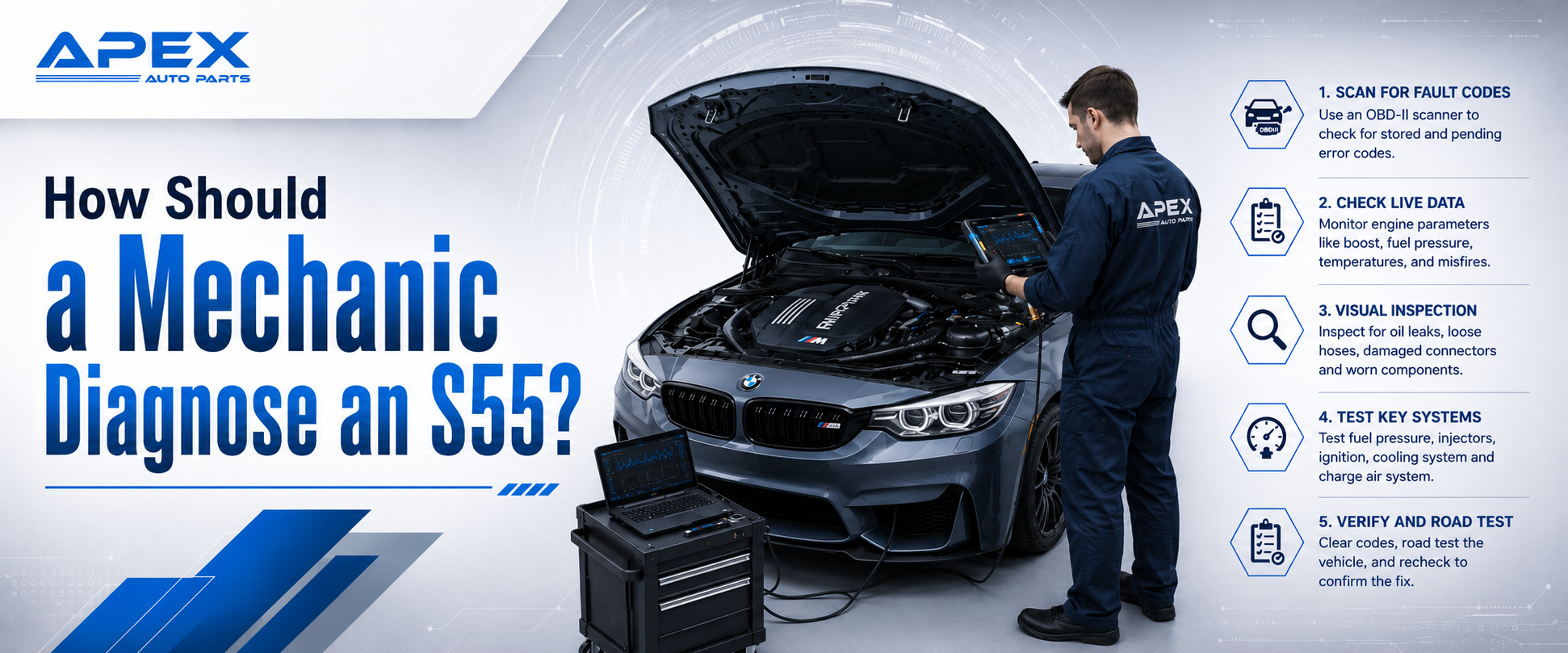
A good diagnosis follows the symptom from the driver to the failed part. It does not begin with a shopping list. The S55 has enough sensors and control systems to provide useful information, but the data has to be read in context.
A sensible process is:
- Scan every control unit and save the fault codes and freeze frame data.
- Check the software level and service history.
- Inspect oil level, coolant levels, and visible leaks.
- Read misfire counts, fuel pressure, fuel trims, boost target, and actual boost.
- Smoke tests the intake when boost leakage is suspected.
- Carry out compression and leak-down tests when one cylinder remains weak.
- Check mechanical timing when camshaft values are genuinely outside the range.
- Inspect the oil filter for metal if there is knocking, low oil pressure, or bearing concern.
This method matters because software faults, electrical faults, and mechanical faults can produce similar warnings. BMW service bulletins for the S55 show that a mechanical-sounding warning can sometimes need programming rather than parts.
When Is a BMW S55 Engine Rebuild Needed?
A BMW S55 engine rebuild is not the first answer to a misfire, oil leak, or boost fault. A rebuild becomes sensible when testing shows internal wear or damage that cannot be fixed from outside the engine. Examples include low compression from worn rings, damaged pistons, scored bores, bearing damage, low oil pressure, bent valves, or major timing damage.
The first step is measurement. A workshop should record compression, leak-down results, oil pressure, and the condition of the oil filter. Once the engine is stripped, the crankshaft, bearings, pistons, bores, cylinder head, and oil system must be checked against proper limits. Reusing parts because they “look fine” is not enough.
The S55 cylinder walls use a sprayed metal coating instead of normal cast iron liners. That means the machine shop must understand this surface before honing or machining the block. The crankshaft journals also need accurate measurement, not a quick polish followed by standard bearings.
A good rebuild may include main bearings, big-end bearings, piston rings, pistons where needed, timing parts, gaskets, seals, head bolts, and careful inspection of the oil pump. The cylinder head should be pressure tested, valves checked, and guides measured. Turbo oil and coolant lines should be cleaned or replaced when contamination is present.
Any failure that puts metal into the oil needs a full cleaning plan. The oil cooler, filter housing, oil lines, sump, and turbo feeds can hold debris. Fitting a rebuilt short engine while leaving contaminated parts in place can damage the fresh bearings within minutes.
Parts must also match the exact build. Apex Auto Parts lists BMW engine categories, including crankshaft bearings, connecting rods, pistons, piston rings, head gaskets, oil pumps, timing chains, and rebuild kits. Availability for an S55 job should still be confirmed by engine code, measurements, and part number before the engine is assembled.
Tuning the BMW S55
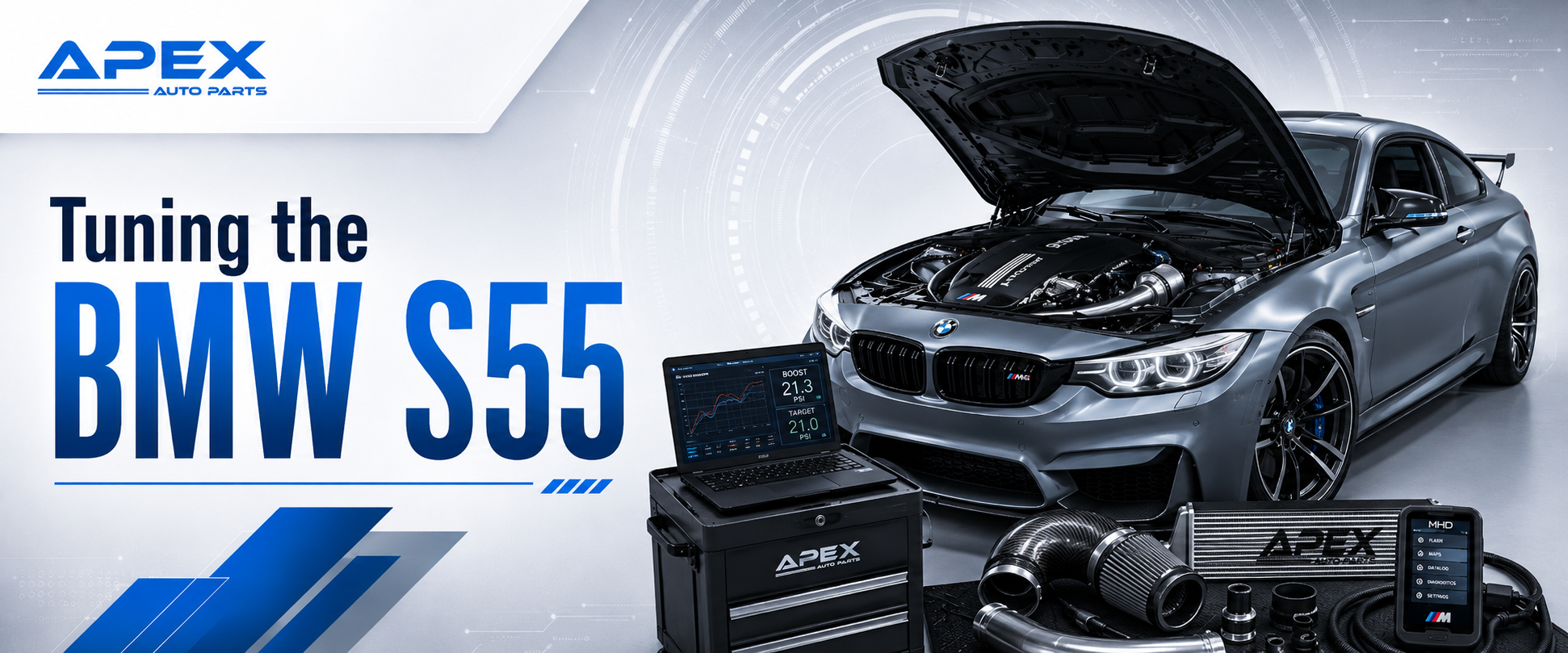
The BMW S55 responds well to tuning because it already has strong airflow, direct injection, two turbochargers, and a rigid block. The mistake is treating tuning as software only. More boost creates more heat, more cylinder pressure, and more load on the ignition, fuel system, clutch, gearbox, and cooling system.
Before tuning, the engine should have no stored faults, no boost leaks, stable fuel pressure, healthy plugs, correct coolant operation, and a clean service history. A tune does not repair a weak engine. It often makes the weak area show itself sooner.
“Stage 1” and “Stage 2” are sales terms, not fixed engineering standards. One company may use different boost, fuel, and torque targets from another. Dyno type, fuel quality, air temperature, and the starting model also change the result. Published S55 tuning data from Dinan ranges from modest gains on a basic control module to gains above 100 wheel horsepower for some flash files, fuels, and supporting setups. That wide range is exactly why buyers should look at the full calibration, not only the stage name.
A Sensible Tuning Order
Start with a health check and maintenance. Fit fresh plugs of the correct type, inspect the coils, pressure test the intake, and make sure both cooling circuits work. Then choose a conservative map for the fuel you can buy regularly.
Next, record data under controlled conditions. The tuner should review boost, ignition correction, fuel pressure, mixture, and intake temperature. If the car repeatedly reduces ignition or fuel pressures, more boost is not the answer.
Cooling becomes more important as power rises. A better heat exchanger or charge cooling setup may help the car hold power after repeated runs, but it must be installed and bled correctly. BMW gave the S55 a dedicated low-temperature charge cooling circuit from the factory, which shows how important temperature control is.
At higher power, the transmission and driveline matter as much as the engine. A manual car may need a stronger clutch. A double-clutch car needs sensible torque control and healthy fluid and hardware. Tyres and brakes must also match the extra speed.
Very high-power builds may need upgraded turbos, extra fuel supply, and internal engine work. At that point, the project should be planned as a complete system. A large dyno number is not useful if the car overheats, misfires, spins the tires, or breaks driveline parts.
How to Improve BMW S55 Reliability?
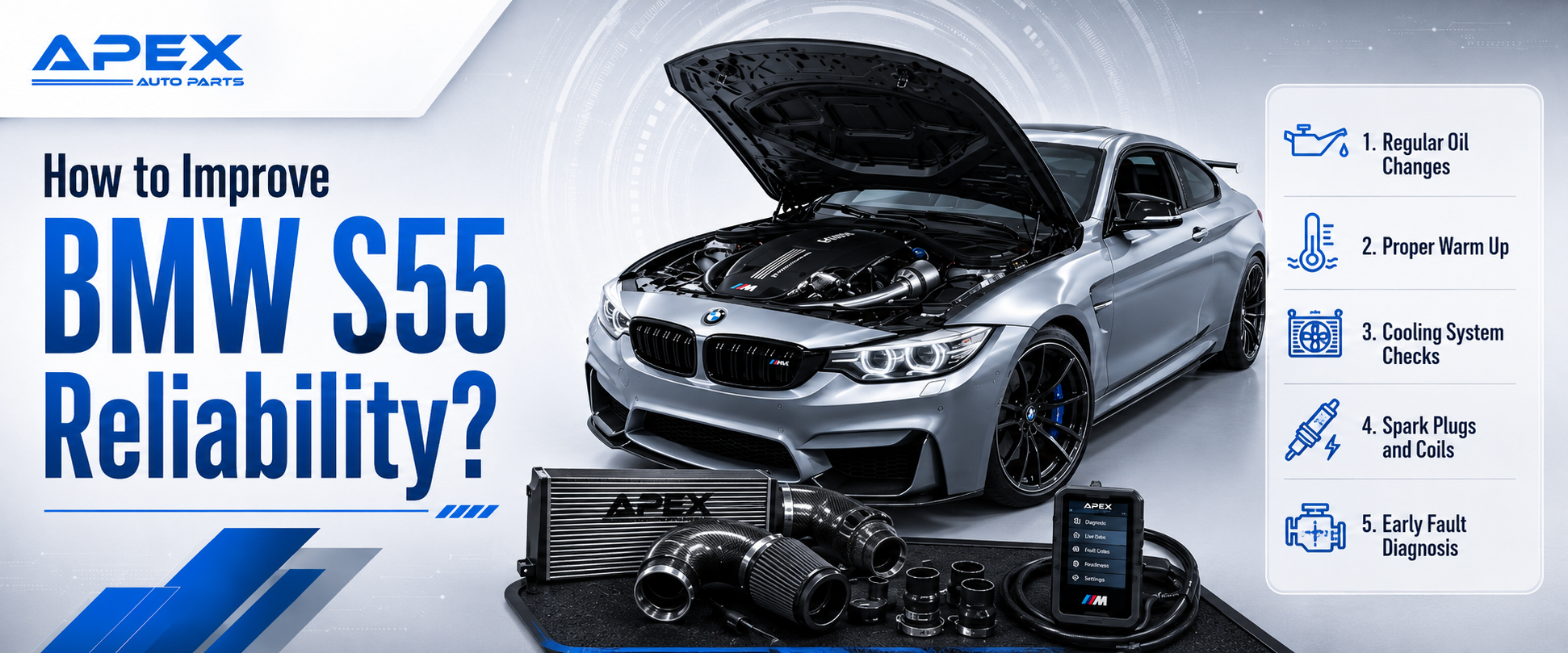
The best way to protect an S55 is not complicated. Use the correct oil approval for the car, keep the level right, and change it based on how the vehicle is used. A car that sees short trips, track use, or extra boost deserves more attention than a standard motorway car.
Avoid full boost while the oil is cold. Coolant warms faster than oil, so a normal coolant gauge does not always mean every engine part is ready for hard use. Drive gently until the engine is fully warm.
Fix small leaks early. Oil on a belt, coolant around a connector, or a loose boost joint can turn into a larger repair. A quick inspection during each service can catch these issues before they leave the car in reduced power mode.
Use good fuel from a trusted station. A tuned map must match the octane and fuel type actually in the tank. Do not use a strong map because it produces a better dyno sheet if the correct fuel is difficult to find.
Keep records of software, parts, and repairs. The next mechanic needs to know what map is installed, which plugs were used, and whether the crank hub, turbos, or fuel system have been changed. Clear information saves diagnostic time.
What to Check Before Buying an S55-Powered BMW?
A used S55 car should be checked as a complete vehicle, not judged only by the engine sound.
Look for:
- A cold start with no warning lights or heavy smoke.
- Full service records and proof of oil changes.
- Details of any engine or gearbox software.
- Receipts for fitted performance parts.
- Stable coolant levels in both circuits.
- Smooth power with no hesitation or drivetrain warning.
- A diagnostic scan, even when the dashboard is clear.
- Signs of oil leaks around the cover, sump and intake system.
- Tyre wear that may show hard use or poor alignment.
- Compression or leak down testing when history or symptoms raise concern.
Do not be frightened by every modification, but do not accept vague answers. A properly tuned car with invoices and data may be safer than a supposedly standard car that has been returned to stock before sale
Is the BMW S55 Engine Still Worth Buying?

Yes, provided the car is bought on condition rather than badge or mileage alone. The S55 gives strong performance, useful low-speed torque, and a large tuning market. It also sits in cars that still feel modern and practical.
The key is to budget for maintenance and diagnosis. Cheap examples can become expensive if they need injectors, cooling work, timing repairs, or an internal rebuild. A more expensive car with a clear history can save money in the long run.
For owners who want a daily car with real M performance, the S55 remains a very good choice. For owners chasing high power, it is also a strong base, but each increase in output should come with a plan for fuel, cooling, ignition, and driveline strength.
Final Thoughts
The BMW S55 engine is far more than a tuned N55. Its closed deck block, forged crankshaft, twin turbo layout, improved oil control, and separate charge cooling system were designed for serious performance. That strong base explains why the engine works well in standard road cars, special CS models, and the 500 hp M4 GTS.
Good ownership still comes down to basic habits. Warm it properly, use the right fluids, repair leaks, read fault data, and do not replace parts without testing. If the engine is tuned, keep the map sensible and monitor how the car behaves under load.
When internal work is required, measure everything and match every component correctly. Apex Auto Parts can support BMW engine repair work with a broad range of internal engine parts, but the engine code, part number, and measurements should always be confirmed before ordering.
Frequently Asked Questions
1. Is the BMW S55 reliable?
The BMW S55 can be reliable when it is serviced correctly and kept close to a sensible power level. Its block, crankshaft, cooling, and oil control systems are strong. Most expensive failures are linked to poor diagnosis, missed maintenance, extreme tuning, or continued driving after clear warning signs appear.
2. Which BMW Has an S55 Engine?
The S55 is found in the F80 M3, F82 M4, F83 M4 Convertible, F87 M2 Competition and F87 M2 CS. It also powers special models such as the M3 CS, M4 CS, and M4 GTS. The original F87 M2 used a different engine.
3. What are the main BMW S55 engine common problems?
The main areas to watch are crank hub and timing concerns, oil leaks, crankcase ventilation faults, ignition misfires, injector problems, boost leaks, and cooling circuit faults. Not every engine develops these issues. Proper fault reading, pressure testing, and live data checks should come before buying replacement parts.
4. How much power does the BMW S55 engine make?
The standard UK M3 and M4 engines produce 431 hp and 550 Nm. Factory versions range from 410 hp in the M2 Competition to 500 hp in the M4 GTS. Competition and CS models sit between these figures, with their own software and supporting hardware.
5. Is the S55 better than the N55?
The S55 is better suited to hard driving and higher power because it has a closed-deck block, two turbochargers, stronger oil control, and extra cooling. The N55 is simpler and often cheaper to own. The better choice depends on the car, budget, and intended use, not power alone.
6. How much power can a standard S55 handle?
There is no single safe figure for every engine. Fuel, tune quality, torque delivery, temperature, mileage, and maintenance all matter. A smooth calibration on a healthy engine is safer than a large torque spike. Before chasing a target, test fuel pressure, cooling, ignition, compression, and boost control.
7. Does every S55 need a crank hub upgrade?
No. Many standard engines run for years without crank hub trouble. The decision becomes more relevant for cars with strong torque tunes, hard launches, or regular track use. Speak to an experienced specialist, check the engine history, and avoid treating unrelated VANOS fault codes as proof of hub movement.
8. When is a BMW S55 engine rebuild necessary?
A BMW S55 engine rebuild is needed when testing confirms internal damage such as low compression, worn rings, damaged pistons, scored bores, bearing failure, low oil pressure, or bent valves. Misfires, boost leaks, and external oil leaks should be diagnosed first because they normally do not require a full rebuild.
9. What oil should be used in an S55?
Use an oil that carries the correct BMW approval for the exact model, climate, and service information. Keep the level correct and shorten the service interval when the car sees track use, repeated short trips, or extra boost. Do not choose oil only by thickness or online opinion.
10. Is the S55 good for daily driving?
Yes. The S55 has strong low-speed torque, smooth cruising ability, and enough flexibility for normal traffic. A standard or lightly tuned car can work very well every day. Running costs are higher than for a normal BMW, so buyers should allow money for premium fuel, tires, servicing, and proper repairs.
References: