
 info@apexautoparts.co.uk
 +44 203 915 7535
 Safe & Fast Shipping
 Whish List
 Compare
 Sign In



The BMW X3 has become one of BMW's most popular SUVs because it offers a useful mix of comfort, performance, space, and everyday driving ability. It is large enough for family use but still feels more like a normal BMW to drive than many heavy SUVs.
Engine choice has always been a big part of the X3 story. Over the years, BMW has offered four-cylinder petrol engines, four-cylinder diesels, six-cylinder petrol engines, larger diesel engines, plug-in hybrid models, and now a dedicated electric iX3.
That wide range of choices is also why BMW X3 reliability cannot be judged with a single answer.
An older second-generation X3 may have a very different engine from a current model. Some older petrol versions have known timing concerns. Certain diesel models have been included in EGR cooler campaigns. Newer B48- and B58-based models have different strengths and repair areas.
A reliable X3 normally comes down to the exact engine, its age, service history, driving pattern, and how quickly previous owners dealt with faults.
This guide explains common BMW X3 problems from a mechanic's perspective. It also looks at the current BMW X3 M50, diesel models, older petrol engines, and what people searching for an electric BMW X3 should understand before buying.
How the BMW X3 Engine Range Has Changed?
The BMW X3 has been sold for more than twenty years, so it would be a mistake to treat every X3 as mechanically identical.
The second-generation F25 arrived with engines including a 2.0-litre four-cylinder diesel and larger six-cylinder petrol options.
BMW listed the original X3 xDrive20d with 184 hp and 380 Nm, while the xDrive35i used a 3.0-litre six-cylinder petrol engine producing 306 hp.
The third generation G01 arrived in 2017. In the UK, BMW offered the X3 xDrive20d with 190 hp and 400 Nm, the xDrive30d with 265 hp and 620 Nm, and the first X3 M40i with 360 hp and 500 Nm.
The current generation moved the range forward again. The latest BMW X3 M50 uses a 3.0-litre six-cylinder petrol engine with mild-hybrid support. BMW lists total output at 398 hp and 580 Nm, with zero to 62 mph taking 4.6 seconds.
This history is important because online discussions about BMW X3 problems often mix several generations. A timing issue from an older four-cylinder petrol engine does not automatically apply to a modern M50.
Always start with the VIN, model year, engine code, and fuel type.
Is BMW X3 reliability Good?

Overall, BMW X3 reliability can be good when the right engine is serviced properly.
The X3 is not a basic SUV. Most versions use turbocharging, direct fuel injection, electronic engine controls, BMW X Drive, and advanced exhaust systems. Diesel versions may have a diesel filter, EGR equipment, and AdBlue systems. New petrol versions may include mild hybrid support.
More technology gives better power, economy, and emissions control, but it also creates more parts that can eventually need repair.
This is why service history matters so much.
A high-mileage X3 that has received regular oil changes and has mainly covered long motorway journeys may be healthier than a lower-mileage vehicle that has missed services and spent its life making very short trips.
Good BMW X3 reliability normally starts with clean oil, correct coolant, stable engine temperature, a healthy turbo system, and warning lights that are investigated rather than ignored.
A BMW recall check should also be part of the ownership process or any used-car inspection. BMW provides an official VIN-based recall tool and states that open recalls and technical updates are carried out free of charge by a BMW partner.
Common BMW X3 problems
The most important thing to understand about BMW X3 problems is that they vary widely by generation.
A mechanic should never hear "X3" and immediately order a timing chain, turbocharger, or EGR valve. The actual fault must be confirmed first.
Timing Chain Concerns on Some Older Petrol X3 Models
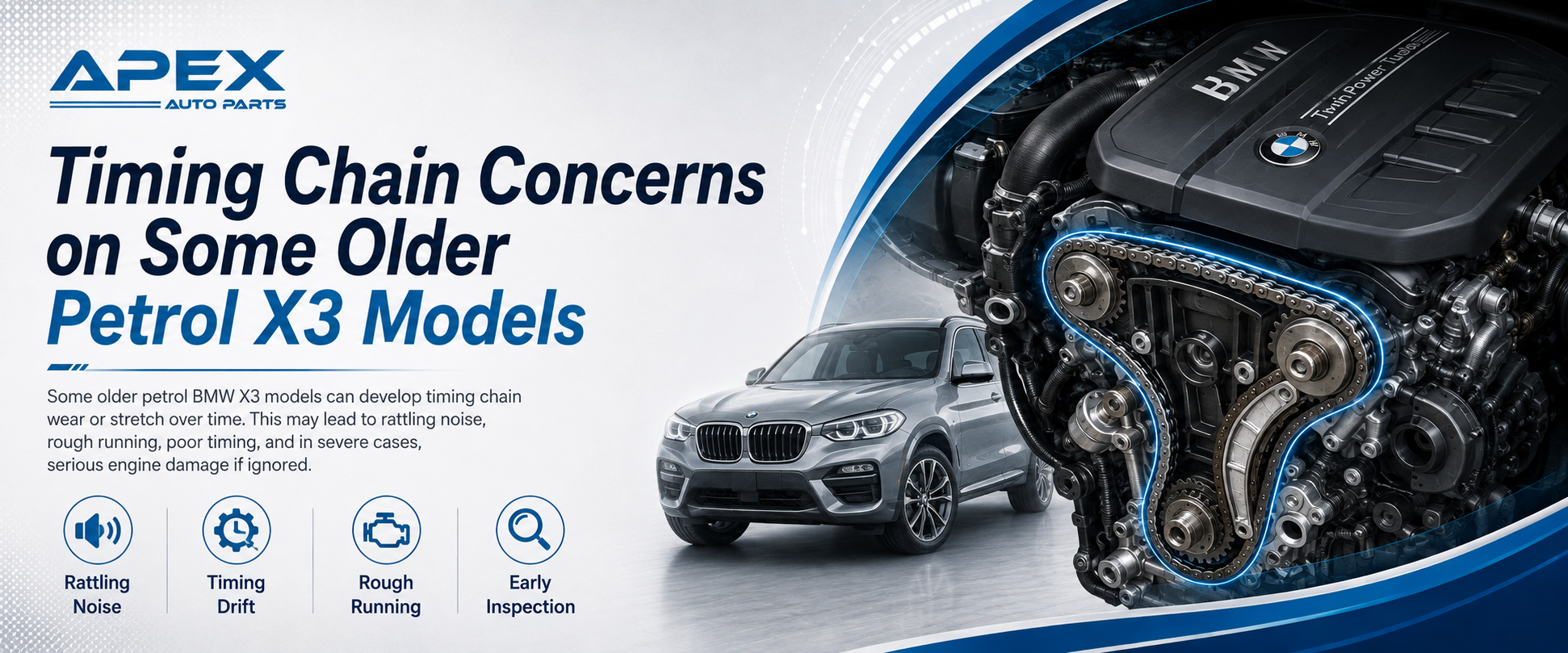
Timing chain problems are among the better-known concerns on some older BMW four-cylinder petrol engines.
BMW issued an extended warranty bulletin covering certain N20 and N26 engines. The affected vehicle list included F25 X3 xDrive28i models with the N20 engine produced during specified periods. The bulletin covered the timing chain and oil pump drive chain.
This does not mean every older petrol X3 will suffer timing failure.
It does mean that owners of affected engines should take unusual whining or timing-area noise seriously.
The timing chain keeps the camshafts and crankshaft moving together. If the chain or related parts become badly worn, engine timing can move away from its correct position.
The driver may notice a whining sound, a rattling noise, poor running, an engine warning light, or timing-related fault codes.
A mechanic should listen to the engine at cold idle and accurately locate the sound. Belt tensioners, pulleys, the alternator, and other rotating parts can make similar noises.
Replacing timing parts based only on a quick listen is poor diagnosis.
Oil Leaks
Oil leaks are common on older German engines, and an ageing BMW X3 is no exception.
The source may be a rocker cover seal, oil filter housing area, sump seal, turbo oil pipe, or another gasket depending on the engine.
The most important part of diagnosis is finding where the oil started leaking.
Oil moves down the engine due to gravity and can travel backwards while the car is moving. A wet undertray therefore does not tell you where the leak began.
A workshop should clean the area, run the engine, and inspect again. Leak tracing dye can also help.
Do not ignore a leak simply because the car still shows a normal oil level. Small leaks tend to worsen with age, and oil reaching hot exhaust components can cause smoke and a burning smell.
Regular oil level checks are especially useful on turbocharged engines because the turbocharger also depends on a good oil supply.
Cooling System Problems
A healthy cooling system is vital for BMW X3 reliability.
The cooling system includes the water pump, thermostat, radiator, expansion tank, hoses, seals, fans, and several connecting parts. The exact design changes between engines.
A slow coolant leak may not leave a large puddle. Some leaks only appear when the engine becomes hot, and the cooling system is under pressure.
Warning signs include coolant loss, a sweet smell, steam, unstable engine temperature, a low coolant warning, or poor cabin heating.
Repeatedly topping up the coolant without finding the leak is a bad idea.
An engine that repeatedly overheats can suffer cylinder head damage, gasket failure, piston damage, or bearing problems.
If coolant is disappearing, a cooling system pressure test should normally be one of the first workshop checks.
Diesel EGR Cooler Problems
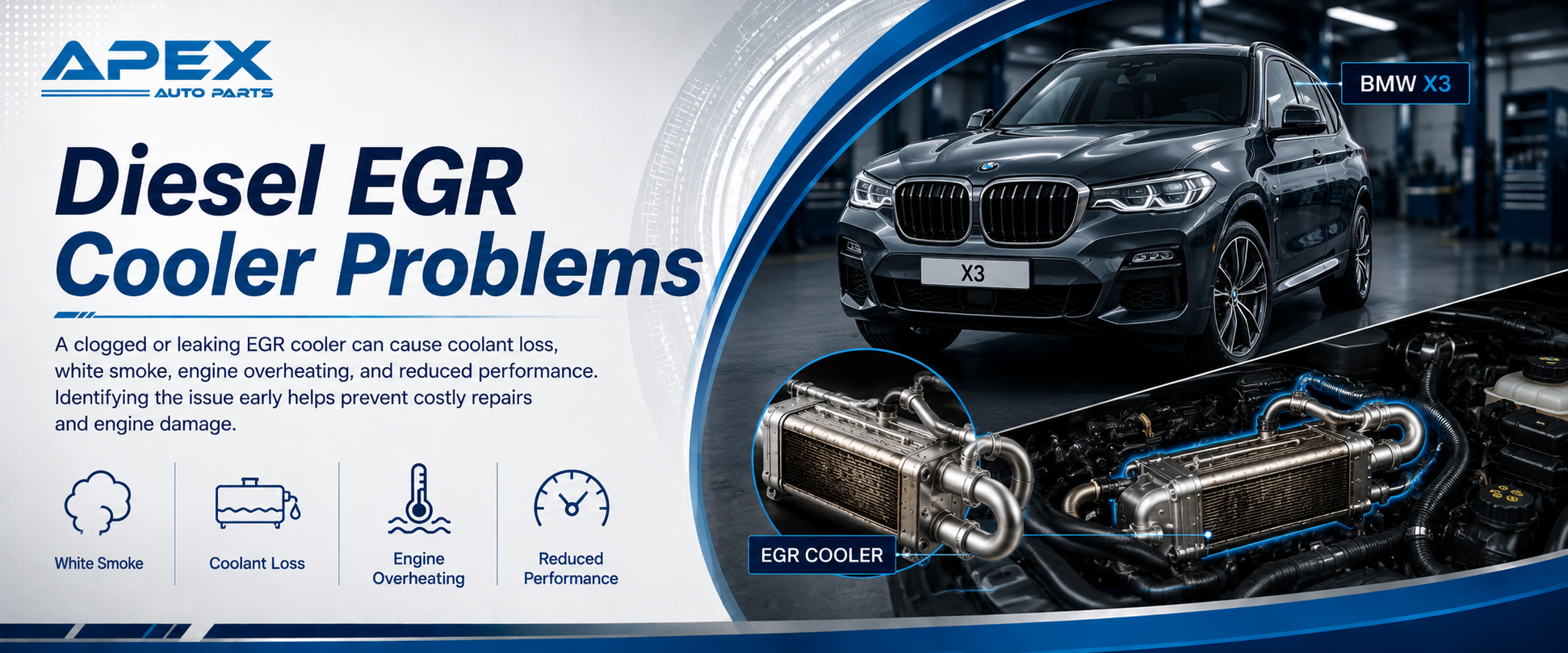
Diesel versions deserve their own section because some older X3 vehicles have been included in BMW EGR cooler campaigns.
BMW announced a European technical campaign covering certain X3 models with four-cylinder and six-cylinder diesel engines.
BMW explained that small amounts of glycol coolant could leak from the EGR cooler. When mixed with soot and oil deposits, the material could become hot enough to damage the intake system and, in rare cases, create a fire risk.
UK recall records also show several EGR cooler-related recalls affecting BMW X3 vehicles, including 2015 models. Repairs have included cooler inspection and replacement where required.
This does not mean every diesel X3 needs an EGR cooler.
Check the VIN.
Possible symptoms can include unexplained coolant loss, EGR fault codes, reduced power, an unusual smell, or smoke from the engine area.
If smoke appears under the bonnet, stop safely and have the vehicle inspected.
A mechanic should also remember that coolant loss can come from many other places. Replacing an EGR cooler without confirming that it leaks may not solve anything.
Diesel Particulate Filter Issues
Another common area of concern on diesel X3 models is the diesel particulate filter.
The filter catches soot from the exhaust. The vehicle then burns much of that soot during regeneration.
A diesel used for regular longer journeys normally has a better chance of completing regeneration than one used almost entirely for short trips.
However, driving style is not the only cause of filter trouble.
A thermostat fault can stop the engine reaching the correct temperature.
An exhaust pressure sensor can give incorrect readings. Poor injectors, EGR trouble, air leaks, or turbo faults can also increase soot or prevent regeneration.
A blocked filter should therefore be treated as a symptom until the cause is known.
A mechanic should inspect filter pressure, soot loading, ash loading, coolant temperature, exhaust temperature, fault codes, and regeneration history.
Cleaning the filter without repairing the fault that blocked it can lead to the warning returning soon afterwards.
Turbocharger and Boost Problems
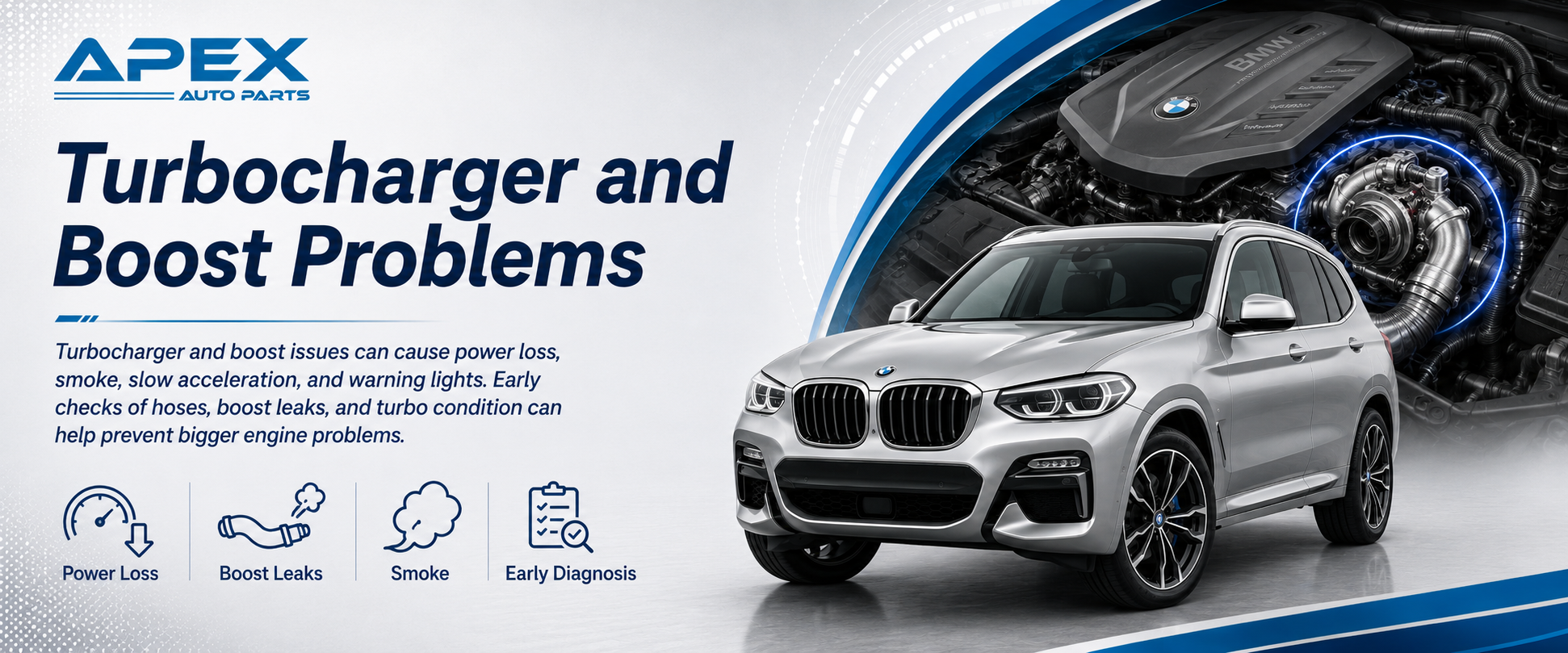
Almost every modern BMW X3 combustion engine uses turbocharging.
The turbo helps a smaller engine produce more power and torque. It works extremely hard, so clean oil and correct engine temperature are important.
Possible turbo-related symptoms include poor acceleration, reduced power, unusual whistling, heavy smoke, or increased oil consumption.
Yet a boost fault does not always mean the turbo itself has failed.
A split intake hose can cause the same loss of power.
An intercooler may leak.
A boost pressure sensor may report the wrong value.
An actuator may fail while the turbocharger itself is still usable.
A restricted exhaust can also affect boost.
The mechanic should compare the requested boost pressure with the actual pressure and check the entire air system before ordering a replacement turbo.
If a turbo really has failed, its oil feed and return lines should be inspected before the new unit is fitted. Otherwise, the same fault can damage the replacement.
Petrol Misfires and Rough Running
Petrol X3 models can suffer rough running for several reasons.
Spark plugs and ignition coils are common starting points, but they are not the only possibilities.
Fuel injectors, air leaks, fuel pressure issues, timing faults, carbon deposits, sensors, and low compression can all cause similar symptoms.
The engine control unit typically records misfire data when a cylinder is not burning properly.
A mechanic should identify the affected cylinder before replacing parts.
Moving a coil from one cylinder to another can sometimes help confirm whether the coil is responsible. Spark plug condition can also provide useful clues.
If the misfire stays on the same cylinder after basic ignition checks, fuel delivery and compression may need to be tested.
Do not drive aggressively with a strong misfire. Unburnt fuel can enter the exhaust and overheat the catalytic converter.
What About the B48 and B58 Engines?
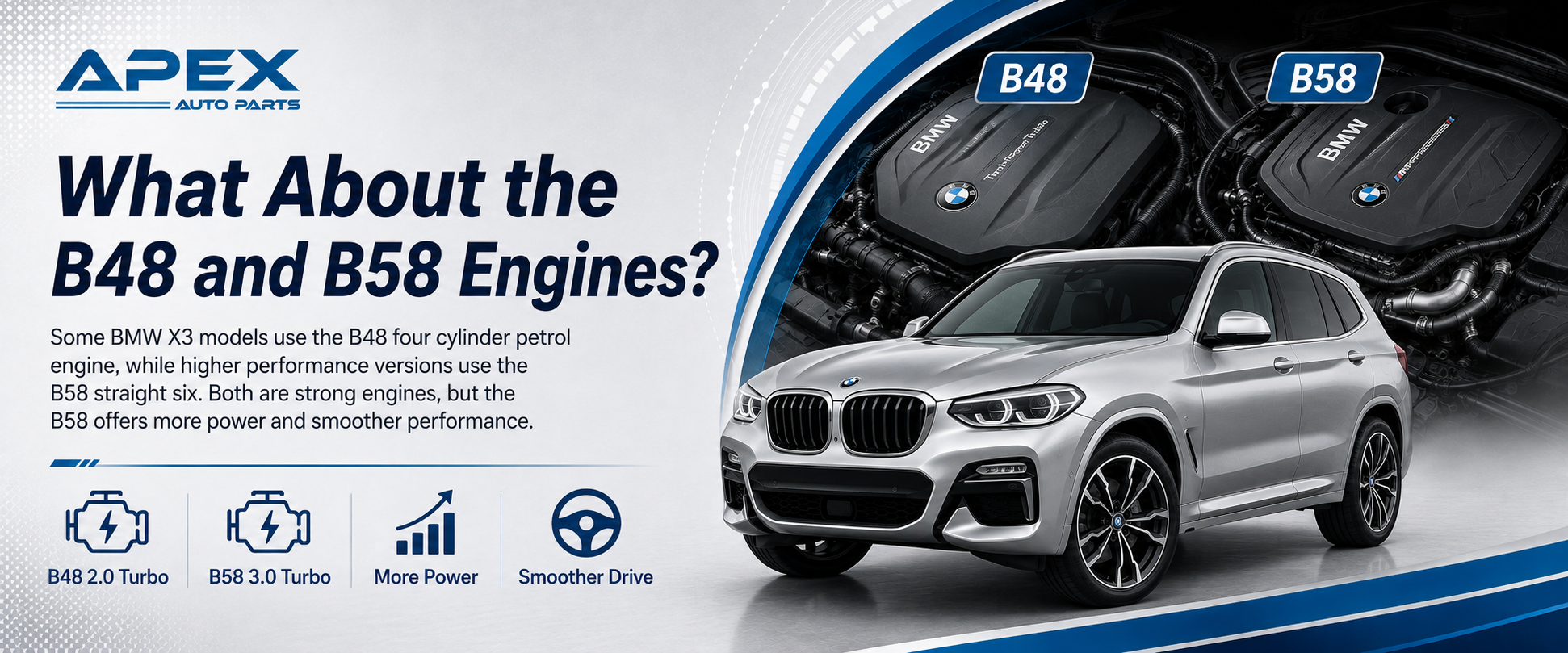
Many later BMW X3 petrol models use BMW's B engine family.
Four-cylinder models commonly use B48-based engines, while performance six-cylinder models, such as the previous M40i and current BMW X3 M50, use versions of the B58 family.
These engines are generally regarded as strong, modern BMW units, but they still require proper maintenance.
Cooling parts, seals, ignition components, sensors, turbo controls, and oil leaks can still require attention as mileage rises.
Newer does not mean maintenance-free.
The advantage is that later engines do not share every fault associated with much older BMW petrol designs.
If buying a G01 or current X3, check the exact engine rather than letting problems associated with an older N20 engine change your view of all newer petrol models.
Is the BMW X3 M50 reliable?
The current BMW X3 M50 is too new to judge in the same way as a vehicle that has been on the road for ten years.
What we do know is that it uses a 3.0-litre six-cylinder M Twin Power Turbo petrol engine, combined with 48-volt mild-hybrid support.
BMW lists total output at 398 hp and 580 Nm, with an eight-speed automatic gearbox and All Wheel Drive.
That gives the M50 very strong performance. BMW quotes zero to 62 mph in 4.6 seconds.
From an ownership perspective, higher performance means maintenance matters.
The engine needs good oil.
The cooling system needs to remain healthy.
The turbocharger needs clean lubrication.
Spark plugs and ignition parts should not be ignored.
The mild hybrid system also adds electrical components that older X3 models lack.
A nearly new BMW X3 M50 should be judged mainly by proper servicing, warranty history, software updates, and how it has been driven, rather than by high-mileage wear, since current examples are still relatively young.
What Does BMW X3 Electric Mean in 2026?

People searching for an electric BMW X3 are usually looking for the BMW iX3.
The current iX3 is a separate battery electric model rather than an X3 fitted with a petrol or diesel engine.
BMW says the new iX3 is available from March 2026 in selected markets. The iX3 40 produces 320 hp and 500 Nm, while the iX3 50 X Drive produces 469 hp and 645 Nm. Depending on version, BMW lists official WLTP ranges extending up to around 500 miles.
This changes the reliability discussion completely.
A BMW X3 electric alternative does not have an engine, spark plugs, injectors, a timing chain, a turbocharger, a diesel filter, or an EGR cooler.
Instead, the key systems include the high-voltage battery, electric motors, charging electronics, cooling system, software, and power electronics.
Electric does not mean nothing can go wrong. It means the parts that can go wrong are different.
When buying a used electric BMW, battery health, charging behavior, software history, accident repairs, and high voltage system warnings matter more than engine compression or turbo condition.
Transfer Case Shudder Is Not Always an Engine Problem
Some owners feel vibration or hesitation and immediately assume they have an engine problem.
On an All Wheel Drive BMW X3, drivetrain faults can sometimes feel like poor engine running.
The X Drive system sends power through a transfer case. Tyres are also important because large differences in tyre size or wear can put extra stress on the All Wheel Drive system.
A shudder during tight turns or low-speed movement therefore requires careful diagnosis.
The mechanic should check tyre size, tread differences, wheel-speed information, transfer-case faults, and drivetrain condition before blaming the engine.
This is a good example of why symptoms should be tested rather than guessed.
Warning Signs You Should Not Ignore

Most serious BMW X3 problems become more expensive when the first warning is ignored.
Arrange a proper inspection if you notice:
- A metal rattle or strong whining noise during a cold start
- Repeated coolant loss
- A red oil pressure or temperature warning
- Heavy blue or white exhaust smoke
- Sudden loss of turbo power
- A diesel filter warning that keeps returning
- Strong misfires or shaking under acceleration
- Smoke or a burning smell from the engine area
- Engine oil that is disappearing quickly
- Warning lights that return after being cleared
A warning light is information. Clearing it does not repair the fault.
How a Mechanic Should Diagnose BMW X3 Problems?
The first step should be understanding the exact symptom.
- When does it happen?
- Only when cold?
- Only during hard acceleration?
- Only in traffic?
- Is coolant disappearing?
- Does the engine use oil?
- Has the vehicle been tuned?
- Has another garage already replaced parts?
The mechanic should then inspect the basics before connecting diagnostic equipment. Oil, coolant, belts, hoses, intake pipes, wiring, battery condition, and visible leaks can explain many faults.
Next comes a full vehicle scan.
The fault code should guide the investigation, not finish it.
A low boost code does not automatically mean turbo failure.
An EGR code does not always mean a failed EGR valve.
A diesel filter warning does not automatically mean a new filter is required.
A misfire code does not always mean a bad ignition coil.
Live data can show boost pressure, fuel pressure, coolant temperature, timing values, injector correction, air flow, and exhaust pressure.
A good diagnosis saves money because it identifies the failed part rather than replacing several healthy ones.
Is a High Mileage BMW X3 Worth Buying?

Yes, in some cases.
Mileage should be viewed together with service history and vehicle use.
A diesel X3 with 100,000 motorway miles may have spent most of its life fully warm and driving at steady speeds.
A petrol X3 with only 50,000 miles may have spent years making two-mile journeys, sitting in traffic, and receiving irregular servicing.
Ask for invoices, not only a service book.
Look for oil services, cooling repairs, timing work where relevant, EGR repairs on diesels, turbo work, plugs on petrol engines, and other major maintenance.
Always start a used X3 from cold when possible.
A warm engine can hide noise, smoke, rough running, and slow oil pressure.
A diagnostic scan before purchase is also valuable.
Use BMW's official recall tool to check the VIN for any open safety work or technical update.
Which BMW X3 Engine Is the Best Choice?
There is no single engine that suits everyone.
A four-cylinder petrol X3 can be a good choice for drivers who cover moderate mileage and make a mix of town and longer journeys.
A diesel X3 can make sense for regular motorway travel, higher annual mileage, and towing. Diesel buyers should pay close attention to the EGR history and the diesel filter's health.
A six-cylinder petrol version offers the best performance and smoothness but will normally use more fuel.
The BMW X3 M50BMW X3 M50 is the current performance-focused choice, with 398 hp and strong six-cylinder power.
Drivers who want to avoid a combustion engine entirely can now consider the BMW iX3 electric alternative.
The right answer depends on how you actually use the car.
How to Improve BMW X3 reliability?

Good maintenance is far cheaper than a major engine repair.
Use the correct BMW-approved oil for the exact engine. Do not choose oil only by its thickness.
Check the oil level between services.
Check coolant when the engine is cold.
Investigate any repeated coolant loss.
Give diesel vehicles enough driving to support normal exhaust system operation.
Listen to the engine during cold starts.
Do not continue driving when the engine is overheating.
Do not tune a car that already has warning lights, boost problems, or cooling faults.
And do not keep replacing parts without first testing the system.
BMW also advises owners to check recalls by VIN, as BMW partners complete open recall work at no charge.
Choosing BMW X3 Parts Through Apex Auto Parts
Correct part matching matters because the BMW X3 has used many engines over several generations.
A timing part for an older N20 petrol engine is not automatically correct for a newer B48.
A diesel EGR part may change by engine and model year.
An M40i or BMW X3 M50 turbo system is completely different from a basic four-cylinder diesel setup.
At Apex Auto Parts, the safest information to provide is the registration, VIN, model year, engine code, and, where available, the original part number.
This is especially important for sensors, gaskets, turbo parts, cooling parts, timing components, fuel system parts, filters, pumps, and internal engine parts.
Matching the correct part the first time can save workshop labour and prevent repeat repairs.
Final Thoughts
BMW X3 reliability depends much more on the exact engine and maintenance history than on the X3 badge itself.
Older N20 petrol models deserve attention around the timing system because BMW issued an extended warranty covering timing chain and oil pump drive chain parts on specified F25 X3 vehicles.
Some diesel X3 models also need their EGR cooler history checked because BMW carried out campaigns covering certain diesel X3 production periods.
Newer B48- and B58-based petrol engines have a different reliability profile. The current BMW X3 M50 also delivers strong performance with 398 hp and mild-hybrid support.
And for drivers searching for an electric BMW X3, the new iX3 removes the combustion engine entirely and replaces traditional engine maintenance with battery, motor, charging, and software considerations.
The safest rule is simple: identify the exact engine, check its history, inspect it from the cold, scan the vehicle, and repair small faults before they become major ones.
FAQS
1. Is the BMW X3 reliable?
The BMW X3 can be reliable when it is serviced properly, but results vary between generations and engines. Older petrol models, diesel versions, and newer B48 or B58 powered cars have different issues. Service records, coolant health, oil changes, cold start behavior, and recall history should all be checked before buying.
2. What are the most common BMW X3 problems?
Common BMW X3 problems can include oil leaks, cooling system faults, turbo or boost issues, petrol misfires, diesel filter trouble, and EGR faults. Some older N20 petrol models also need timing system attention. The exact fault pattern depends on engine type, model year, mileage, and previous maintenance.
3. Is BMW X3 reliability better on petrol or diesel models?
BMW X3 reliability can be good with either fuel type. Petrol models avoid diesel filter and EGR concerns, while diesel versions can suit high mileage motorway driving very well. The better choice depends on your journeys. Condition, service history, and the exact engine are more important than fuel type alone.
4. Does the BMW X3 have timing chain problems?
Some older F25 X3 vehicles using the N20 petrol engine were included in a BMW timing chain and oil pump drive chain extended warranty program. That does not apply to every X3 engine. Unusual whining, rattling, or timing related codes should be diagnosed before a chain replacement is approved.
5. Is the BMW x3 m50 a good engine choice?
The BMW x3 m50 is a strong option for drivers who value performance. Its 3.0 litre six cylinder petrol powertrain produces 398 hp and 580 Nm, reaching 62 mph in 4.6 seconds. Long term reliability will depend on servicing, cooling, oil quality, software updates, and sensible maintenance.
6. What problems do diesel BMW X3 models have?
Diesel X3 models can develop EGR faults, diesel filter blockage, boost leaks, injector problems, coolant leaks, and sensor faults. Certain diesel X3 vehicles were also included in BMW EGR cooler campaigns. Owners should check the VIN rather than assume every diesel model is affected.
7. Is a high mileage BMW X3 worth buying?
A high mileage BMW X3 can be worth buying if it has strong service records and passes a proper inspection. Motorway mileage can be easier on a diesel than repeated short journeys. Check cold start noise, fluid levels, warning lights, turbo response, recall history, and diagnostic fault codes before purchasing.
8. Is there a BMW x3 electric model?
Yes. People searching for a BMW x3 electric are generally looking for the BMW iX3. The new iX3 is fully electric and became available in selected markets from March 2026. It replaces engine related maintenance with battery, electric motor, charging system, cooling, and software considerations.
9. How long can a BMW X3 engine last?
There is no fixed lifespan for a BMW X3 engine. A properly serviced engine can cover high mileage, while a neglected example may develop expensive problems much earlier. Oil quality, cooling system health, driving style, turbo condition, service intervals, and how quickly warning signs are repaired all affect engine life.
10. What should I check before buying a used BMW X3?
Check the engine from cold, service invoices, oil and coolant levels, warning lights, leaks, turbo response, and stored fault codes. Diesel buyers should check EGR and filter history. Older petrol buyers should identify the exact engine. Always check the VIN for open BMW recalls or technical updates before purchasing.
Reference:
press BMW group