 info@apexautoparts.co.uk
 +44 203 915 7535
 Safe & Fast Shipping
 Whish List
 Compare
 Sign In

The BMW M54 Engine remains popular among BMW owners, home mechanics, engine builders, and people looking for an older straight-six petrol car. It is smooth and simple compared with many newer engines, and fitted to several well-known BMW models from the early 2000s.
Many examples have now covered high mileage. This means buyers need to look beyond the engine’s strong reputation. Aging cooling parts, oil leaks, air leaks, crankcase ventilation faults, and missed servicing can turn a good engine into an expensive project.
The good news is that most M54 faults give warning signs before complete engine failure. Rough running, rising oil use, coolant loss, weak low-speed pull, warning lights, and unusual intake noises should all prompt proper checks.
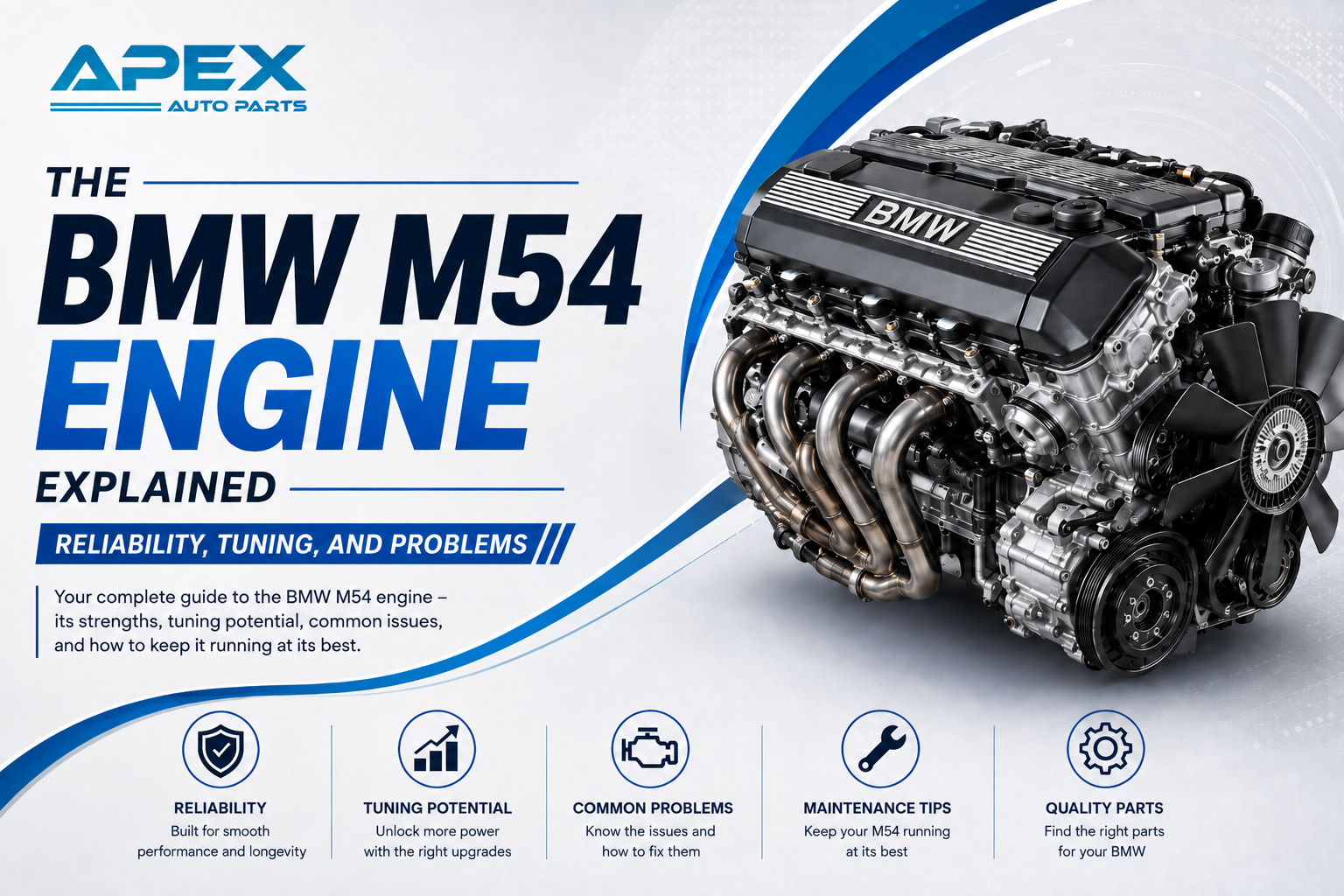
This guide explains how the BMW M54 works, which cars use it, how reliable it is, and which faults warrant attention. It also covers sensible BMW M54 tuning, what is involved in a BMW M54 turbo conversion, and what to check before buying replacement engine parts.
What Is the BMW M54 Engine?
The BMW M54 Engine is a naturally aspirated straight six petrol engine introduced around 2000. It followed the M52TU engine and was used before newer BMW six-cylinder engines, such as the N52, became more common.
BMW produced the M54 in three main sizes. The M54B22 had a capacity of about 2.2 liters, the M54B25 was a 2.5-liter version, and the M54B30 was the largest at about 3.0 liters.
Power depended on the model and market. The European M54B30 used in the E46 330i produced 231 hp, while the M54B25 in the E46 325i produced 192 hp. The 2.2 liter engine used in models such as the later E46 320i produced about 170 hp.
The engine has a straight-six layout, which means all six cylinders sit in a single line. This design is naturally well-balanced and helps the engine run with less vibration than many four-cylinder units.
BMW used a light alloy cylinder head and crankcase, Double VANOS variable camshaft control, an electronic throttle, and a controlled intake system. BMW’s technical training material states that the M54 was designed to maintain power and fuel economy while meeting stricter emissions targets.
What Makes the BMW M54 Different?
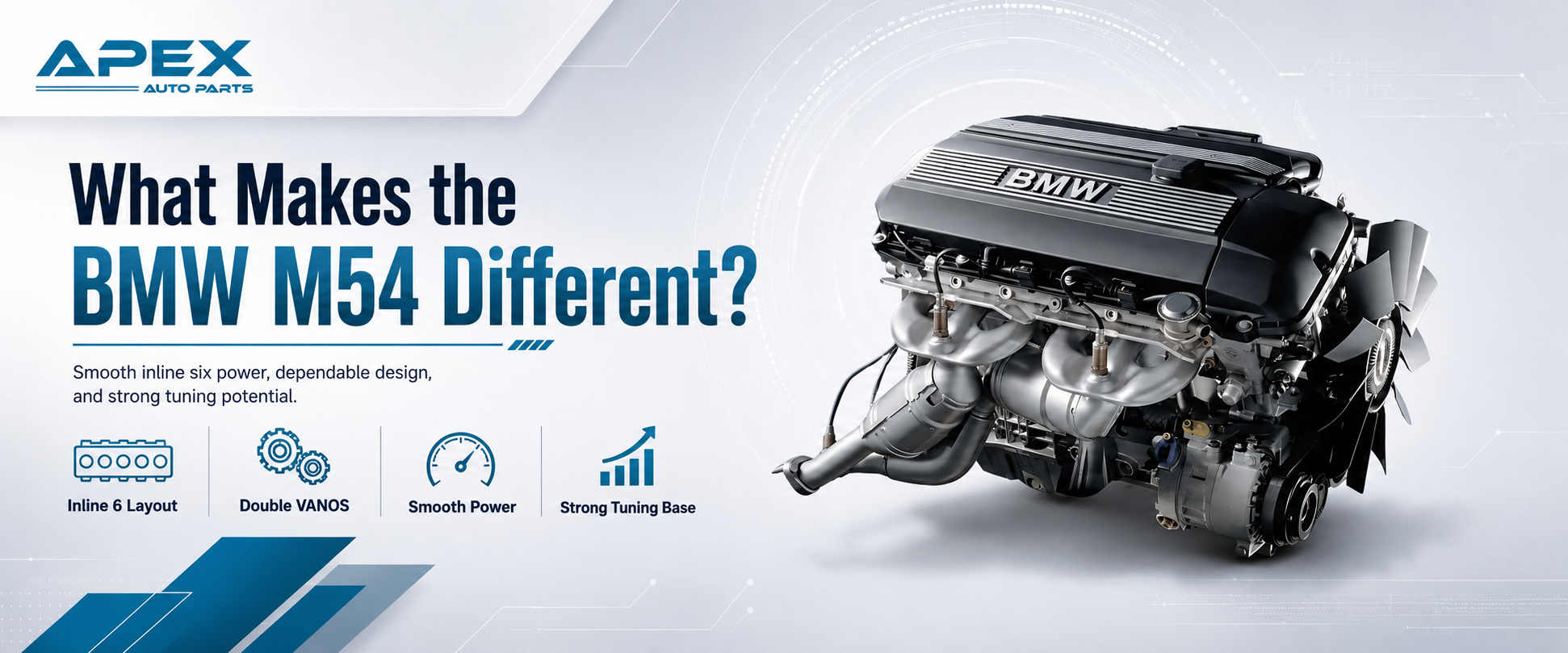
The engine’s appeal comes from the way several simple ideas work together. It does not use a factory turbocharger, direct petrol injection, or Valve tronic. This makes it less complicated than many newer BMW petrol engines.
Double VANOS changes the position of both camshafts. This helps the engine produce useful pulling power at lower speeds while still breathing well at higher engine speeds. BMW fitted the system to M54-powered models such as the E46 325i and E39 530i.
The intake manifold also changes how air reaches the engine. BMW’s training material explains that a resonance flap changes the effective intake path. At lower speeds, the longer path helps torque. At higher speeds, the flap opens to provide the extra air volume needed for power.
The electronic throttle allows the engine computer to control the throttle plate according to the driver’s request, traction control needs, cruise control, and safety checks. The MS43 engine management system constantly compares throttle position signals and can reduce engine power if it detects a serious fault.
This mix gives the BMW M54 its smooth response. It does not deliver the sudden push of a modern turbo engine. Instead, power builds steadily and predictably as engine speed rises.
Main BMW M54 Engine Versions
The M54B22 is the smallest version. It suits drivers who want the sound and smooth feel of a straight six but do not need the strongest acceleration. It was used in cars such as the E46 320i and Z3 2.2i. BMW introduced the M54B22 in the E46 320i in 2001, while the Z3 2.2i received the same engine family as of late 2000.
The M54B25 offers a useful middle ground. It was fitted to models such as the E46 325i, E39 525i, Z3 2.5i in some markets, and several Four Wheel Drive versions. The E46 325i produced 192 hp in European form.
The M54B30 is the version most enthusiasts want. It powered the E46 330i, E39 530i, Z3 3.0i, early Z4 3.0i, E53 X5 3.0i, and other models. BMW rated the European E46 330i at 231 hp, while its technical training information listed 300 Nm of torque for the M54B30.
The M54B30 also has a 10.2: 1 compression Ratio in BMW’s technical material. This helps normal engine response, but it becomes an important point when planning forced induction.
What BMW models have the M54 engine?
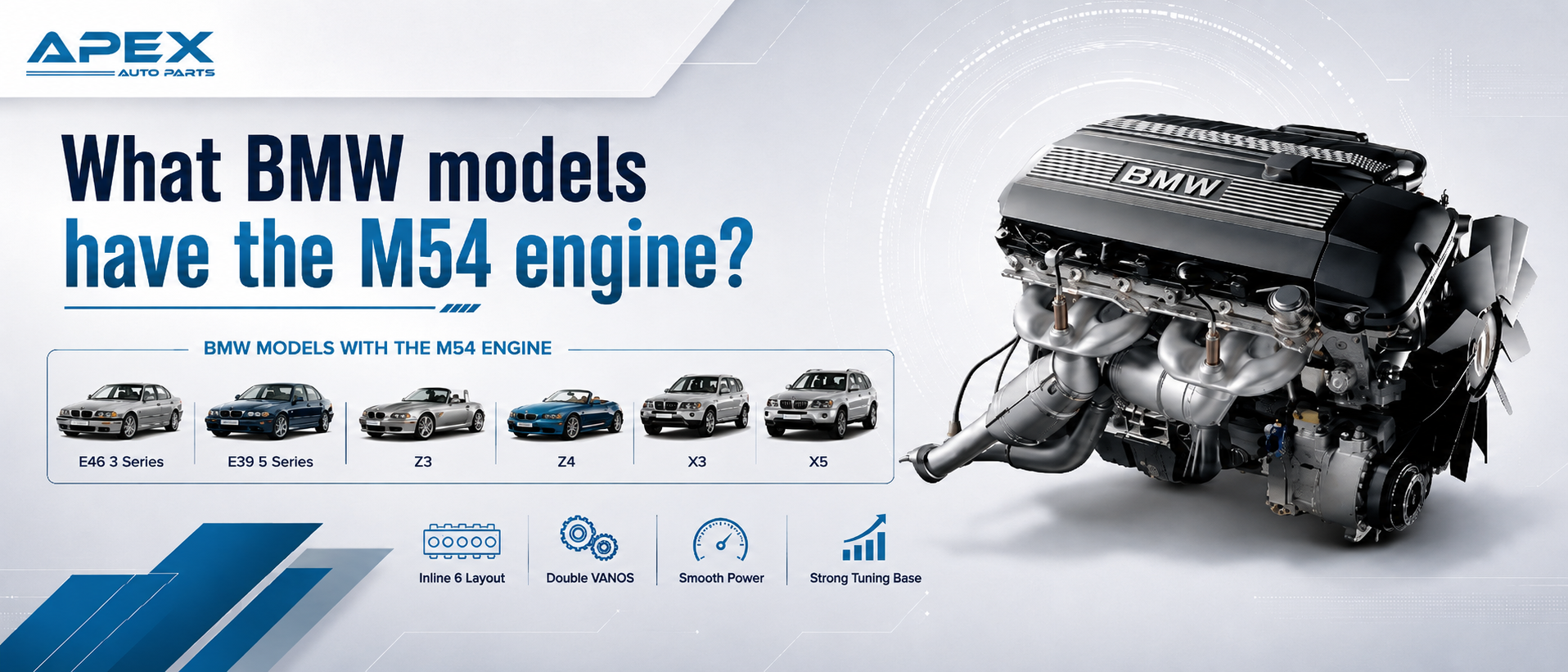
Drivers asking which BMW has the M54 engine need to check the model, market, production year, and engine code. BMW sometimes changed engines during the production life of the same model.
Major M54 applications include:
- E46 320i, 325i, 325xi, 325ti, 330i, 330xi and 330Ci
- E39 520i, 525i and 530i
- Z3 2.2i, 2.5i and 3.0i
- Early Z4 2.2i, 2.5i and 3.0i
- E53 X5 3.0i
- E83 X3 2.5i and 3.0i
- E65 730i in certain markets
- Some early E60 and E61 six-cylinder petrol models
BMW Group Classic confirms M54 use across the E46 325i and 330i, the E39 525i and 530i, the Z3 2.2i and 3.0i, and the E53 X5 3.0i. BMW also states that the E65 730i used the M54 already found in the 3 Series, 5 Series, and X5.
Do not order parts using the badge alone. A 325i from one year may use a different engine family from a later 325i. Check the VIN, engine code, production date, and original part number.
Is BMW M54 Reliability Really Good?
BMW M54 Reliability is generally strong when the engine is kept cool, properly lubricated, and free from major air leaks. The basic engine can handle high mileage because its design is not heavily stressed under standard conditions.
However, the engine’s reputation sometimes causes owners to ignore maintenance. They assume that every noise, leak, or warning light can wait. This is where small faults become serious.
A reliable engine is not the same as a maintenance-free engine. Most M54-powered cars are now around two decades old. Plastic connectors, rubber seals, vacuum hoses, cooling parts, pulleys, and electrical sensors can fail with age, even when the engine remains healthy.
A well-cared-for M54 should start cleanly, idle evenly, pull smoothly through the rev range, hold a steady temperature, and use a reasonable amount of oil. It should not require constant coolant top-ups or leave large oil marks after every journey.
Service history matters more than mileage alone. A 150,000-mile car with regular oil changes and cooling repairs may be safer than a 90,000-mile example with no invoices and several years of missed maintenance.
Main BMW M54 engine problems?
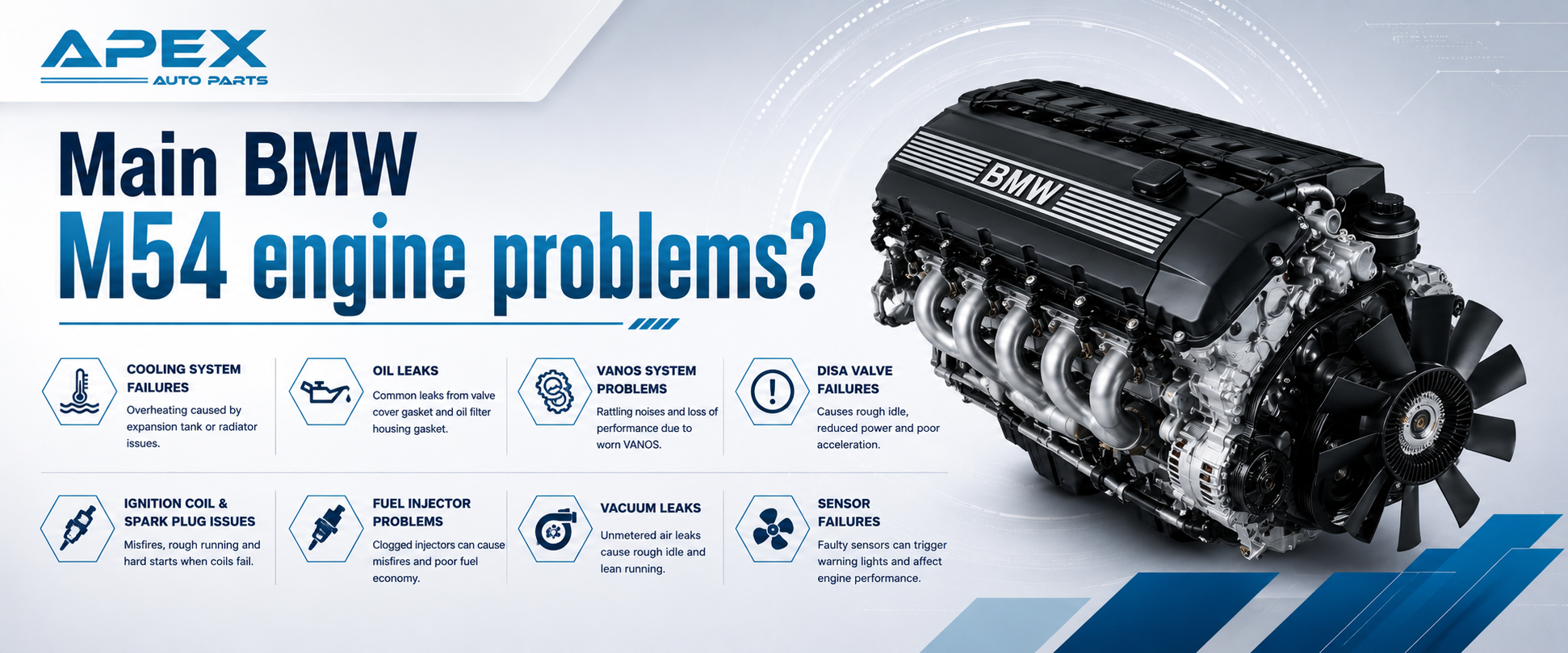
The most common BMW M54 engine problems are usually related to the systems around the engine rather than a broken crankshaft or damaged block.
A mechanic should first look for cooling faults, crankcase ventilation trouble, air leaks, worn intake parts, oil leaks, ignition faults, and poor previous repairs.
Cooling System Age and Overheating
Cooling problems deserve urgent attention because overheating can damage an aluminum cylinder head. The driver may first notice a low coolant warning, a sweet smell, coolant marks around the expansion tank, an unstable temperature gauge, or weak cabin heating.
A proper inspection should cover the expansion tank, radiator, coolant hoses, thermostat, water pump, cap, fan operation, and any plastic connections. A small leak can draw air into the system, making the cooling problem harder to diagnose.
Do not simply top up the coolant every week. Find the leak. An M54 that has overheated should also be checked for cooling system pressure, combustion gas in the coolant, poor compression, and signs of cylinder head damage.
If buying an M54 BMW, ask whether the cooling system has been renewed. An invoice showing the exact parts is more useful than a seller's claim that it was “checked”.
Crankcase Ventilation Problems
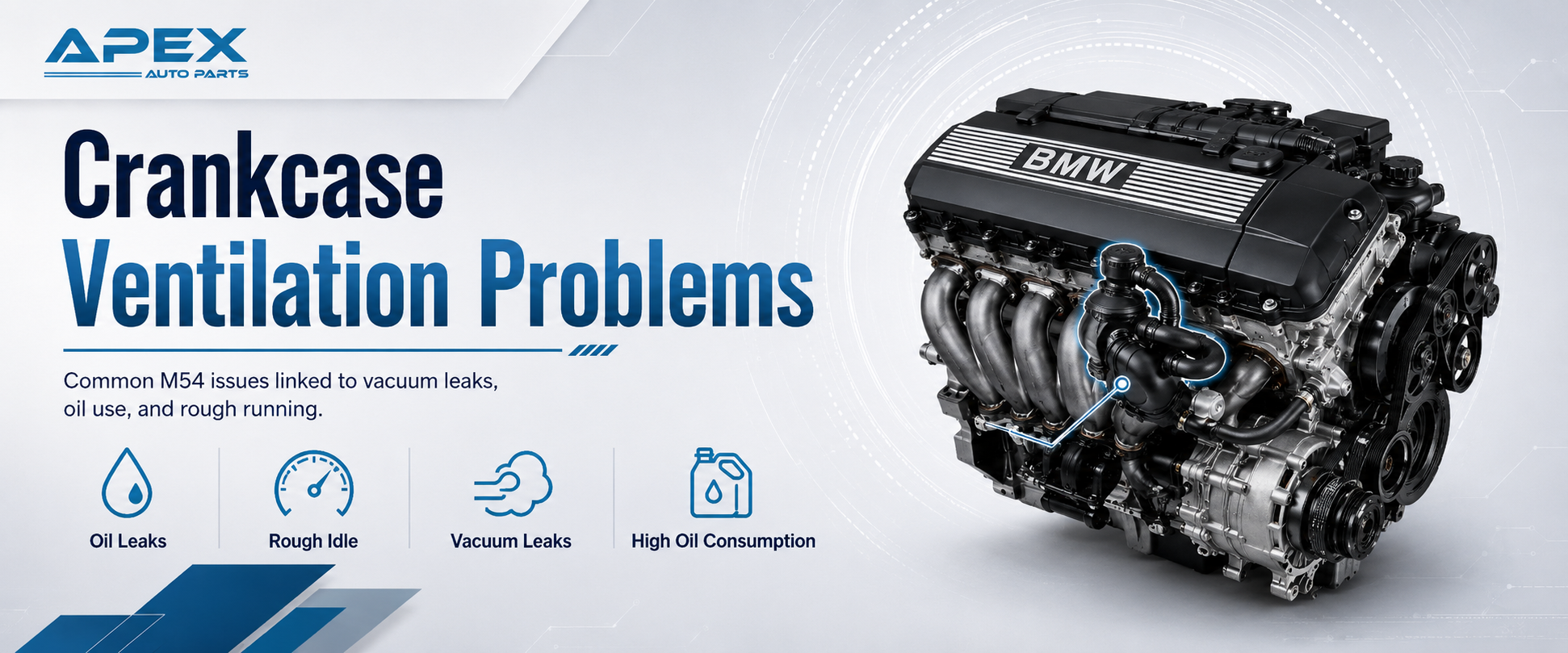
The crankcase ventilation system separates oil vapor and controls pressure inside the engine. When the pressure control valve or connected hoses fail, the engine may develop oil use, rough idle, whistling noises, mixture faults, or oil leaks.
BMW service information states that a blocked or defective crankcase ventilation system can damage oil seals, increase oil consumption, put oil into the intake, and cause rough running or misfires.
In cold-climate versions, moisture can collect inside the system. Sludge and blocked hoses may stop the system from working properly. A mechanic should inspect the valve, separator, hoses, dipstick return path, intake pipes, and engine vacuum rather than changing one hose and hoping for the best.
Heavy suction at the oil cap, a loud honking sound, blue smoke, or oil in the intake can point towards a ventilation problem. These signs can also have other causes, so crankcase pressure should be tested.
Vacuum Leaks and Split Intake Boots
Air entering after the mass air sensor is not measured correctly by the engine computer. This can make the mixture too lean, leading to a rough idle, hesitation, misfires, and engine warning lights.
The rubber intake boots can split, especially around smaller branches that are hard to see from above. Vacuum hoses, manifold seals, brake vacuum connections, and crankcase pipes may also leak.
A smoke test is often the fastest way to find these faults. Spraying chemicals around a running engine is less controlled and may be unsafe.
Do not replace the airflow meter just because the engine has lean mixture codes. Check for unmetered air, fuel pressure, injector issues, and exhaust leaks first.
Intake Resonance Flap Problems
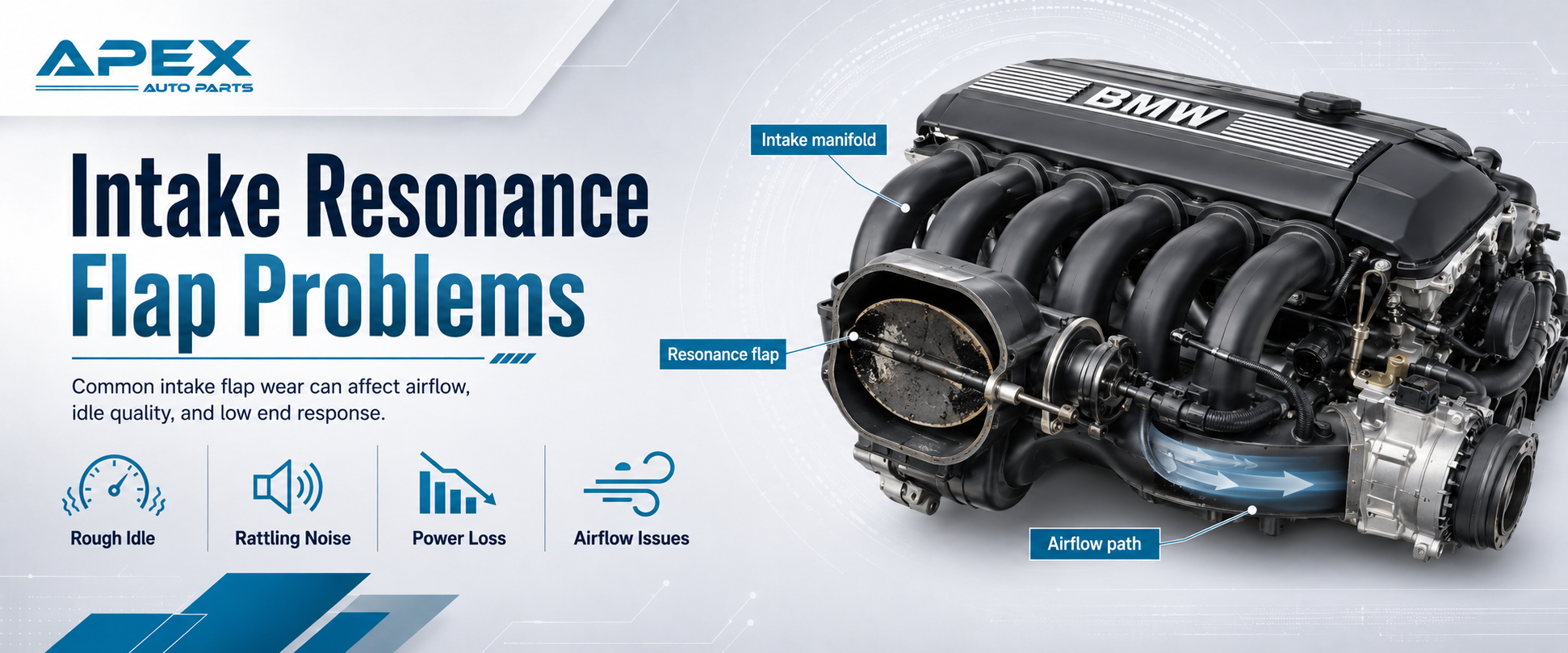
Owners often know the intake resonance flap as the DISA valve. It changes the intake path to support low-speed torque and high-speed airflow.
BMW’s technical training material explains that the flap remains closed throughout much of the lower-speed range and opens as engine speed rises. This helps the engine provide torque at lower speeds and additional power at higher revs.
As the assembly ages, the flap, pivot, seal, or actuator can wear. Possible signs include a rattle from the intake manifold, an air leak, uneven power delivery, or reduced low-speed pull.
The unit should be removed and inspected if a mechanic suspects damage. Loose internal pieces should not be ignored, as they are close to the engine intake.
Double VANOS Wear
Double VANOS helps the BMW M54 Engine produce smooth power across a wide speed range. When it loses effectiveness, the engine may feel flat at lower speeds, hesitate, idle poorly when cold, or use more fuel.
VANOS symptoms can be mistaken for vacuum leaks, ignition faults, camshaft position sensor faults, a worn intake flap, or low compression. Diagnosis should include fault codes, live camshaft readings, oil condition, engine timing, and a full intake check.
Old or dirty oil can make variable camshaft systems less responsive. Changing parts without checking oil supply and fault data may waste money.
Oil Leaks
Oil leaks are common inspection points on older M54 engines. A mechanic will usually check the rocker cover gasket, oil filter housing area, sump gasket, front and rear crank seals, VANOS oil line, and crankcase ventilation pipes.
Oil from the oil filter housing area can spread across the front of the engine and reach belts or hoses. A rocker cover leak may drip onto the exhaust side, causing a burning smell.
Clean the area before deciding where the leak begins. Oil can travel across the engine, making the lowest wet point appear to be the source even when the leak started higher up.
Crankcase pressure should also be checked. BMW notes that incorrect crankcase pressure can damage engine oil seals and raise oil consumption.
Oil Consumption
Some oil use may be normal, especially in a high-mileage engine, but sudden or excessive oil use warrants investigation.
BMW’s own service guidance tells technicians to check the maintenance history, external leaks, oil level, oil quality, driving conditions, and crankcase ventilation before performing major internal engine work.
Blue smoke after long idling may suggest oil entering through valve seals or the intake system. Smoke during hard acceleration may point towards piston ring wear, although a proper compression and leak test is needed.
Never overfill the engine to reduce how often you top it up. BMW warns that an excessively high oil level can increase oil consumption because the oil is thrown against the cylinder walls.
Ignition Coils, Spark Plugs, and Misfires
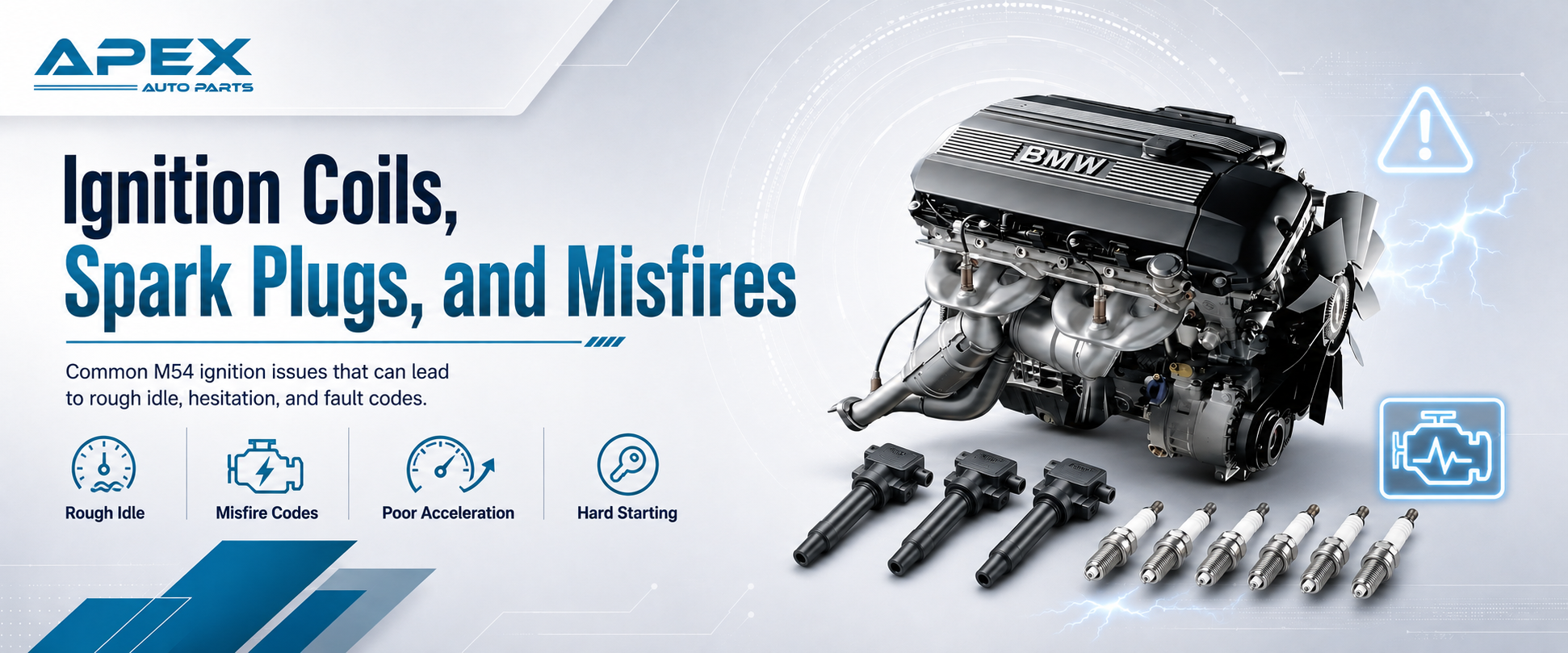
A misfire does not automatically mean the engine is worn out. Spark plugs, ignition coils, air leaks, injectors, low fuel pressure, sensors, and compression can all cause rough running.
Read the fault codes and note whether the misfire persists on a single cylinder. A mechanic can swap a coil with another cylinder and see whether the fault follows it.
Inspect the spark plug as well. Oil in the plug well may come from a rocker cover seal. A wet fuel smell may point towards failed ignition, while a very clean plug can suggest coolant entry.
Repeatedly fitting coils without finding the main cause can become expensive. Diagnose the fault rather than using new parts as test equipment.
Why Diagnosis Matters Before Buying Parts?
Many M54 symptoms overlap. A weak engine may have a split intake boot, a worn resonance flap, a VANOS issue, a blocked ventilation system, low fuel pressure, or a failing airflow sensor.
A scan tool is useful, but a fault code is not a final diagnosis. Lean mixture codes do not always mean the oxygen sensors are faulty. Misfire codes do not always mean the coils are bad.
A sensible process should include:
- Checking all stored and pending fault codes
- Reading fuel trim and airflow data
- Performing an intake smoke test
- Checking crankcase pressure
- Testing cooling system pressure
- Inspecting spark plugs and coils
- Confirming fuel pressure where needed
- Checking compression when basic tests do not find the fault
This approach protects the owner from having to replace good parts. It also helps prevent a new part from being damaged by an unfixed fault.
How to Improve BMW M54 Reliability?
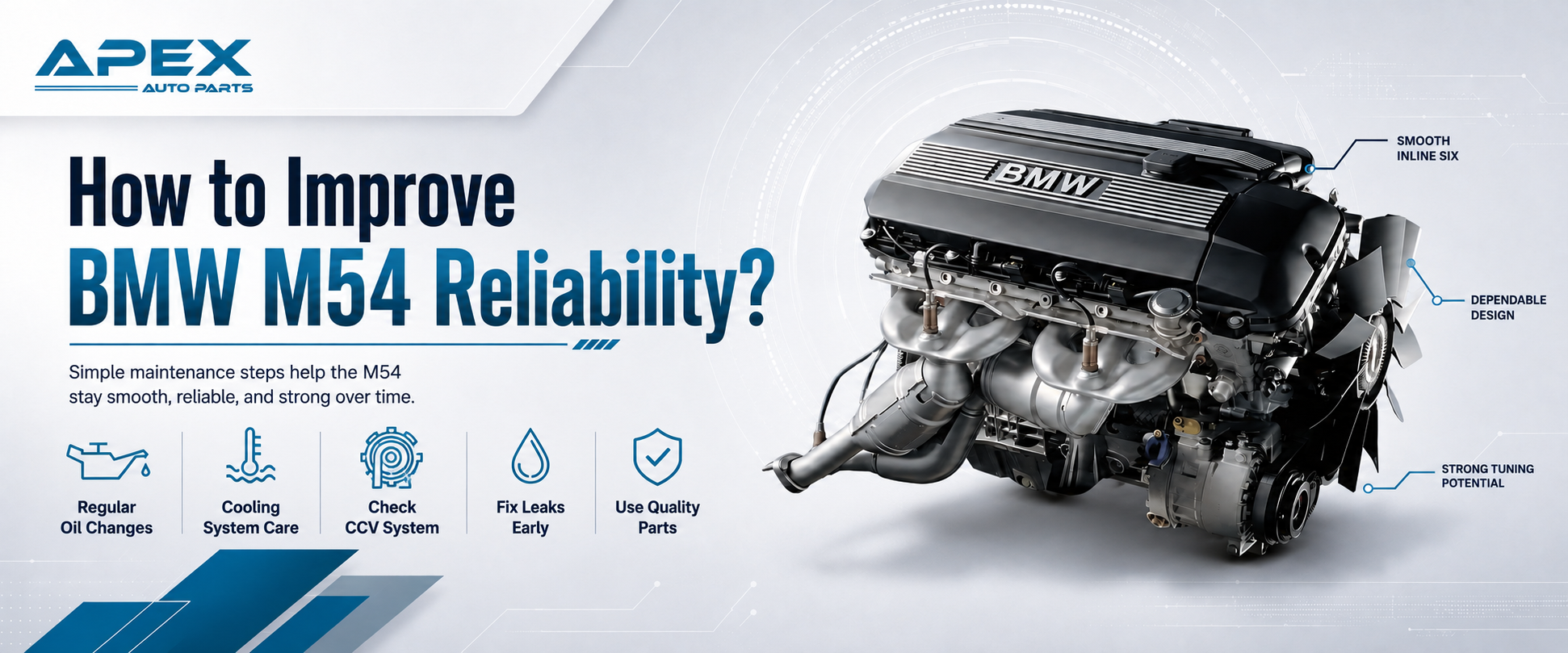
Good maintenance is the best way to protect BMW M54 Reliability. The engine does not need unusual treatment, but it does need faults fixed before they spread.
Use the correct oil specification and a good quality filter. The safest oil choice depends on the exact vehicle, climate, mileage, and BMW approval. Check reliable service information using the VIN.
Do not stretch oil changes simply because the dashboard allows a long interval. Short journeys, city driving, high engine speeds, fuel quality, and extreme temperatures can accelerate oil aging. BMW service information notes that operating conditions and long service intervals may accelerate oil degradation and engine wear.
Check the coolant level only when the engine is cold. Investigate any loss. A small leak today can become a serious overheat later.
Listen for intake rattles, belt noises, and new whistling sounds. Check oil leaks before they reach rubber belts or hot exhaust parts.
A practical maintenance plan includes regular attention to:
- Engine oil and filter
- Coolant level and cooling pressure
- Intake boots and vacuum hoses
- Crankcase ventilation
- Spark plugs and coils
- Belts, tensioners, and pulleys
- Oil leaks around the engine
- Fault codes and fuel trim readings
Preventive repairs should be based on condition and service history. Replacing every part at random is not good maintenance.
Is BMW M54 tuning Worth It?
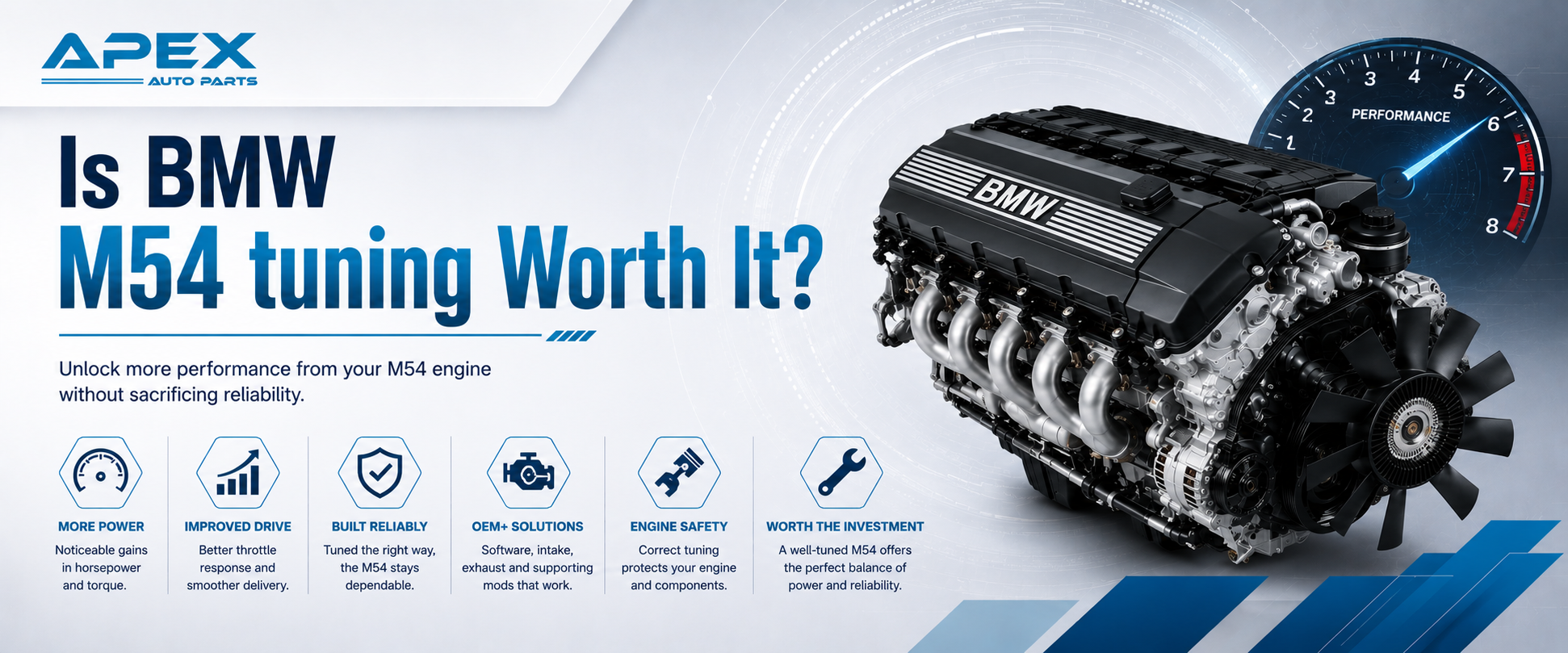
BMW M54 tuning can improve sound, throttle feel, and driving character, but naturally aspirated power gains are usually limited unless the engine receives major mechanical work.
Before making any modifications, bring the engine back to full health. A worn VANOS system, an air leak, a weak fuel pump, dirty injectors, low compression, or a damaged intake flap will reduce performance. Tuning a faulty engine normally makes the fault more obvious.
A basic naturally aspirated setup may include a well-designed intake, a freer-flowing exhaust, suitable exhaust manifolds, and careful ECU calibration. Results depend on engine size, parts used, fuel quality, and engine condition.
Cheap open-air filters may draw hot air from the engine bay and make more noise without delivering useful airflow. Removing factory intake parts without understanding how the resonance system works can also hurt low-speed torque.
BMW designed the intake flap to adjust airflow for both lower-speed torque and higher-speed power. Any modifications to the intake should respect how the original system controls airflow.
More serious BMW M54 tuning may involve camshafts, cylinder head work, a different intake manifold, higher engine speeds, and custom mapping. Costs rise quickly, while the car may become less pleasant for normal road use.
For many owners, the best upgrade is restoring lost factory performance. A healthy M54B30 in a light E46 or Z3 already delivers smooth, enjoyable power.
What Should Owners Know About a BMW M54 Turbo Build?
A BMW M54 turbo conversion can produce much more power than standard intake and exhaust modifications. However, it is not a simple bolt-on job.
The M54 was designed as a naturally aspirated engine. BMW technical information lists a 10.2: 1 compression ratio for the M54B30. Adding boost increases cylinder pressure and heat, so the tune, fuel supply, ignition timing, cooling, and engine condition become critical.
A safe project normally requires a properly sized turbo, exhaust manifold, wastegate, intercooler, pipework, oil feed and return, larger fuel injectors, a suitable fuel pump, engine management, exhaust work, and careful tuning.
The clutch or automatic gearbox may also struggle with the extra torque. Engine mounts, differential bushes, driveshaft components, brakes, tires, and cooling should be considered part of the overall build.
Before fitting a BMW M54 turbo, check compression and cylinder leakage. Confirm stable oil pressure, good cooling, healthy crankcase ventilation, and no serious oil use.
There is no single safe boost level for every M54. Engine mileage, fuel, compression, mapping, turbo size, charge temperature, and driving use all matter. A figure that works on one car may damage another.
For a road car, a modest and well-controlled build is usually wiser than chasing the largest possible power figure. Poor tuning can cause detonation, broken ring lands, head gasket damage, overheating, or gearbox failure.
What to Check Before Buying an M54 BMW?
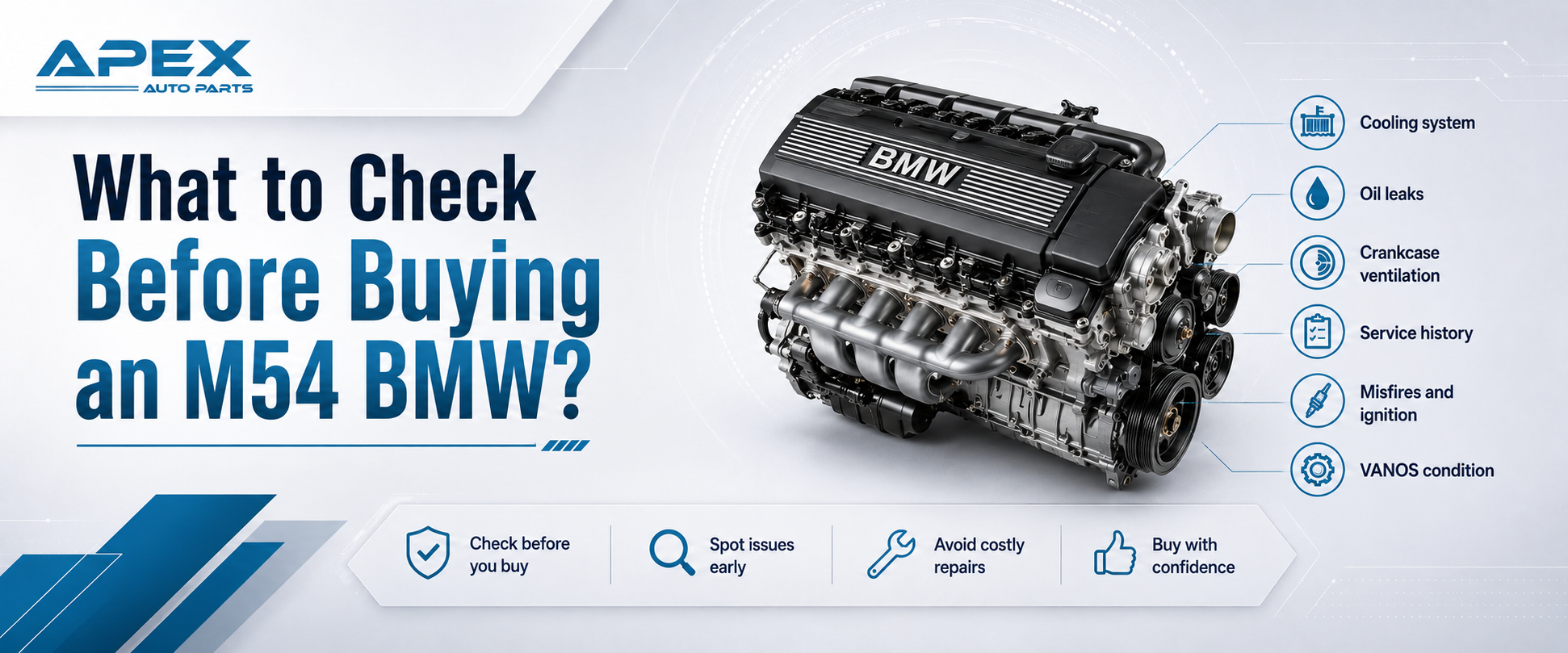
Start the engine from cold. A warm engine can hide starting problems, smoke, rattles, and poor idle.
The idle should settle without strong shaking. Listen for whistling, intake rattles, belt noises, tapping, or knocking. A light injector sound is different from a deep mechanical knock.
Check the coolant level before the test drive. Look for dried coolant marks around the expansion tank, radiator, thermostat area, hoses, and under the car.
Inspect the engine for oil leaks. A freshly cleaned engine is not always a good sign. Ask why it was cleaned and check again after the test drive.
During the drive, the engine should pull evenly. Hesitation, low-speed torque weakness, misfires, or an engine warning light require diagnosis.
After the drive, allow the engine to idle. Look for smoke and check for coolant pressure problems. Do not open a hot cooling system.
Ask for invoices covering oil services, cooling work, crankcase ventilation, rocker cover repairs, intake parts, spark plugs, and any VANOS work. Proof matters more than promises.
Choosing the Correct BMW M54 Parts
The BMW M54 was installed in many models, and parts can vary by engine size, body type, market, production date, and emissions version.
A gasket, coolant hose, pulley, sensor, intake pipe, or ventilation part that fits one M54 car may not fit another. The M54B22, M54B25, and M54B30 also use several different parts.
Provide the registration number, VIN, engine code, and old part number when possible. Check whether the car has an automatic or manual gearbox and whether it is a normal Rear Wheel Drive or Four Wheel Drive model.
At Apex Auto Parts, owners, garages, mechanics, and engine builders can provide vehicle details when searching for BMW engine components. Accurate identification helps reduce incorrect orders and delays during repairs.
Parts selection should come after diagnosis. The right component will not resolve a fault caused by another system.
Final Thoughts
The BMW M54 Engine remains a strong choice for drivers who want a smooth six-cylinder BMW without the added pressure and heat of a factory-turbo engine.
Its internal design has a good reputation, but age-related components should not be overlooked. Cooling faults, crankcase ventilation issues, intake leaks, oil leaks, worn resonance flaps, ignition issues, and missed servicing account for many complaints linked to BMW M54 engine problems.
Good BMW M54 Reliability depends on early diagnosis. Fix coolant loss before overheating. Find the source of oil use. Smoke tests the intake instead of guessing. Check crankcase pressure before replacing seals.
Sensible BMW M54 tuning can improve the driving experience, but large, naturally aspirated gains are costly. A BMW M54 turbo project can deliver far more power, though it requires expert planning and careful calibration.
A healthy standard engine is still the best starting point. Restore it first, understand how it behaves, and only then decide whether tuning is worth the extra cost.
FAQS
1. Is the BMW M54 Engine reliable?
The BMW M54 Engine can be very reliable when the cooling, oil, intake, and crankcase ventilation systems are maintained. The main engine is strong, but most cars using it are now old. Service history, overheating history, oil use, and the quality of previous repairs matter more than mileage alone.
2. What are the most common BMW M54 engine problems?
Common BMW M54 engine problems include coolant leaks, aging water pumps, split intake boots, crankcase ventilation faults, oil leaks, worn intake resonance flaps, misfires, and reduced VANOS performance. Most of these faults can be repaired without replacing the complete engine when they are found and diagnosed early.
3. What BMW has the M54 engine?
Drivers asking what BMW has the m54 engine should look at models such as the E46 320i, 325i and 330i, E39 520i, 525i and 530i, Z3 2.2i and 3.0i, early Z4 models, X3 2.5i and 3.0i, X5 3.0i, and certain 730i models.
4. How long can a BMW M54 last?
A BMW M54 can cover high mileage when it receives regular oil changes, avoids overheating, and has air and coolant leaks repaired early. There is no fixed lifespan. A neglected, low-mileage engine may fail before a properly maintained engine that has traveled much farther.
5. Why does my BMW M54 Engine use oil?
Oil use may come from external leaks, crankcase ventilation faults, valve seal leakage, piston ring wear, incorrect oil, overfilling, or demanding driving conditions. Start by checking for leaks and testing the ventilation system. BMW advises completing these basic checks before deciding that major internal engine work is required.
6. Is BMW M54 tuning worth doing?
Basic BMW M54 tuning may improve throttle response, sound, and high-speed breathing, but large power gains are difficult to achieve without major work. Repair air leaks, VANOS problems, ignition faults, and fuel issues first. Restoring lost factory power often gives better value than fitting several cheap performance parts.
7. Can the standard M54 handle a BMW m54 turbo conversion?
A standard engine may support a carefully planned BMW M54 turbo build, but no boost level is safe for every engine. Compression, mileage, fuel quality, cooling, crankcase ventilation, mapping, and charge temperature matter. Test the engine first and use a tuner with real M54 experience.
8. Which BMW M54 version is best?
The M54B30 is usually the most wanted version because it offers the strongest standard power and torque. The M54B25 provides a good balance of performance and running costs, while the M54B22 offers smooth six-cylinder driving with lower output. Condition is more important than choosing the largest engine.
9. Does the BMW M54 Engine have a timing belt?
No. The BMW M54 Engine uses a timing chain rather than a rubber timing belt. The chain is designed for long service, but correct oil care still matters. Rattling, camshaft timing faults, or poor running should be diagnosed rather than automatically blamed on the chain.
10. What should I check before buying an M54 BMW?
Check cold starting, idle quality, coolant level, oil leaks, exhaust smoke, warning lights, intake noises, and smooth acceleration. Ask for proof of oil and cooling system work. A compression test, diagnostic scan, smoke test, and cooling pressure test provide useful protection before buying a high-mileage example.
References:
archive org
ge39