
 info@apexautoparts.co.uk
 +44 203 915 7535
 Safe & Fast Shipping
 Whish List
 Compare
 Sign In

The BMW 3 Series has been one of BMW’s most important cars for decades. Drivers like it because it mixes comfort, handling, strong engines, and a premium feel without becoming as large as a 5 Series. BMW says the 3 Series has now passed seven generations, showing how long the model has been central to the brand.
Many people search for BMW 3 Series, although BMW officially calls the car the BMW 3 Series. Whatever name you use, engine condition is one of the most important things to check when buying or maintaining an engine.
The difficult part is that there is no single BMW 3 Series Engine. Over the years, BMW has fitted naturally aspirated petrol engines, turbocharged petrol engines, four-cylinder diesels, six-cylinder diesels, and newer mild-hybrid systems. Some are simple and can last a very long time. Others deliver much more power but need closer attention to oil, cooling, timing parts, fuel systems, and turbochargers.
Good BMW 3 Series Engine Reliability therefore depends on the exact engine, how it has been serviced, how it has been driven, and whether small faults were repaired early.
At Apex Auto Parts, we see the same basic rule across engine repairs: correct diagnosis must come before ordering parts. A leaking gasket, a weak fuel pump, a stretched timing chain, a cooling fault, or a damaged breather can produce similar symptoms. Replacing parts without confirming the cause can waste money and leave the original problem untouched.
This guide explains the main BMW 3 Series engine families, the most important BMW 3 Series engine problems, petrol and diesel reliability, warning signs, maintenance, BMW 3 Series engine tuning, and what owners should check before buying.
Which BMW 3 Series Engines Have Been Used Over the Years?
BMW has changed its engine range many times as the 3 Series has developed.
Older E46 cars became well known for BMW straight six petrol engines such as the M54. The later E90 generation introduced engines including the N52 naturally aspirated six-cylinder, N54 turbocharged six-cylinder, several four-cylinder petrol units, and diesel engines.
BMW’s own history of the fifth generation 3 Series shows how quickly engine technology changed. The E90 era included a 320d four-cylinder diesel with common-rail injection, naturally aspirated 325i and 330i six-cylinder petrol engines, and the 335i with a 3.0-liter turbocharged six-cylinder engine producing 306 hp.
The F30 generation moved further towards turbocharging. Four-cylinder turbo petrol engines became more important, while diesel versions remained very popular in the UK. BMW later updated the range again, including the 340i with a newer 3.0-liter turbocharged six-cylinder engine.
The current G20 generation continues the move towards smaller turbo engines, electrification, and mild-hybrid technology. BMW’s later 3 Series range includes four-cylinder petrol engines, six-cylinder performance versions, and electrified models.
This history matters because reliability advice for one BMW 3 Series engine may be completely wrong for another.
What Makes a BMW 3 Series Engine Reliable?
A reliable engine does not need to be completely free from faults. Very few engines are.
What matters is whether faults are predictable, repairable, and unlikely to destroy the engine when normal maintenance is followed.
From a mechanic’s point of view, several things matter most.
A reliable engine needs clean oil reaching the bearings, timing parts, turbocharger, and valve gear. It needs a cooling system that can control temperature. Fuel pressure must remain correct. The crankcase ventilation system must control internal pressure, and the timing system must keep the valves and pistons working together correctly.
BMW’s own technical information explains that its crankcase ventilation systems are designed to maintain a slight vacuum inside the engine. Problems in that system can increase oil use, push oil into the intake, and damage seals.
Even the strongest engine can fail when these basic systems are ignored.
Which Older Petrol BMW 3 Series Engines Are the Most Reliable?
For drivers wanting an older petrol car, naturally aspirated six-cylinder engines are often attractive because they avoid the extra heat and pressure created by turbochargers.
The E90 N52 is one of the engines worth considering.
BMW used naturally aspirated six-cylinder petrol engines extensively during the fifth-generation 3 Series. BMW’s period information lists the 325i and 330i versions and notes that these engines featured advanced valve control and lightweight construction.
The N52 can cover high mileage when properly serviced, but age now matters as much as basic engine design.
Owners should pay attention to cooling faults, oil leaks, crankcase ventilation problems, VANOS-related faults, and electrical cooling components.
If you are viewing an older 325i, 328i, or 330i, do not judge it simply because the engine sounds smooth while warm. Ask to hear it from the cold. Check the coolant level before starting, inspect underneath for oil, and look for evidence that cooling repairs have already been completed.
A fifteen-year-old BMW with 120,000 miles and a strong record may be a safer purchase than an 80,000-mile car with missing history.
What About the BMW M54 Engine?
The M54 fitted to earlier 3 Series models remains popular with BMW enthusiasts.
Its basic engine structure can be durable, but the age of cars using it means owners now need to think about the complete engine system rather than the block alone.
Cooling parts, hoses, seals, crankcase ventilation components, oil leaks, vacuum pipes, and sensors may all be old.
The engine should idle smoothly and pull cleanly without excessive smoke. Coolant loss deserves immediate investigation.
With an older BMW, replacing one failed cooling component while leaving several other original parts in poor condition can lead to another repair shortly afterward. A mechanic should look at the whole cooling system rather than treating each leak as a separate event.
N54 Reliability: Fast but More Demanding
The N54 changed the character of the 3 Series.
BMW used its 3.0-liter twin-turbo six-cylinder engine in models including the 335i. BMW described the engine as producing 306 hp when it was introduced in the fifth-generation 3 Series.
Its performance and tuning potential are excellent, but ownership needs more care than with a simple naturally aspirated petrol engine.
One well-documented concern is the high-pressure fuel pump. BMW extended the warranty for the high-pressure fuel pump on eligible N54-equipped E90, E92, and E93 vehicles in the United States to 10 years or 120,000 miles.
A weak fuel system may cause long starting, hesitation, warning lights, poor power, or uneven running.
Other areas that deserve checking include injectors, ignition coils, plugs, turbo condition, boost leaks, oil leaks, cooling system, and carbon buildup in the intake system.
The important lesson is not that every N54 is unreliable. It is that buying a poorly maintained one because the purchase price looks attractive can become very expensive.
Is the N55 Better for Reliability?
The N55 replaced the N54 in many applications and retained the strong six-cylinder turbocharged character.
For a road car, a well-maintained N55 can be a good balance between performance and everyday use.
However, buyers still need to check for oil leaks, cooling, ignition parts, fuel pressure, crankcase breathing, and turbo-related faults.
A rough idle does not automatically mean the engine itself is damaged. A weak coil, a worn plug, a vacuum leak, a breather problem, an injector fault, or a fuel pressure issue may cause similar behavior.
That is why diagnostic testing matters before expensive engine work begins.
N20 Four Cylinder Petrol: Timing Chain Needs Attention
The N20 delivered strong performance from a smaller four-cylinder turbocharged engine and appeared in F30-generation cars such as the 328i.
The important reliability issue is the timing system.
BMW of North America issued a component warranty extension covering the timing chain and oil pump drive chain on eligible N20 and N26 vehicles. The bulletin also describes a possible whining noise from the lower engine area caused by wear in the oil pump chain drive sprockets.
This does not mean every N20 engine will fail.
It does mean buyers should take timing noise seriously.
Listen carefully when the engine starts from cold. Any unusual whine, rattle, or scrape should be investigated rather than dismissed, even if the car still drives normally.
If timing wear progresses far enough, the repair becomes much more serious than changing the guides and chains early on.
Modern B48 Petrol Engine Reliability
The B48 is one of BMW’s newer four-cylinder petrol engine families and is used across many modern BMW models, including versions of the G20 3 Series.
For many owners it offers a good mix of performance, economy, and daily usability.
But newer does not mean maintenance-free.
BMW issued a technical bulletin in late 2025 covering certain vehicles, including the G20 3 Series, fitted with specific B48 variants, in which coolant could leak from the oil filter housing area. BMW identified deformation around an insert in the housing as a possible cause and introduced a repair involving redesigned parts.
This is a useful example of how BMW 3 Series Engine Reliability should be judged. A known repair issue does not make the whole engine bad. What matters is whether the fault is found early and repaired correctly.
If a B48 powered car is losing coolant, do not simply keep topping up the tank. Pressure tests the system and locates the leak.
B58 Six Cylinder Reliability
The B58 is one of the most desirable modern BMW six-cylinder engines.
It replaced the earlier N55 in several models and became the basis for higher performance versions of the 3 Series.
For a buyer who wants strong performance, it is one of the better modern choices when service history is good.
The engine is still complex. Cooling systems, turbocharger components, fuel delivery, electronic valves, seals, hoses, and sensors all need to work together.
Owners planning modifications should be especially careful. An engine producing standard power may tolerate a small weakness that becomes apparent once boost and torque are increased.
BMW Diesel Engines: Good for the Right Driver
Diesel engines have always played a major role in the UK 3 Series market.
They suit drivers covering longer distances because they produce high torque at lower engine speeds and typically provide better fuel economy than equivalent petrol engines.
However, modern diesel reliability depends heavily on how the car is used.
A driver completing long motorway trips gives the exhaust system a better opportunity to reach normal operating temperature. A car completing repeated short journeys may struggle more with EGR contamination and diesel particle filter regeneration.
Diesel buyers should therefore choose the engine that best suits their driving pattern, not simply because diesel fuel economy looks attractive.
N47 Diesel Problems
The N47 is one of the BMW diesel engines that deserves careful inspection.
Timing chain concerns are well known in the wider BMW ownership community, and BMW UK has previously published information about extended timing chain warranty coverage for selected models.
Later N47T engines also appeared in official BMW campaigns involving diesel fuel and emissions components. BMW issued an EGR cooler safety recall covering certain N47 vehicles, while separate warranty extensions covered items such as injectors and diesel particulate sensors on eligible vehicles in the United States.
For an N47-powered 3 Series, check:
- Timing chain noise, especially during cold starting
- EGR system condition
- DPF history
- Injector behavior
- Turbo boost
- Oil leaks
- Cooling system condition
Do not assume a diesel rattle is normal just because the engine still performs well.
Common BMW 3 Series Engine problems
Different generations have different weaknesses, but several BMW 3 Series Engine problems appear repeatedly across petrol and diesel cars.
Oil leaks are common as seals age. A small leak from the upper engine may spread down the block, making it difficult to find the real source.
Cooling problems are another major concern. Coolant leaks should never be ignored. An engine that repeatedly loses coolant needs pressure testing.
Turbo engines may suffer from boost leaks, worn hoses, actuator faults, or oil supply problems. A loss of power does not automatically mean the turbocharger needs to be replaced.
Petrol cars may develop ignition coil and spark plug faults. Diesel cars may experience issues with the EGR, injectors, DPF, or fuel pressure.
Timing system noise requires fast diagnosis, particularly on engine families with known chain concerns.
The main warning signs worth investigating are:
- Knocking, rattling, or whining noises
- Blue or white exhaust smoke
- Repeated coolant loss
- Heavy oil consumption
- Rough starting
- Misfires under acceleration
- Loss of turbo boost
- Engine warning messages
- Metal inside the oil filter
- Rising engine temperature
A warning light tells you where to begin testing. It does not tell you which part to buy.
Oil Leaks Should Not Be Treated as Normal
BMW engines often develop oil leaks with age, but that does not mean owners should accept them.
Oil can reach hot exhaust parts and create smoke or a burning smell. It may also damage rubber hoses and other components.
More importantly, a falling oil level reduces the protection available to bearings, timing parts, and turbochargers.
When an engine is oily, clean the affected area first. Run the engine, inspect again, and locate the highest fresh point of leakage.
Replacing several gaskets based on guesswork is rarely a good repair method.
Cooling System Problems Can Destroy a Good Engine
Overheating can turn a repairable BMW into an engine replacement job.
The cooling system includes much more than the radiator. Water pumps, thermostats, hoses, expansion tanks, seals, electrical connectors, sensors, and coolant passages all matter.
BMW has issued safety and technical information regarding electric coolant pump systems on certain 3 Series vehicles, highlighting why cooling faults require proper diagnosis rather than repeated topping up.
If coolant disappears without an obvious puddle, pressure testing should be the next step.
Never assume that coolant loss is harmless because the temperature warning has not appeared yet.
What Should BMW 3 series convertible Buyers Check?
A used BMW 3 Series Convertible needs the same engine checks as the saloon, but there are a few extra things worth considering.
The E93 3 Series Convertible arrived in 2007 with BMW’s first electrically operated folding hard top. Initial UK models included the 325i and 335i, with other petrol and diesel choices following later.
The 335i Convertible used the more demanding turbocharged petrol engine, while naturally aspirated versions may appeal to buyers seeking simpler ownership.
When inspecting an E93, engine condition is only part of the purchase. Battery health matters because the roof system relies on electrical power. Check roof operation, boot seals, drainage, water ingress, and electrical behavior.
BMW later moved its two-door coupe and convertible models into the 4 Series family.
Is BMW 3 Series Engine Tuning Safe?
BMW 3 Series Engine tuning can work well when the engine is healthy, and the changes are sensible.
BMW itself offered M Performance Power Kits for selected 3 Series models, including some 320d, 330d, and 335i versions, showing that controlled increases in output can be achieved when the engine and supporting systems are properly matched.
Aftermarket tuning is different because the quality of software and hardware varies widely.
Before increasing power, a mechanic should check compression, cooling, oil leaks, fuel pressure, spark plugs, coils, turbo condition, boost hoses, and gearbox health.
A weak cooling system does not become stronger after tuning.
A worn turbo does not become healthier with more boost.
A fuel pump already struggling to maintain pressure will not enjoy higher fuel demand.
For road use, smooth power and safe temperatures matter more than chasing the highest possible number on a dyno sheet.
How to Improve BMW 3 Series Engine Reliability?
The best reliability upgrade is usually maintenance rather than modification.
Do not wait for the dashboard to tell you that the oil is dangerously low. Check levels regularly.
Use oil that meets the correct BMW engine specification. Change it at sensible intervals, particularly if the car completes short trips or is driven hard.
Keep the cooling system dry and stable. Any repeated coolant loss needs diagnosis.
Listen during cold starts. Timing problems and worn internal parts may be easier to hear before the engine warms up.
Repair misfires early. Unburned fuel can cause further problems.
If the vehicle is diesel, make sure its use suits a diesel engine. Regular longer journeys can be healthier for the emissions system than constant short journeys.
Most importantly, keep records. A folder showing oil changes, cooling repairs, timing work, plugs, injectors, and other major maintenance adds real value to an older BMW.
Choosing Replacement BMW Engine Parts
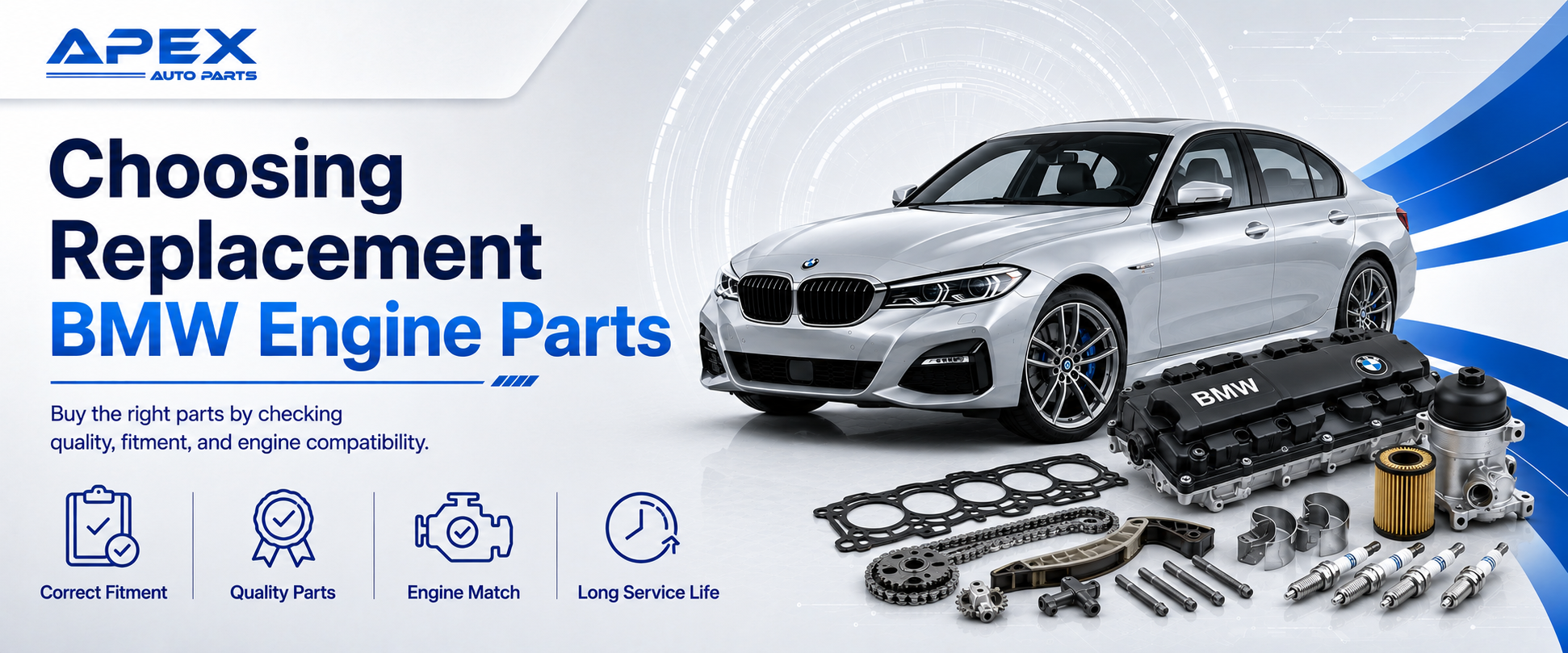
BMW part selection can be confusing because the same model badge may use different engines depending on the production date and market.
Do not order a component simply because the listing says 320i, 320d, or 330i.
Use the VIN, registration, engine code, and original part number wherever possible.
At Apex Auto Parts, this is particularly important when customers are buying engine components such as pistons, bearings, timing parts, oil pumps, gaskets, cylinder head parts, valves, seals, and rebuild components.
A cheap wrong part is never cheap once the engine has to be dismantled again.
The part should match the engine. The repair should also address the reason the original component failed.
What to Check Before Buying a Used BMW 3 Series?
Buying the right BMW 3 Series begins before the test drive.
Ask the seller not to warm the engine before you arrive.
A cold engine can reveal timing noise, poor starting, smoke, misfires, and other faults that may become less obvious once temperatures rise.
Check the coolant before starting. Inspect the oil level. Look around the engine for fresh leaks.
Drive the car gently at first, then test it under normal acceleration once it is warm. The engine should pull evenly without hesitation, warning messages, heavy smoke, or unusual noises.
After the test drive, inspect the engine again.
A diagnostic scan is valuable even when the dashboard has no warning light. Stored or pending faults may reveal problems that have not yet triggered a permanent warning.
Service history should influence the buying decision more than shiny paint or low mileage.
Repair or Replace a Failing BMW Series 3 Engine?
Not every damaged BMW 3 Series Engine needs replacement.
A failed gasket, timing system, injector, turbocharger, oil pump, or cylinder head may be repairable when the main block and crankshaft remain healthy.
A rebuild becomes more sensible when internal wear affects pistons, rings, bearings, crankshaft surfaces, or cylinder bores.
Replacement may make more sense when the block is cracked, the repair cost exceeds that of a suitable replacement engine, or major internal damage has spread through the lubrication system.
Diagnosis should come first.
Compression testing, cylinder leak testing, oil pressure checks, cooling pressure tests, and inspection of the oil filter can reveal a great deal before the engine is removed.
Final Thoughts
A single engine or generation cannot judge BMW 3 Series Engine Reliability.
Older naturally aspirated six-cylinder engines can offer simple and enjoyable ownership, but their age means that cooling and oil leaks require attention. The N54 provides excellent performance but demands more care around fuel, turbo, and ignition systems. The N20 deserves a close inspection of the timing chain. Diesel engines such as the N47 require careful timing and emissions system checks. Modern B48 and B58 engines are strong choices, but they still require proper servicing and a healthy cooling system.
Most serious BMW 3 Series Engine problems do not begin as complete engine failures. They begin as small noises, leaks, temperature changes, misfires, or warning messages.
Deal with those signs early.
The best used BMW is rarely the cheapest example or simply the one with the lowest mileage. It is usually the car with a clear history, proper repairs, sensible ownership, and a properly maintained engine.
FAQs
1. Is BMW 3 Series Engine Reliability Good?
BMW 3 Series Engine Reliability can be very good when the correct engine is chosen, and maintenance is kept up to date. Naturally aspirated petrol engines are often simpler, whereas turbocharged petrol and diesel engines require closer attention to oil, cooling, timing systems, fuel pressure, emissions equipment, and the quality of previous repairs.
2. What are the most common BMW 3 Series Engine problems?
Common BMW 3 Series Engine problems include oil leaks, coolant loss, timing chain wear, ignition misfires, injector faults, turbo boost problems, crankcase ventilation faults, and diesel EGR or DPF issues. The exact problems depend heavily on engine code, age, mileage, driving pattern, and previous maintenance.
3. Which BMW 3 Series Engine is the most reliable?
For older petrol cars, naturally aspirated six-cylinder engines such as the N52 are often attractive because they avoid turbo-related stress. For newer models, well-maintained B48 and B58 engines are strong options. The best BMW 3 Series Engine is still the one with documented servicing and no ignored faults.
4. Is the N47 BMW 3 Series Engine reliable?
The N47 can deliver strong fuel economy and torque, but the timing chain condition warrants careful attention. EGR, DPF, injector, turbo, and cooling faults can also appear with age. Before buying an N47-powered BMW 3 Series, listen from cold, check the service records, and have any unusual timing noises inspected.
5. Are petrol BMW 3 Series engines better than diesel engines?
Petrol engines usually suit lower annual mileage and frequent short journeys better. Diesel models can be excellent for motorway driving and higher mileage because of their torque and fuel economy. Reliability depends on use. Repeated short trips can create more trouble for diesel emissions systems such as the EGR and DPF.
6. Is BMW 3 Series Engine tuning worth doing?
BMW 3 Series Engine tuning can improve power and response, especially on turbo engines, but engine health must come first. Cooling, oil pressure, fuel delivery, plugs, coils, turbochargers, and gearbox condition should be checked before modification. A mild professional tune is usually safer than chasing maximum power from an aging engine.
7. What should I check on a BMW 3 Series Convertible engine?
When buying a BMW 3 Series Convertible, check cold starting, coolant level, oil leaks, warning lights, misfires, turbo behavior (where fitted), and full service history. E93 models also test the folding roof, battery condition, drainage, boot seals, and electrical systems, as convertible faults can significantly increase ownership costs.
8. How long can a BMW 3 Series Engine last?
There is no fixed lifespan for a BMW 3 Series Engine. A properly maintained engine can cover high mileage, while a badly neglected low-mileage engine may fail much earlier. Regular oil changes, stable cooling, correct parts, sensible driving, and early repair of leaks or warning signs have a major effect on engine life.
9. Is the BMW 3 Series expensive to repair?
Repair cost depends on the engine and the fault. Spark plugs, coils, hoses, and some gaskets may be manageable, while repairs to the turbocharger, timing, injector, cylinder head, or internal bearings can cost much more. Proper diagnosis is important because replacing expensive parts without confirming the failure quickly increases the total bill.
10. What should I check before buying a used BMW 3 Series?
Before buying a used BMW 3 Series, start it from cold, inspect oil and coolant levels, check for leaks, listen for timing noise, test acceleration, and scan the vehicle for faults. Ask for invoices for oil changes, cooling repairs, timing work, and major engine servicing, rather than relying solely on mileage.
References:
press BMW group
press BMW group