 info@apexautoparts.co.uk
 +44 203 915 7535
 Safe & Fast Shipping
 Whish List
 Compare
 Sign In


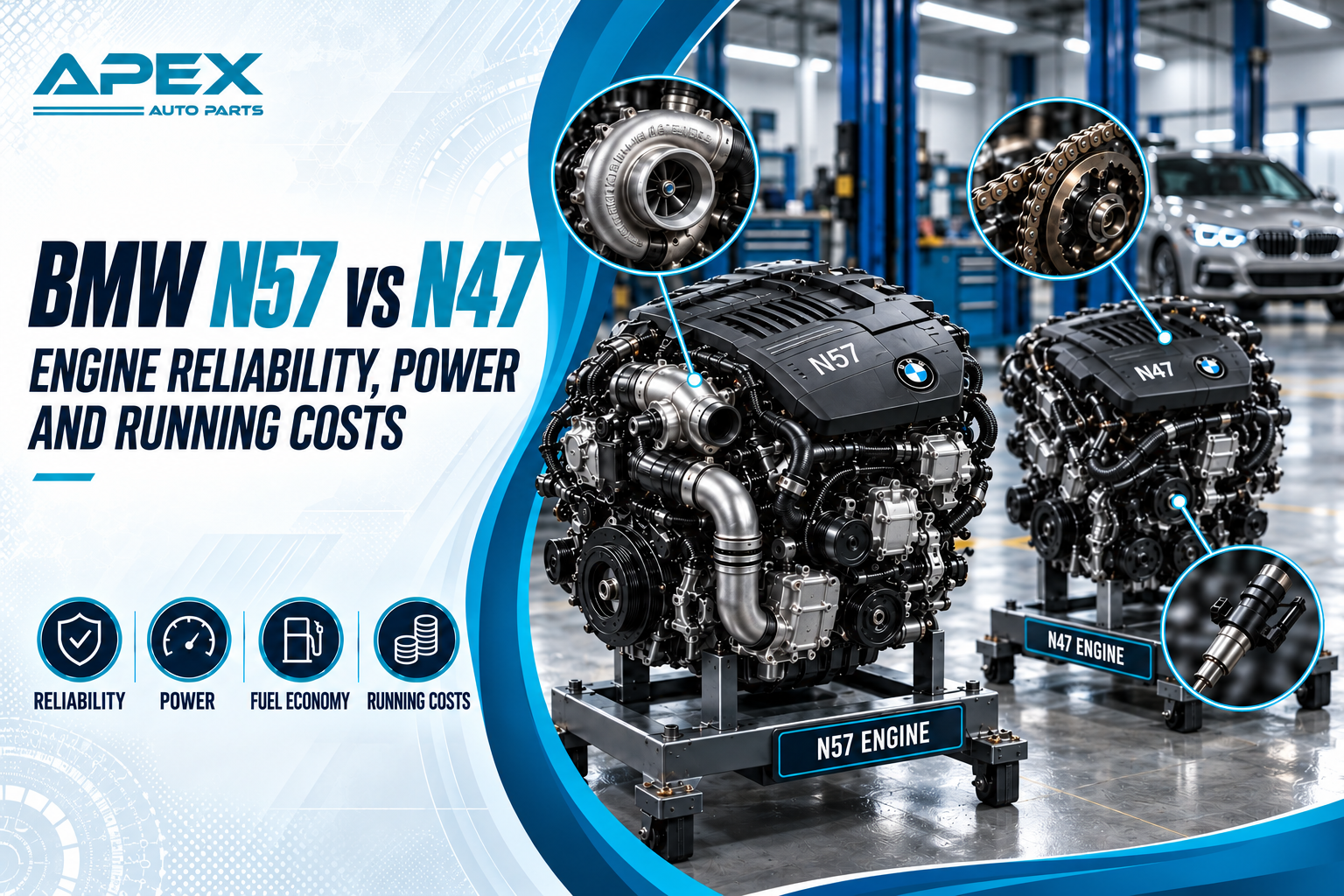
BMW produced several diesel engines that became extremely popular across the UK, but few are discussed as often as the N47 and N57 engines. Both arrived during a period when BMW was trying to combine strong diesel torque with better fuel economy and lower emissions. They share some technology and even some maintenance concerns, but they are very different engines when it comes to size, performance, repair costs, and the type of BMW they suit.
The N47 is mainly known as BMW's 2.0-litre four-cylinder diesel engine. It appeared in a wide range of cars, including versions of the BMW 1 Series, 3 Series, 5 Series and several X models. Depending on version and year, it was offered with different power outputs, but one of the better-known later specifications produced 184 hp and 380 Nm. BMW used that version in models such as the 120d, where it combined useful performance with very strong official fuel economy.
The N57 engine is a larger 3.0-litre straight-six diesel. It was designed for cars that needed more power, smoother operation, and much stronger torque. BMW introduced a 245 hp and 540 Nm version in the 730d, while later versions increased output to 258 hp and 560 Nm. More powerful applications reached 313 hp and 630 Nm, showing how much performance BMW was able to extract from the same basic six-cylinder diesel family.
For a used buyer, however, horsepower is only part of the decision. The N47 became well known for timing chain concerns, especially because the timing system is positioned at the rear of the engine. The N57 also uses a rear-mounted timing chain arrangement, so it is not completely free from timing-related risk.
However, the N57 is generally viewed as the stronger choice when a buyer wants smoothness, torque, and long-distance performance, provided the higher servicing and repair costs are acceptable. Independent used BMW guidance has specifically highlighted the rear-mounted timing chain arrangement on both N47 and N57 engines.
The choice between an N47 engine and an N57 engine, therefore, depends on more than reliability alone. The N47 is lighter, more economical, and usually cheaper to run when it is healthy. The N57 is smoother, more powerful, and better suited to larger BMW models, but its six-cylinder layout means there are more components and potentially larger repair bills.
This guide explains the differences between the BMW N47 and N57 in practical terms. It covers power, torque, fuel economy, timing chain concerns, turbocharger problems, injectors, DPF and EGR issues, running costs, and the checks worth carrying out before buying a used BMW fitted with either engine.
What Is the BMW N47 Engine?
The N47 is a four-cylinder turbocharged diesel engine that BMW used extensively from the late 2000s into the middle of the following decade. It replaced earlier four-cylinder diesel designs and became one of BMW's most important engines because it could provide good motorway performance without the fuel consumption of a larger six-cylinder unit.
The engine is most commonly associated with a capacity of around 2.0 litres. It appeared in different states of tune depending on model and year, meaning an N47 fitted to one BMW may not have the same turbocharging or output as the N47 fitted to another.
BMW's 2011 technical information listed the 2.0 litre diesel in the 120d at 184 hp and 380 Nm. The engine produced its maximum power at 4,000 rpm and maximum torque between 1,750 and 2,750 rpm. BMW also quoted fuel consumption of roughly 4.5 to 4.6 litres per 100 km under the testing standards of the time.
That explains why the N47 became so popular. A relatively small diesel could provide strong everyday acceleration while still delivering the fuel economy expected from a four-cylinder engine. For drivers covering high annual mileage, an N47 BMW could be extremely inexpensive to fuel compared with a similar petrol model.
The main problem is that the engine's reputation has been affected heavily by timing chain failures and timing chain noise on certain cars. This issue should be taken seriously when buying used, particularly if the service history is incomplete.
What Is the BMW N57 Engine?
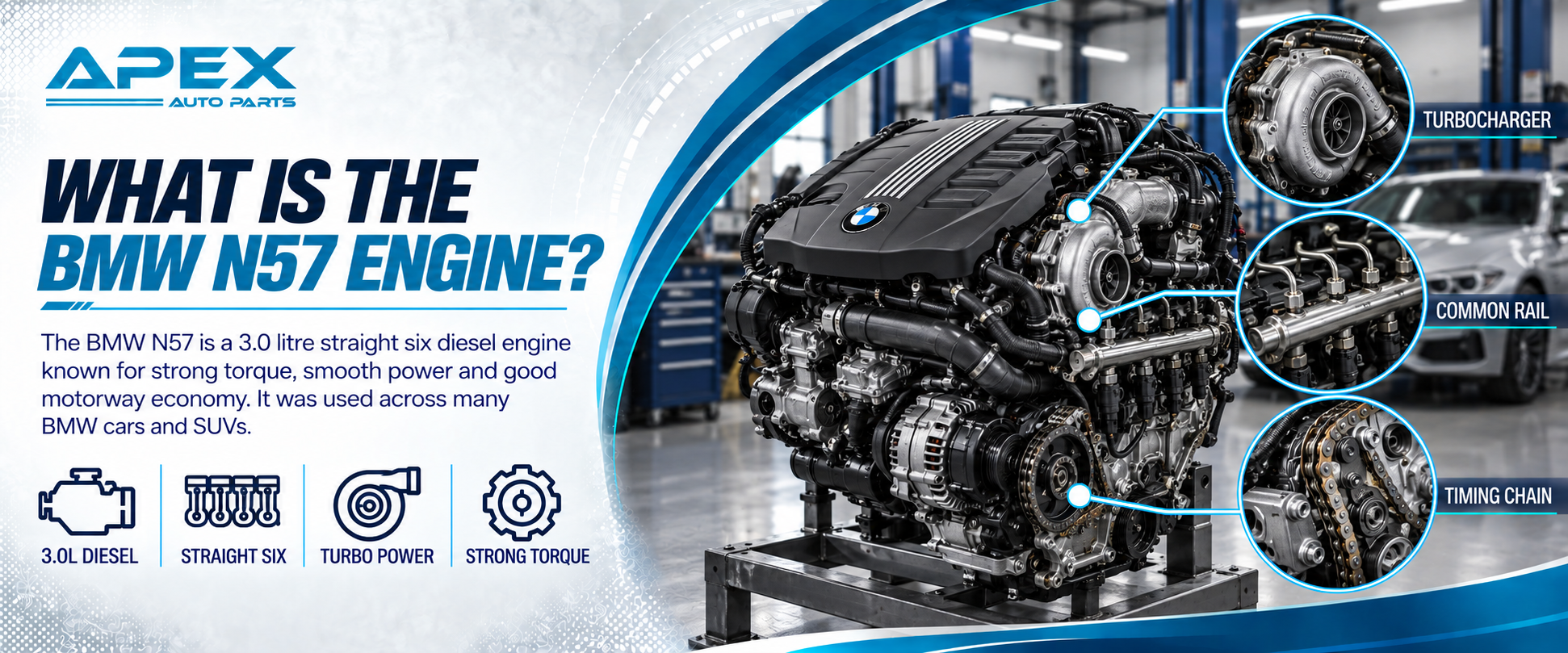
The N57 is a 3.0-litre straight-six diesel that sits above the N47 in BMW's diesel engine range. Instead of four cylinders, it uses six cylinders arranged in a straight line. This configuration is naturally smoother and allows BMW to produce much more torque without making the engine feel harsh.
BMW introduced a 2,993 cc version in the 730d, producing 245 hp and 540 Nm. The engine used an aluminium crankcase, common rail direct fuel injection and a variable geometry turbocharger. BMW described it as a new generation of six-cylinder diesel designed to improve power, efficiency and weight.
BMW continued developing the N57 family. A later 258 hp version produced 560 Nm between 1,500 and 3,000 rpm, while more powerful twin-turbo applications such as the 535d reached 313 hp and 630 Nm.
This gives the N57 a very different driving character from the N47. Instead of working harder to move a larger vehicle, the N57 relies on its substantial torque. A 530d or 730d can accelerate strongly from low engine speed without needing constant downshifts, which makes the engine particularly well suited to motorway driving.
The N57 is often regarded as one of BMW's more desirable diesel engines because it combines performance and economy extremely well. It is not maintenance-free, however. Timing chains, turbocharging systems, emissions equipment, and fuel system components can all create significant bills if neglected.
N47 vs N57 Basic Difference
The most obvious difference is engine size. The N47 is mainly a 2.0 litre four-cylinder diesel, while the N57 is a 3.0 litre straight six diesel. That extra litre of capacity and two additional cylinders give the N57 a substantial advantage in power, torque and smoothness.
A later N47 could produce around 184 hp and 380 Nm in a single turbo 120D specification. By comparison, the N57 produced 245 hp and 540 Nm even in an early 730d specification. Later 258 hp versions produced 560 Nm, while higher output versions exceeded 300 hp.
The N47 is therefore better understood as the economy-focused engine. It provides enough torque for a 1 Series, 3 Series or normal 5 Series driving while using relatively little diesel.
The N57 is the performance diesel. It suits heavier vehicles and buyers who want stronger motorway acceleration without moving to a petrol engine.
Neither approach is automatically better. The right choice depends on the vehicle, annual mileage and how much money the owner is prepared to spend on maintenance.
N47 Engine Power & Performance
The N47 was offered with several different outputs, so buyers should always check the exact model rather than assuming every 2.0 litre BMW diesel has the same specification. Versions used in lower-powered cars focused more heavily on economy, while models such as the 120d and 320d offered a stronger balance between efficiency and performance.
One important later specification produced 184 hp and 380 Nm. BMW quoted 0 to 100 km/h in 7.2 seconds for the 120d using this version, showing that the N47 could make a compact BMW genuinely quick while still returning impressive fuel economy.
BMW also used the N47 in other markets with slightly different tuning. For example, the US market 328d used a version producing around 180 hp and 280 lb ft of torque. This highlights why exact engine and vehicle identification matters when comparing specifications.
In normal driving, the N47 feels strongest in the middle of the rev range. Diesel torque arrives early, so motorway acceleration is much better than the horsepower figure might suggest.
For an everyday 320d or similar BMW, the engine provides more than enough performance for normal UK roads.
N57 Engine Power & Performance
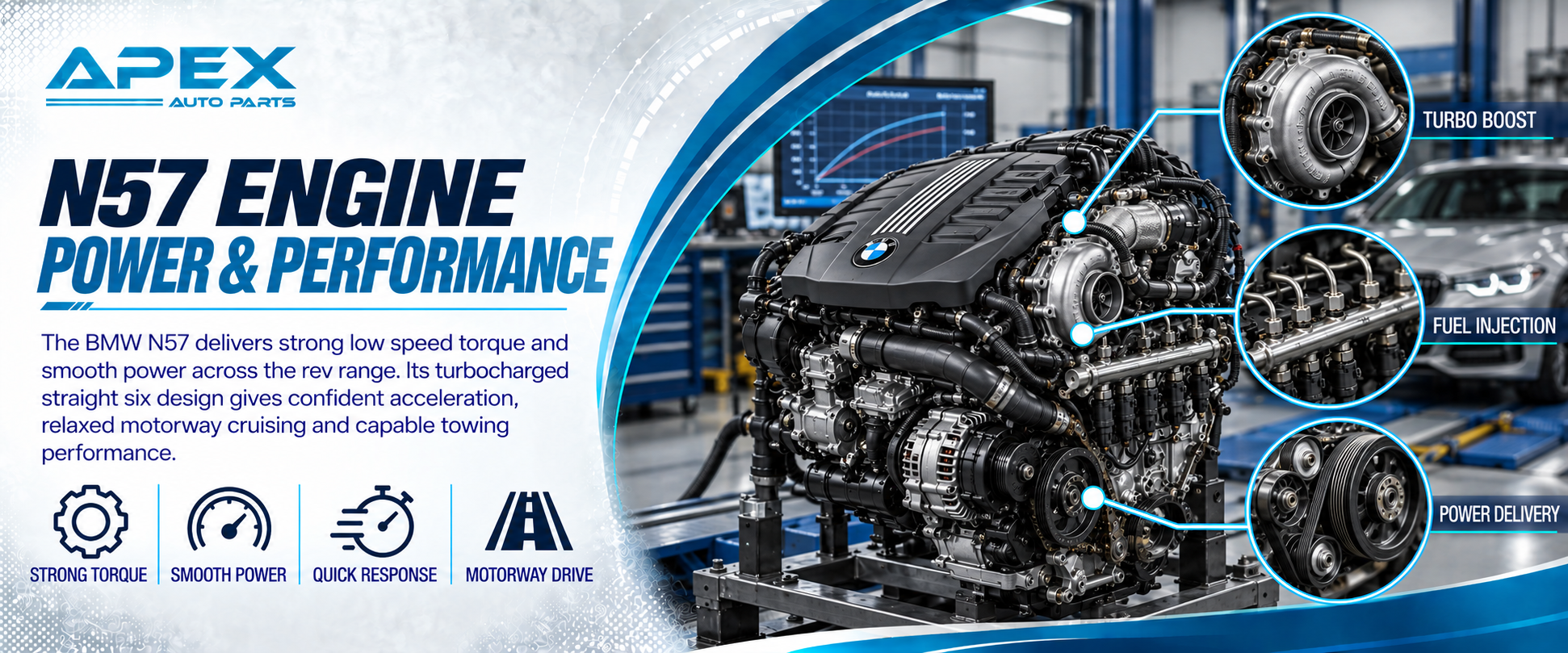
The N57 operates at a completely different level. BMW's early 730d version produced 245 hp and 540 Nm at only 1,750 rpm, which gave a large luxury saloon strong acceleration without requiring high engine speed.
Later development increased the normal single turbo version to 258 hp and 560 Nm. BMW's technical data from this period shows how much more torque the six-cylinder engine offered compared with the four-cylinder diesel alternatives.
Higher output N57 applications went further still. BMW listed the 535d at 313 hp and 630 Nm, giving a diesel 5 Series acceleration and overtaking ability that would have been considered performance car territory only a few years earlier.
The N57's main advantage is not simply maximum horsepower. The engine can provide a large amount of torque without feeling strained. This is especially noticeable when overtaking at motorway speed, climbing hills or carrying several passengers.
For a driver who enjoys strong acceleration but still covers a lot of motorway miles, the N57 offers a combination that the smaller N47 cannot fully match.
Which Engine Feels Better to Drive?
The N57 feels noticeably smoother because a straight six engine is naturally better balanced than a four-cylinder design. At idle and under acceleration, there is usually less vibration, and the engine feels more refined.
The N47 is not necessarily unpleasant, but it has the more obvious sound and vibration expected from a four-cylinder diesel. In a smaller BMW, this is rarely a serious issue because the engine matches the size and character of the car.
The difference becomes more noticeable in larger vehicles. An N57-powered 5 Series, X5 or 7 Series tends to feel more effortless because the engine does not need to work as hard to move the vehicle.
The N57 also has a wider reserve of torque. Pressing the accelerator at motorway speed produces stronger acceleration without as much need for the gearbox to drop several ratios.
If driving refinement and effortless power are priorities, the N57 is the clear winner. If fuel economy and lower everyday operating costs matter more, the N47 still makes a strong case.
N47 Fuel Economy
Fuel economy is one of the N47 engine's biggest strengths. BMW designed the engine to provide enough performance for normal use while reducing fuel consumption and emissions.
BMW's 184 hp 120d technical figures quoted consumption of around 4.5 to 4.6 litres per 100 km under the official test procedure used at the time. Actual UK road economy naturally varies according to vehicle, gearbox, traffic and driving style.
A lightweight 1 Series or 3 Series fitted with the N47 can be very economical during steady motorway driving. This is one reason these engines became popular with commuters and company car drivers.
The advantage becomes particularly noticeable for somebody travelling 15,000 or 20,000 miles every year. A difference of several miles per gallon can become a meaningful saving over that distance.
However, economy should not be the only consideration when buying an older N47. Saving money on fuel means little if the vehicle immediately requires major timing chain work.
N57 Fuel Economy
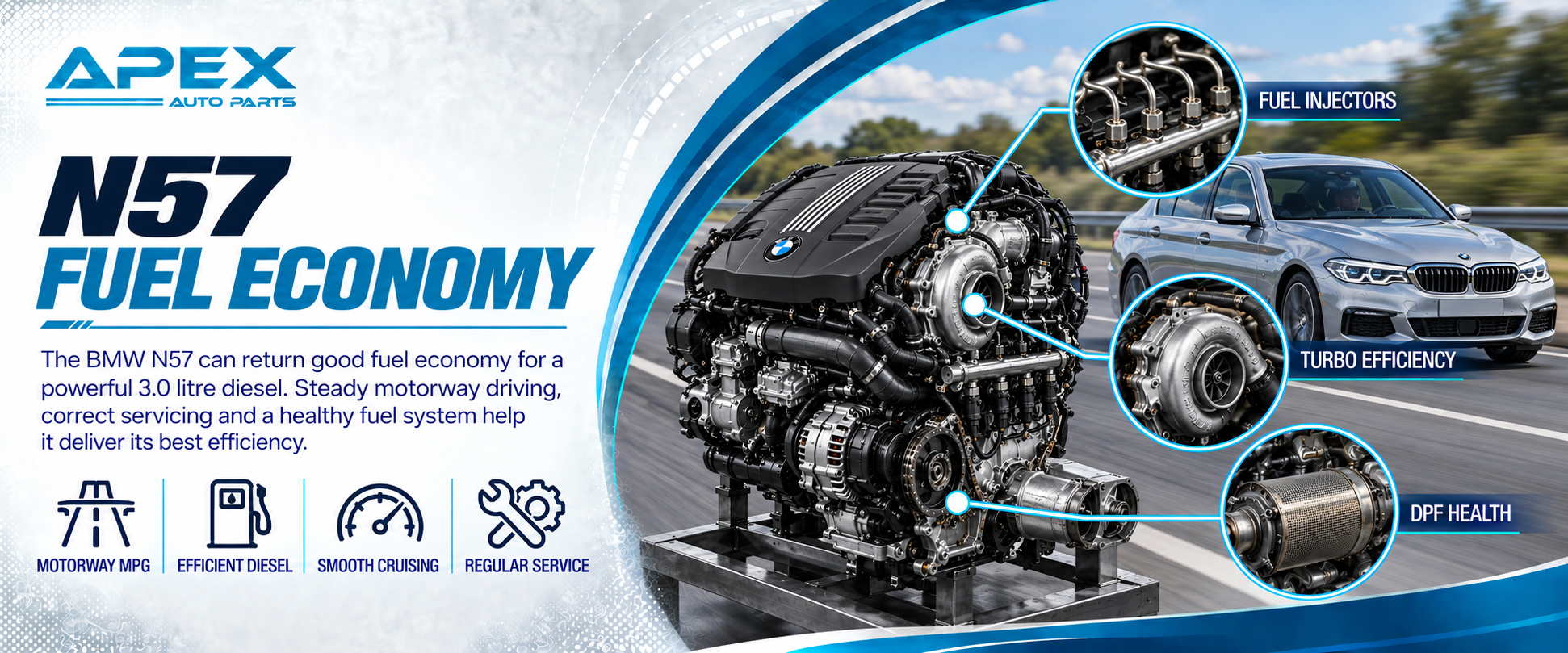
The N57 normally uses more fuel than an N47 because it has greater capacity, two extra cylinders, and is often installed in larger and heavier cars. However, it can still be surprisingly efficient considering its performance.
BMW's 2011 figures listed a 258 hp 530d at approximately 52.3 mpg in automatic form under the official testing system of that period. The 313 hp 535d was listed at around 50.4 mpg. These historical test figures should not be compared directly with modern WLTP numbers, but they show how strongly BMW focused on efficiency.
In real use, an N57 driven gently on long motorway journeys can return good diesel economy while still providing far more performance than an N47.
The disadvantage becomes clearer in urban driving. A 3.0-litre six-cylinder engine in a heavier car will normally use more fuel than a 2.0-litre four-cylinder equivalent.
For high mileage motorway use, the difference may be worth paying because of the N57's smoothness and power. For shorter everyday journeys, the N47 usually costs less to fuel.
N47 Timing Chain Problems
Timing chain problems are the issue most strongly associated with the N47 engine. The chain is mounted at the rear of the engine, between the engine and gearbox area, which makes access considerably more difficult than it would be with a front-mounted timing system.
Reports of timing chain wear and failure became common enough to have a major effect on the N47's used car reputation. Honest John recorded increasing reports of timing chain failures on 2.0 litre N47 diesels and specifically linked some cases with extended oil change intervals.
A worn timing chain may produce a metallic rattling or scraping sound, particularly around cold starting or certain engine speeds. However, buyers should not rely only on noise because chain wear can progress differently from one vehicle to another.
If the chain fails, the camshafts and crankshaft can lose synchronisation. Pistons and valves may then make contact, potentially causing severe internal engine damage.
Because the chain sits at the rear, replacing it usually involves a large amount of labour. This is one of the reasons an inexpensive used N47 BMW can suddenly become very expensive.
Does the N57 Have Timing Chain Problems Too?
The N57 should not be treated as immune to timing chain concerns. Independent BMW used-car buying guidance notes that both the N47 and N57 use rear-mounted timing chains and recommends paying close attention to the system as mileage rises.
However, the N47 has developed a much stronger reputation for widespread timing chain concerns. That difference is important because online discussions sometimes make it sound as though every rear-wheel-drive BMW diesel will fail in the same way.
An N57 buyer should still listen carefully during a cold start and check service history. Any persistent metallic rattle deserves specialist investigation.
Oil quality and service intervals matter because the chain, guides and tensioning components depend on lubrication. An engine that has repeatedly exceeded sensible oil service intervals deserves more caution regardless of mileage.
The N57 may therefore be the preferable engine from a timing chain reputation perspective, but that does not mean a used example can be purchased without inspection.
Why Oil Changes Matter So Much?
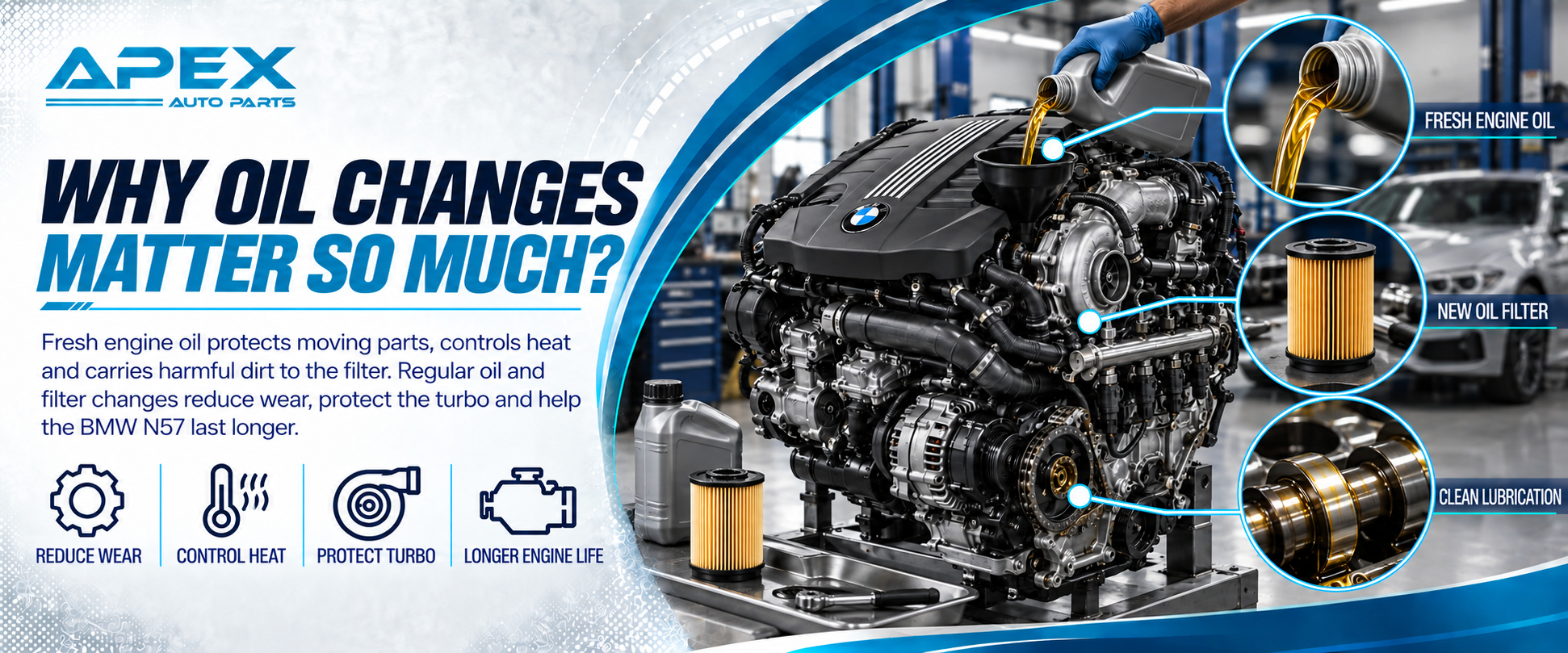
Both the N47 and N57 rely heavily on engine oil. The oil lubricates bearings, timing components, and the turbocharger, so poor-quality oil or excessively long service intervals can affect several expensive areas at once.
Diesel engines also introduce soot and other contamination into the oil over time. If the oil remains in the engine for too long, its ability to protect moving components gradually reduces.
This is why many experienced owners choose shorter oil change intervals on older, high-mileage BMW diesels rather than simply stretching servicing as far as possible.
When buying used, evidence of regular oil changes is much more reassuring than an owner saying the vehicle followed very long intervals because the dashboard allowed it.
For both engines, a strong service history can make the difference between a desirable high-mileage diesel and a potential repair project.
Turbocharger Reliability
Both the N47 and N57 rely on turbocharging, although the exact turbo arrangement varies according to version. Lower-output engines may use a simpler single-turbo arrangement, while higher-output N57 derivatives can use multiple turbochargers.
BMW's early 245 hp N57 used a single variable geometry turbocharger, while later high-performance N57 derivatives used more complex multi-stage turbocharging.
Turbocharger life depends heavily on oil quality and engine condition. Poor lubrication can damage turbo bearings, while boost leaks or control faults can make a healthy turbo appear to be failing.
Symptoms can include weak acceleration, smoke, unusual whistling, or increased oil consumption. None of these symptoms prove that the turbocharger itself is defective.
The complete air and boost system should be tested before a replacement turbo is ordered. A split hose or leaking intercooler connection is much cheaper to repair than a turbocharger.
N57 Multi Turbo Running Costs
Higher output N57 engines deserve special attention because some use more complex turbo systems than the normal single-turbo 30D versions. The extra turbocharging allows impressive horsepower and torque, but it also adds more components.
A standard 30d version is therefore usually easier to recommend to somebody focused on long-term running costs than a highly tuned 35d or M Performance diesel.
This does not mean the higher output N57 is unreliable. It simply means there are more expensive components involved if a failure occurs.
A 313 hp 535d, for example, delivers significantly more performance than a normal four-cylinder diesel and produces 630 Nm in BMW's published specification. That performance has to come from additional fuel, airflow, and turbocharging capacity.
Used buyers should decide whether they genuinely need the additional output. For motorway cruising and normal overtaking, a standard N57 30d already provides substantial performance.
Diesel Particulate Filter Problems
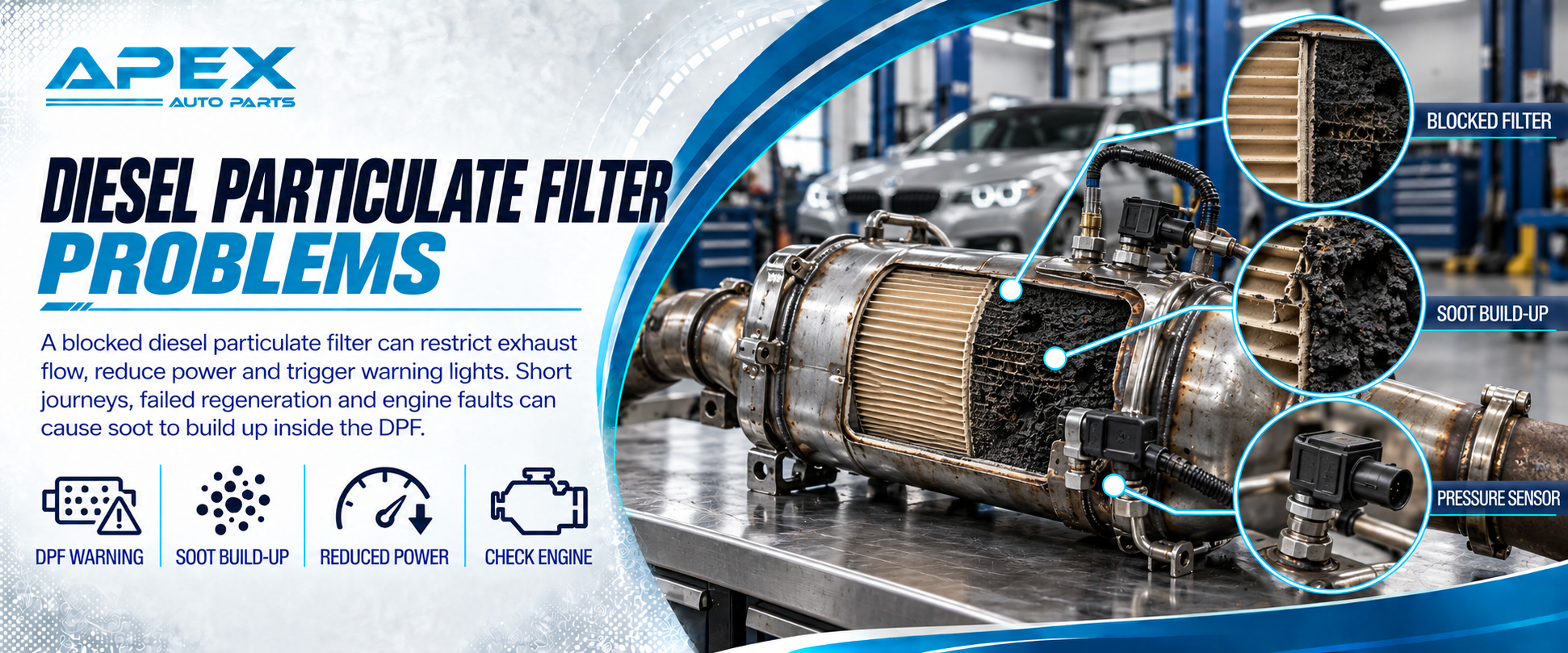
N47 and N57-equipped cars can use a diesel particulate filter. The DPF traps soot produced during diesel combustion and periodically burns much of that soot away through regeneration.
This process needs a suitable exhaust temperature. A BMW used for regular motorway travel normally has better conditions for DPF regeneration than one used only for short local trips.
If regeneration repeatedly fails to complete, the soot load increases. Eventually, a warning may appear, and engine performance can be reduced.
The DPF itself may not always be the original problem. A thermostat that prevents the engine from reaching the correct temperature, an EGR issue, or a faulty exhaust sensor can interfere with regeneration.
For this reason, a restricted filter should be diagnosed as part of the complete emissions system rather than automatically replaced.
EGR Problems
Both engine families use exhaust gas recirculation to reduce emissions. The EGR system routes a controlled amount of exhaust gas back into the intake under certain operating conditions.
Carbon and oil residue can accumulate in the intake and EGR system over time. This can affect airflow and eventually cause rough running, hesitation, or warning lights.
A faulty EGR system may also interfere with DPF regeneration, creating a second problem further down the exhaust.
Drivers should not assume every diesel power loss is caused by the turbocharger. EGR, boost, and DPF systems interact closely, which means one problem can sometimes produce several diagnostic codes.
When buying an older N47 or N57 BMW, a clean diagnostic scan and a proper road test are extremely valuable.
Swirl Flaps and Intake Deposits
BMW diesel engines use systems inside the intake to help control airflow under different operating conditions. As engines age, oily vapour from the crankcase ventilation system can combine with soot from EGR operation and create deposits inside the intake.
Heavy deposits can restrict airflow and affect how smoothly the engine responds. Moving intake components also need to operate correctly.
The exact intake design varies between engine versions, so owners should not assume that a repair procedure for one BMW diesel applies to every N47 or N57.
If the engine has poor low-speed response or airflow-related faults, the intake system should be inspected rather than immediately replacing sensors.
Cleaning or repairing the actual restriction can restore performance when the main engine itself is still healthy.
Fuel Injector Problems
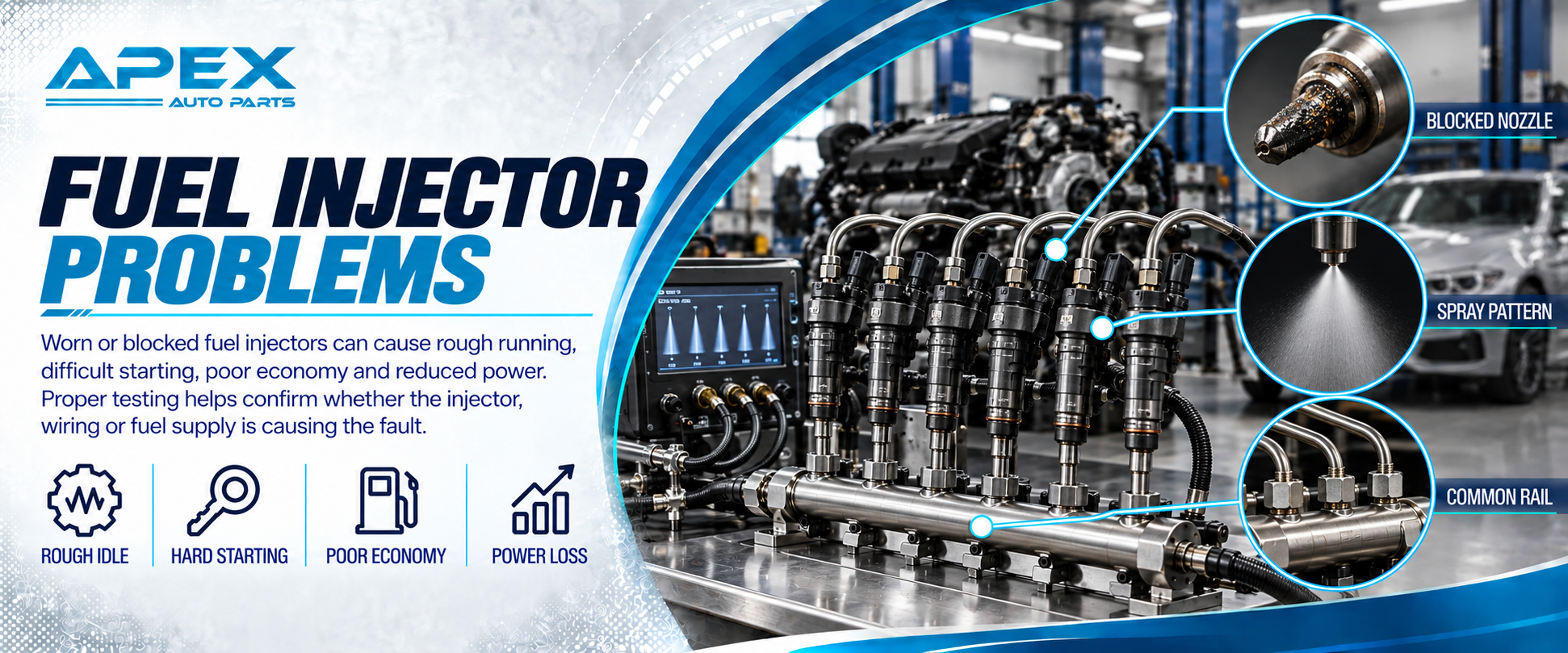
Both the N47 and N57 use common rail direct fuel injection. BMW's N57 documentation describes high-pressure common rail injection as one of the main technologies used to produce its combination of power and efficiency. Early versions used very high injection pressures, while later systems were further developed.
Injectors operate under demanding conditions and can become expensive as mileage rises. A faulty injector may cause difficult starting, uneven idle, excessive smoke, or poor performance.
The same symptoms can be caused by compression problems, EGR faults, or fuel pressure issues, so injectors should be tested before replacement.
The N57 naturally has six injectors instead of four. That means a complete injector replacement can cost significantly more than on the N47.
This is a good example of the general ownership difference between the engines. The N57 provides more performance and refinement, but when certain components need replacing, there are simply more of them.
High Pressure Fuel System Problems
The common rail system depends on a high-pressure pump delivering fuel to the rail and injectors. A problem in this system can cause difficult starting, reduced power, or complete failure to start.
Fuel contamination is especially serious because metal wear or debris in a high-pressure system can spread through more than one component.
A mechanic should check rail pressure and fuel delivery before assuming individual injectors are responsible.
Preventative maintenance mainly comes down to correcting fuel filter servicing and avoiding contaminated fuel.
If major fuel system damage has occurred, repair costs can be substantial on either engine.
Crankcase Ventilation & Oil Use
The crankcase ventilation system controls pressure and oil vapour inside the engine. When it stops operating correctly, it can contribute to oil consumption, intake contamination, and external oil leaks.
Excessive crankcase pressure can push oil past seals that were previously dry. Replacing the visible seal without addressing the pressure problem can allow the leak to return.
Oil vapour can also contribute to deposits in the intake system when combined with EGR soot.
If an N47 or N57 repeatedly develops oil leaks or uses more oil than expected, crankcase ventilation should be considered as part of the diagnosis.
A good diesel specialist will look at the complete system rather than simply repairing each visible leak separately.
Cooling System Reliability
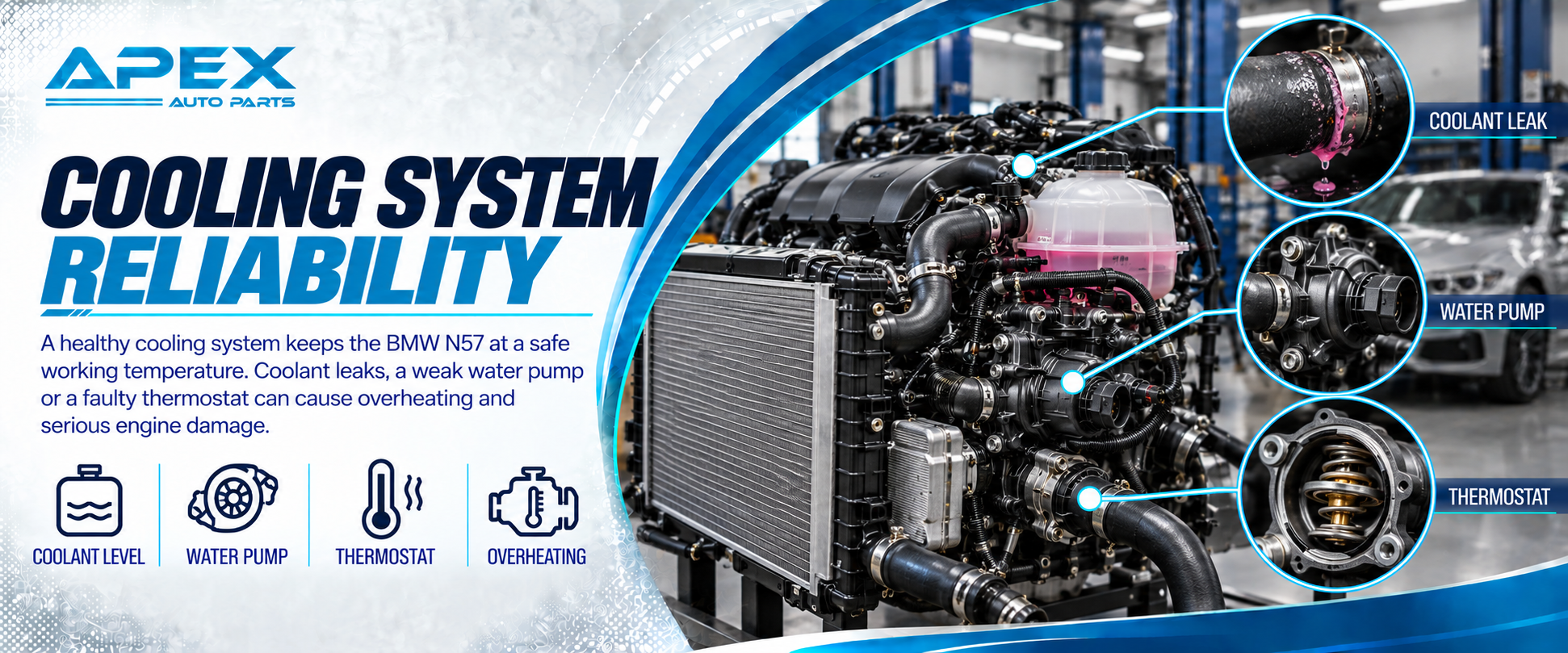
Both engines depend on stable coolant temperature. A diesel that runs too cold can experience problems with efficiency and DPF regeneration, while an overheating engine risks major mechanical damage.
Thermostats, pumps, hoses and radiators should therefore be treated as important maintenance components rather than ignored until a warning appears.
A thermostat that remains open may cause the engine to take too long to warm up. The driver may not notice much difference from inside the car, but the lower operating temperature can interfere with normal diesel emissions behaviour.
At the opposite extreme, coolant loss or poor circulation can cause overheating.
Repeated coolant top-ups should always be investigated. The cooling system should not normally consume coolant.
N47 vs N57 Timing Chain Repair Cost
The exact price of timing chain replacement depends heavily on the vehicle, labour rate, parts used, and how much associated work is carried out. The rear location of the chain is what makes the job difficult on both engine families.
On an N47, the repair can represent a large percentage of the value of an older 1 Series or 3 Series. This is why evidence of timing chain work can add significant value when buying a used car.
The N57 uses a larger six-cylinder engine and can require more expensive parts and labour. However, the vehicles fitted with the N57 also tend to have higher market values, which can make the repair easier to justify on a good example.
Buyers should avoid choosing an engine based on an internet figure for chain replacement because workshop prices vary considerably. Instead, obtain a quote based on the exact registration or VIN.
Most importantly, do not ignore genuine chain noise because the cost of preventive replacement is still far lower than rebuilding an engine after the timing system fails.
N47 vs N57 Routine Servicing Costs
The N47 normally wins on routine servicing costs because it is a four-cylinder engine. It uses less engine oil and has four cylinders worth of certain components rather than six.
The N57 requires a greater quantity of oil and has six injectors, six glow plugs, and additional internal components. Some high-output versions also use more complicated turbo systems.
This does not mean an N57 is necessarily expensive every month. A well-maintained engine may travel long distances with only normal servicing.
The difference becomes noticeable when several ageing components need attention at the same time. A six-cylinder engine can turn an injector, glow plug, or turbo-related repair into a noticeably larger bill.
Owners should therefore budget according to the engine rather than the purchase price of the car alone.
Which Engine Is Cheaper to Run?
For fuel and ordinary servicing, the N47 is generally cheaper. Its smaller capacity and four-cylinder layout make it the sensible choice for somebody focused on commuting costs.
Insurance and vehicle tax can also vary according to the exact car, although these costs are tied to the vehicle and emissions rather than simply the engine family.
The N57 uses more diesel and can cost more when major components fail. However, the comparison becomes more complicated if an N47 requires major timing chain work shortly after purchase.
A cheap car with an unresolved mechanical problem is rarely cheaper in the long run.
The best value is therefore usually the engine with the strongest maintenance history, even if the purchase price is slightly higher.
Is the N57 More Reliable Than the N47?
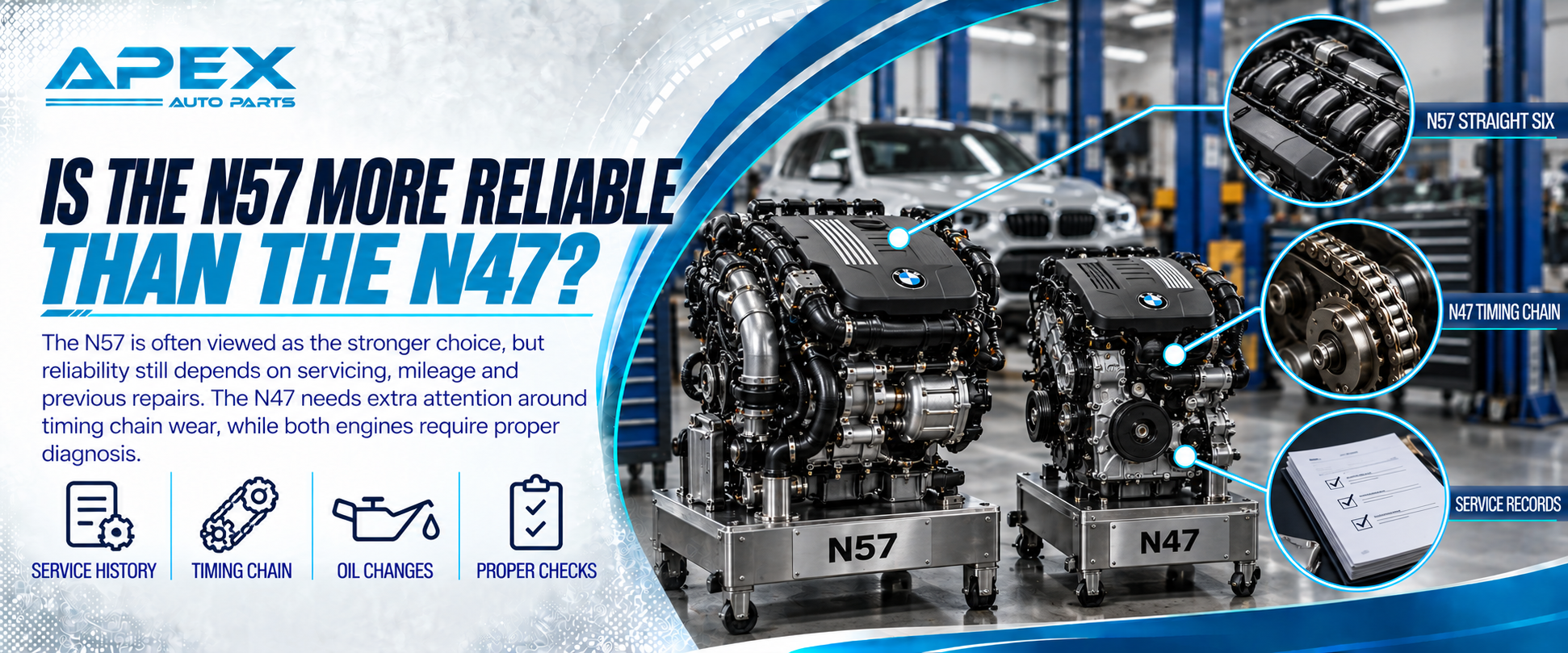
For many used BMW buyers, the N57 is generally considered the safer choice between the two when comparing well-maintained examples, particularly because the N47 has the stronger reputation for timing chain trouble. Independent used-car buying guidance has documented N47 timing chain failures and also notes that both N47 and N57 engines use rear-mounted chains.
That does not mean every N47 will fail. Many have covered high mileage successfully, especially when maintained carefully.
It also does not mean every N57 is reliable. An N57 with poor oil history, DPF trouble, damaged injectors, and worn turbo equipment can easily cost more to repair than an N47.
The better question is therefore whether a particular engine has been maintained properly.
As a general design choice, the N57 offers more refinement and power with a less severe timing chain reputation, but ownership costs are higher when major work is required.
Which Engine Is Better for High Mileage?
Both engines can cover high mileage, but the N57 is especially well suited to drivers who spend a lot of time on motorways. Its straight six layout is smooth, and the large torque reserve means it can maintain motorway speeds with very little effort.
A well-maintained N47 can also be excellent for high annual mileage. In fact, its superior fuel economy may make it financially attractive for somebody travelling 20,000 miles a year.
The difference is vehicle size and performance expectations. In a 320D, the N47 makes sense. In a heavier 5 Series, X5 or 7 Series, the N57 feels much more natural.
Regardless of engine, high-mileage motorway use can actually suit modern diesel emissions equipment better than repeated short journeys.
The real concern is not a six-figure odometer reading. It is a six-figure odometer reading with no maintenance evidence.
Which Engine Is Better for Short Journeys?
Neither the N47 nor the N57 is ideal if the vehicle will only complete very short journeys. Both are diesel engines and rely on emissions systems that work better when the engine and exhaust reach proper operating temperature.
Repeated five-- or ten-minute trips can make DPF regeneration more difficult. They also increase the number of cold starts relative to total mileage.
The N47 uses less fuel in town, but that does not solve the underlying problem if the DPF never receives suitable regeneration conditions.
Someone mainly travelling short urban distances may be better served by a petrol BMW rather than choosing between these two diesels.
The N47 and N57 make the strongest case when the owner regularly completes longer journeys.
What to Check Before Buying an N47 BMW?
The first priority should be the timing chain. Try to inspect the vehicle with the engine completely cold and listen carefully during start-up. Metallic rattling or scraping from the rear area of the engine deserves specialist inspection.
Service history should then be examined in detail. Regular oil changes are reassuring, while large unexplained gaps should make the buyer more cautious. If the seller says the timing chain has already been replaced, ask for an invoice showing when the work was completed and which parts were used.
The road test should include gentle acceleration, strong acceleration, and steady motorway-style driving if possible. The engine should pull smoothly without boost-related hesitation, excessive smoke, or reduced power warnings.
DPF and EGR conditions should also be checked using proper diagnostic equipment. A car can drive reasonably well during a short test while still storing useful fault information.
Finally, inspect for oil and coolant leaks once the engine is warm.
What to Check Before Buying an N57 BMW?
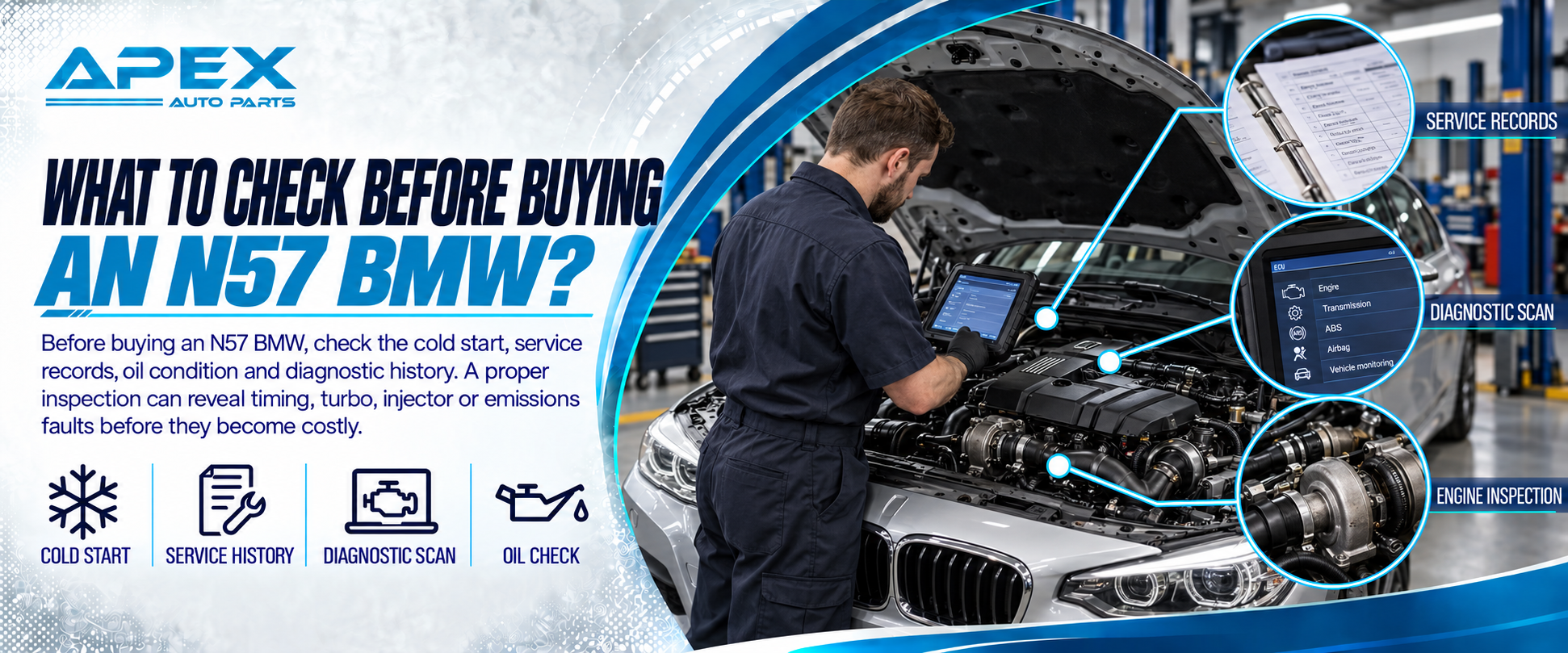
An N57 buyer should also start with a cold engine. Listen for timing-related rattles and make sure the straight six settles into a smooth idle without obvious vibration.
Check service records carefully because regular oil changes are important for the chain, turbocharger, and internal engine. Higher output twin turbo versions deserve extra attention because their boost systems are more complicated.
During the road test, the engine should pull very strongly and smoothly. A healthy N57 normally has enough torque that obvious hesitation is easy to notice.
Look for DPF and EGR warnings, excessive smoke, and evidence of poor previous tuning. Modified diesel BMWs can produce impressive power, but increased boost and torque may place more load on the turbochargers, gearbox, and drivetrain.
After the test drive, inspect for oil and coolant leaks and consider a specialist diagnostic scan before purchasing.
Modified N47 & N57 Engines
Both engines are popular for remapping because turbocharged diesels can often produce noticeably more torque through software changes.
A mild and professionally developed calibration on a healthy engine is very different from an aggressive tune applied to a poorly maintained high-mileage car. Increased boost and fuelling can place extra load on the turbocharger, cooling system, clutch or automatic gearbox.
The N57 has especially strong tuning potential because the standard engine already produces large torque figures.
However, buying a modified used BMW requires caution. Ask who carried out the software work, whether supporting modifications were fitted, and whether the vehicle has been serviced more frequently.
A standard car with excellent maintenance history is usually the safer option for someone prioritising reliability.
N47 and N57 Engine Parts
Correct identification is essential when buying N47 engine parts or N57 engine parts because there are multiple versions within each family. The same basic engine name can appear with different turbochargers, injectors, emissions components, and power outputs.
An N47 fitted to a lower-powered model may not use the exact same components as a higher-output N47. The difference became even greater within the N57 family because BMW offered single-turbo and multi-turbo configurations.
Before ordering engine parts, check the VIN, production date, engine code, and original part number wherever possible.
At Apex Auto Parts, accurate vehicle information helps match components to the actual engine rather than relying only on a description such as “BMW 2.0 diesel” or “BMW 3.0 diesel”.
Correct matching is particularly important for expensive parts such as timing kits, turbochargers, injectors, oil pumps, and internal engine components.
Why Quality Engine Parts Matter?
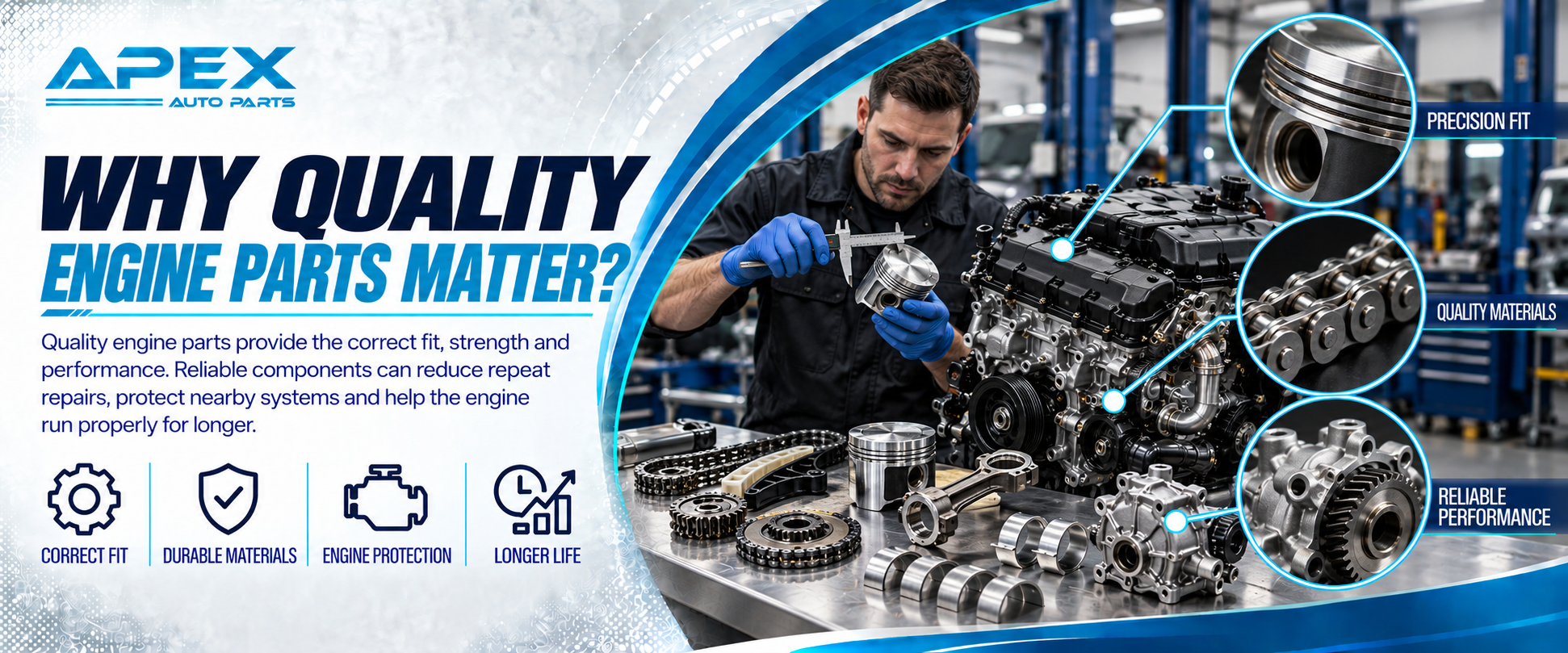
Labour can make up a large percentage of a diesel engine repair bill. This is especially true for timing chain work because of the rear-mounted chain position.
Using a poor-quality timing component simply to reduce the parts bill can therefore be a false saving. If it fails prematurely, much of the same labour may need to be paid again.
The same principle applies to cooling, fuel and turbocharger components. A cheap replacement is not good value if it creates another breakdown shortly after fitting.
That does not mean every repair requires the most expensive dealer boxed component. High-quality OEM specification and reputable aftermarket options can provide good value when correctly selected.
The priority should be accurate fitment and dependable quality rather than the lowest price.
N47 vs N57: Which One Should You Buy?
For a buyer focused mainly on fuel economy, the N47 still has strong advantages. It suits lighter BMW models particularly well and can return excellent motorway economy when healthy.
The major concern is timing chain history. An N47 with no evidence of careful servicing and suspicious chain noise is a much riskier purchase than one with detailed records and documented timing work.
The N57 is the stronger choice for performance, smoothness and relaxed motorway driving. Its 3.0-litre straight six produces far more torque, with mainstream versions offering around 540 to 560 Nm and stronger variants reaching 630 Nm or more.
The trade-off is running cost. The N57 uses more fuel and has six cylinders' worth of fuel and glow system components. Higher output versions also have more complex turbocharging.
If both cars are equally well maintained and the running cost is acceptable, the N57 is generally the more desirable engine. If maximum fuel economy is the priority, a properly maintained N47 remains difficult to dismiss.
Final Thoughts
The BMW N47 engine and N57 engine were created for different jobs. The N47 is a compact 2.0 litre four-cylinder diesel designed to combine useful torque with excellent fuel economy. BMW offered versions around the 184 hp and 380 Nm level, providing enough performance for popular cars such as the 1 Series and 3 Series while keeping fuel consumption low.
The N57 is the larger and more powerful alternative. Early 3.0-litre versions produced 245 hp and 540 Nm; later mainstream engines reached 258 hp and 560 Nm, and more powerful models such as the 535d offered 313 hp and 630 Nm. The six-cylinder layout also makes the engine noticeably smoother.
Reliability is where the comparison becomes more complicated. The N47 has a well-documented reputation for timing chain problems, and its rear-mounted chain makes repair labour-intensive. The N57 also has a rear-mounted timing arrangement, so buyers should not ignore timing noise or service history simply because they chose the six-cylinder engine.
Both engines can also develop DPF, EGR, turbocharger, injector, cooling and sensor problems as age and mileage increase. These systems should be diagnosed carefully because loss of power or a warning light does not automatically prove that an expensive component has failed.
For running costs, the N47 normally wins. It uses less diesel, requires less oil and has four cylinders rather than six. The N57 costs more to maintain but rewards the owner with substantially stronger torque, smoother operation and easier motorway performance.
For most enthusiasts choosing between two equally well-maintained examples, the N57 is the more desirable engine. For drivers mainly concerned with fuel economy and lower routine costs, a well-maintained N47 can still make excellent sense.
Whichever engine you choose, condition matters more than reputation alone. A well-serviced N47 with documented timing work can be a far safer purchase than a neglected N57. Before buying, inspect the engine from cold, review invoices, scan the vehicle for stored faults, and make sure the DPF, EGR, turbo, and cooling systems are operating correctly.
When N47 engine parts or N57 engine parts are required, use the VIN, engine code, and original part number to confirm fitment. Apex Auto Parts can help match the correct component to the exact BMW specification, which is particularly important for timing components, injectors, turbochargers, and other costly engine parts.
FAQS
1. Is the BMW N57 more reliable than the N47?
The N57 is generally considered the more desirable of the two engines from a reliability and refinement perspective, mainly because the N47 developed a stronger reputation for timing chain failures. However, the N57 also uses a rear-mounted timing chain and can develop expensive turbo, injector, EGR, and DPF problems if maintenance has been neglected.
2. What is the biggest problem with the N47 engine?
The most widely discussed N47 engine problem is timing chain wear and failure. The timing chain sits at the rear of the engine, which makes replacement labour-intensive. Metallic rattling or scraping should be investigated quickly, particularly on cars with incomplete oil service history.
3. Does the BMW N57 have timing chain problems?
The N57 can experience timing chain wear and uses a rear-mounted timing chain arrangement, so it should not be treated as completely free from timing concerns. Used buyers should listen during cold starts and examine oil service history carefully, especially as mileage rises.
4. How much power does the N47 engine produce?
Power depends on version and model. One common later 2.0 litre N47 specification produced 184 hp and 380 Nm, while other versions used different tuning. BMW used the engine across several models, so the exact vehicle and engine code should always be checked before comparing specifications.
5. How much power does the N57 engine produce?
N57 output varies considerably. BMW offered early 3.0-litre versions with 245 hp and 540 Nm, later mainstream versions with 258 hp and around 560 Nm, and stronger applications such as the 535d with 313 hp and 630 Nm.
6. Which is more economical, the N47 or N57?
The N47 is normally more economical because it is a smaller 2.0-litre four-cylinder engine. The N57 is a 3.0-litre six-cylinder and generally uses more diesel, especially around town. However, an N57 can still deliver impressive motorway economy considering its much higher power and torque.
7. Is an N47 worth buying?
An N47 can still be worth buying if the engine has a strong service history, runs quietly and shows no evidence of timing chain trouble. A car with documented timing chain replacement can be particularly attractive. Avoid choosing one only because it is cheap, since major timing work can quickly remove the initial saving.
8. Is the N57 good for high mileage?
A well-maintained N57 can be a strong, high-mileage engine, particularly for motorway use. Its six-cylinder design provides smooth operation and strong low-speed torque. Buyers should still check the timing chain condition, turbo operation, injectors, cooling, DPF, and EGR systems before purchasing a high-mileage example.
9. Which costs more to repair, an N47 or N57?
The N57 will generally cost more when comparable major components need replacement because it has six cylinders, requires more oil, and can use more complicated turbo systems. However, N47 timing chain work can also be expensive because of the rear-mounted chain position. Actual cost depends heavily on the exact vehicle and fault.
10. Which is better, the N47 or N57?
The N57 is better for power, torque, smoothness, and effortless motorway driving. The N47 is better for fuel economy and generally lower routine servicing costs. For a used buyer, maintenance history matters more than the badge. A properly maintained N47 can be a better purchase than a neglected N57.
References:
bmw group
Press bmw group