 info@apexautoparts.co.uk
 +44 203 915 7535
 Safe & Fast Shipping
 Whish List
 Compare
 Sign In


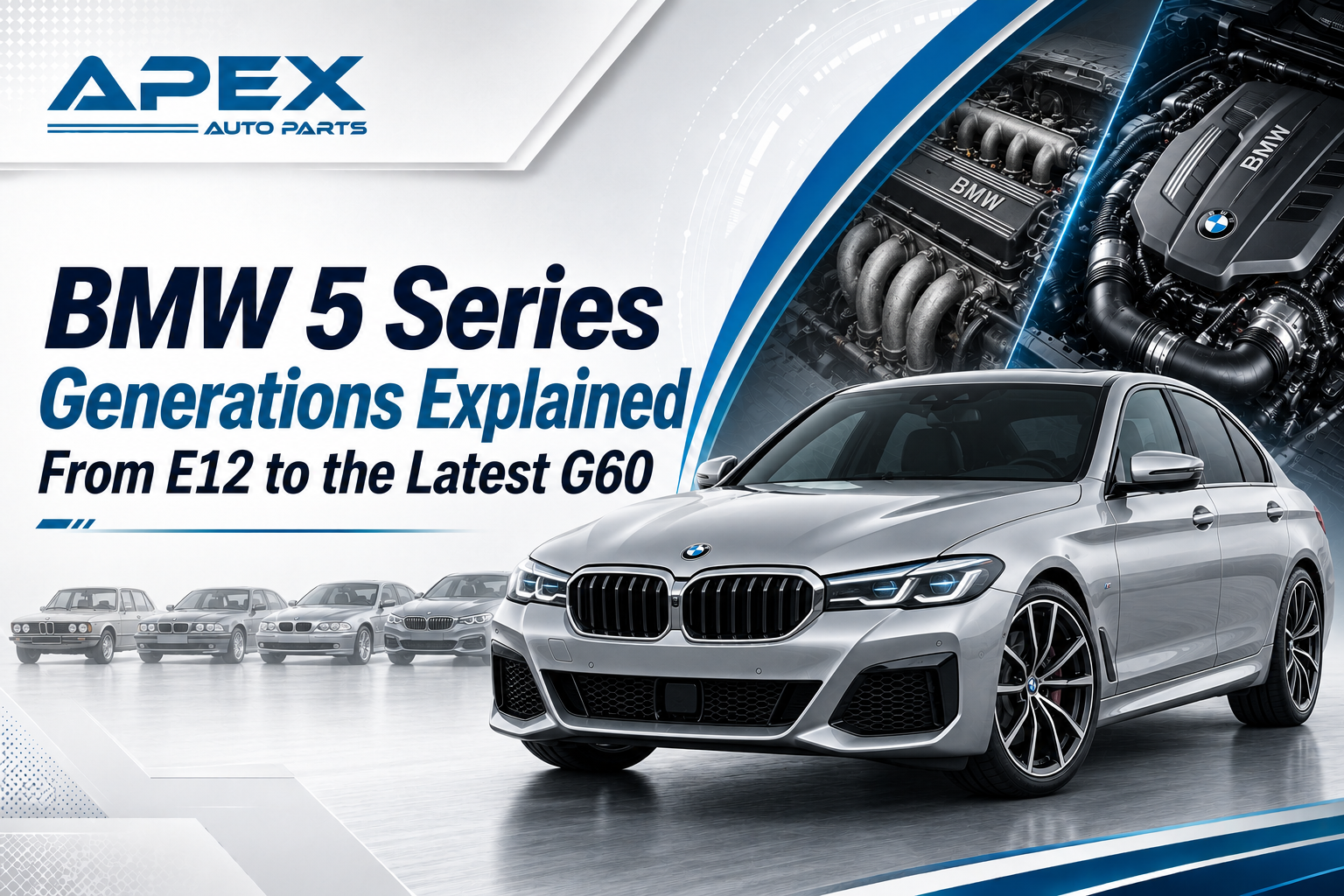
The BMW 5 Series has been around for more than 50 years, and during that time it has changed from a fairly simple executive saloon into one of BMW’s most advanced cars. Across eight generations, the 5 Series has moved through carburetor petrol engines, early diesel engines, naturally aspirated straight sixes, turbocharged petrol and diesel units, plug-in hybrids and, with the latest G60, fully electric power.
BMW introduced the first 5 Series in 1972 to replace its New Class models. BMW knew the first generation internally as the E12. Since then, the line has passed through the E28, E34, E39, E60, F10, G30 and now the G60. BMW confirms that the current model is the eighth generation of the 5 Series.
For used buyers, the generation code matters because two cars carrying the same 520i or 530d badge may be completely different underneath. Engine design, fuel systems, turbochargers, cooling systems, electronics and even the meaning of BMW model numbers have changed over time. BMW itself explains that the two digits after the series number used to relate closely to engine capacity, while on modern models they mainly indicate performance level rather than exact engine size.
This is also why BMW 5 Series engine reliability cannot be judged with one simple statement. An E39 straight six, an F10 turbo diesel and a G60 plug-in hybrid may all be 5 Series cars, but their maintenance needs and likely problems are very different.
In this guide, we will go through every BMW 5 Series generation from the E12 to the current G60, explain what changed, look at the important engines, and highlight the BMW 5 Series engine problems worth understanding before buying or repairing one.
BMW E12 The First 5 Series
The E12 is where the 5 Series story officially began. BMW launched it in 1972 as the replacement for the New Class saloons. It also introduced the naming style that BMW still uses today, with models such as 520 and 528 sitting under the 5 Series name. BMW produced the E12 until 1981.
Early E12 models used four-cylinder and six-cylinder petrol engines. Some versions used carburetors, while fuel injection became available as the range developed. These were mechanically simple cars compared with a modern BMW. There were no complex hybrid systems, advanced emissions controls or large networks of sensors managing every part of the engine.
That simplicity is one reason enthusiasts still like them. A knowledgeable mechanic can diagnose many E12 engine faults without needing the advanced computer equipment required for later generations.
Age, however, is now the biggest reliability issue.
Any E12 that survives today is several decades old, so BMW 5 Series engine reliability on these cars depends much more on restoration quality and previous maintenance than on the original design. Rubber hoses, seals, fuel lines, cooling parts and wiring may all have been replaced several times.
Rust also needs to be considered alongside engine condition. A strong engine does not make an E12 worth buying if the body and structure require major repairs.
Typical engine-related areas to inspect include oil leaks, cooling system condition, carburetor or injection setup, ignition parts and general engine wear. A compression test can also be useful if you are considering a car with an unknown engine history.
When sourcing BMW 5 series engine parts for an E12, part identification can require more care than with a modern vehicle. Production dates and exact engine versions matter, and some original parts can be harder to find.
BMW E28 Diesel Arrives and the M5 Is Born
The E28 replaced the E12 in 1981 and remained in production until 1987. It kept the familiar four-door shape but introduced important changes underneath.
One of the biggest developments was diesel power. BMW introduced diesel engines into the 5 Series during the E28 generation with models such as the 524d and turbocharged 524td. The E28 also introduced the fuel-saving 525e and, most importantly for performance fans, the first BMW M5. BMW's own archive records the first M5 as using a 286 hp six-cylinder engine.
The E28 still feels relatively simple compared with later models, but electronic control has started to become more important.
For buyers today, cooling system condition and general engine wear deserve attention. Fuel hoses, vacuum lines and old electrical connectors may have deteriorated simply because of age.
On older six-cylinder petrol engines, oil leaks can also appear around gaskets and seals. A small amount of staining may not mean the engine is finished, but active leaks should be investigated.
Diesel versions need careful inspection as well. Old fuel system components, turbo wear and poor starting can become expensive if the car has not been maintained.
The first M5 is a completely different buying proposition. Originality, service history and repair quality matter enormously because these cars are now valuable classics. Cheap replacement BMW 5 Series engine parts or badly carried-out modifications can reduce both reliability and value.
BMW E34 The 5 Series Becomes More Modern
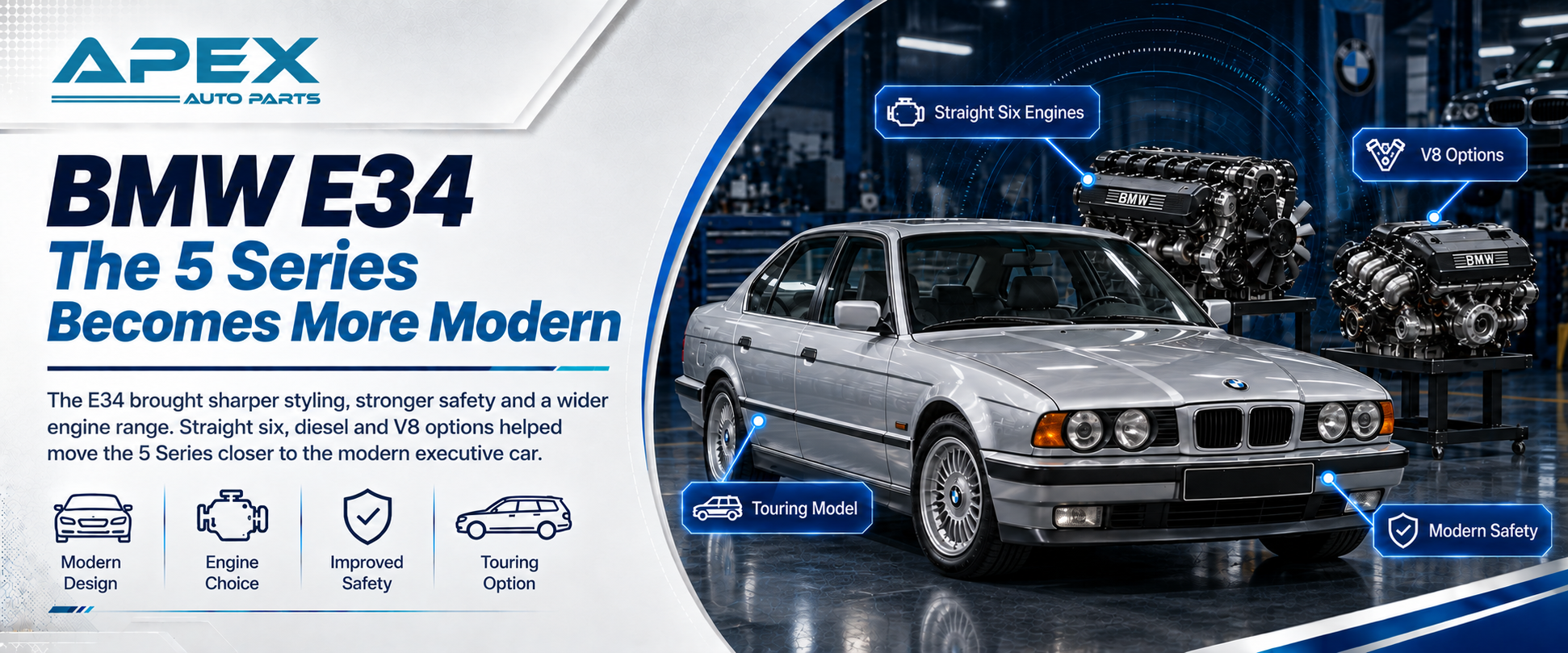
BMW introduced the third generation E34 in 1988, and it represented a major step forward.
The design became more modern, the car gained better safety and refinement, and the engine range expanded significantly. BMW offered four-cylinder, six-cylinder, and eventually V8 engines, along with petrol and diesel power. Touring estate versions also joined the range during this generation, giving buyers much more choice than before.
The E34 is also where the 5 Series began to feel much closer to the modern executive car that people recognize today.
Popular engines included BMW's straight-six petrol units, while later cars gained V8 options. The 535i, for example, used a 3.4-litre straight six producing 211 hp, while the later 540i used a 4.0-litre V8 producing 286 hp.
Diesel technology also improved. BMW moved from the earlier M21 diesel to newer units such as the M51 used in the 525tds.
From a reliability point of view, E34 engines can be strong when maintained correctly. However, age again plays a major role.
The cooling system's condition should be checked closely because old hoses, water pumps and radiators can eventually fail. Oil leaks from ageing seals and gaskets are also common on many high-mileage examples.
Vacuum leaks can cause rough running on petrol engines, while old ignition parts can create misfires or hesitation.
On diesel models, turbo condition and fuel injection equipment need careful inspection.
The important thing when buying an E34 is not to assume that a well-known engine is automatically a good engine. A strong design can still be ruined by poor servicing or repeated overheating.
BMW E39 One of the Best Known 5 Series Generations
The E39 arrived in 1995 and remains one of the most respected generations among BMW enthusiasts.
BMW focused heavily on quality, comfort, and handling. Large parts of the chassis used aluminum, helping reduce weight, and the engine range included petrol and diesel choices. The E39 M5 became particularly famous for its V8 engine producing 400 hp. BMW says almost 1.5 million E39 models were sold during the generation's production life.
The E39 is often praised for achieving a very good balance between modern comfort and mechanical simplicity.
It has more electronics than an E34, but it is still far less complicated than a modern G60.
Many petrol E39 models used BMW straight-six engines, while larger versions used V8 power. Diesel options also became more important as European buyers increasingly moved towards diesel executive cars.
BMW 5 Series engine reliability on the E39 can be excellent when the engine has received regular maintenance. However, cooling system components deserve serious attention.
Plastic cooling parts, hoses, expansion tanks, radiators, thermostats and water pumps can deteriorate with age. A small cooling failure can become a major engine repair if the car is driven while overheating.
Oil leaks can also become common as seals and gaskets age.
On petrol engines, crankcase ventilation faults and vacuum leaks may cause rough running or increased oil use.
Diesel versions can experience turbo, injector or fuel system problems as mileage increases.
The E39 is old enough now that condition is more important than specifications. A carefully maintained 525i with a good history may be a far better purchase than a poorly maintained higher-performance model.
BMW E60 Technology Changes the 5 Series
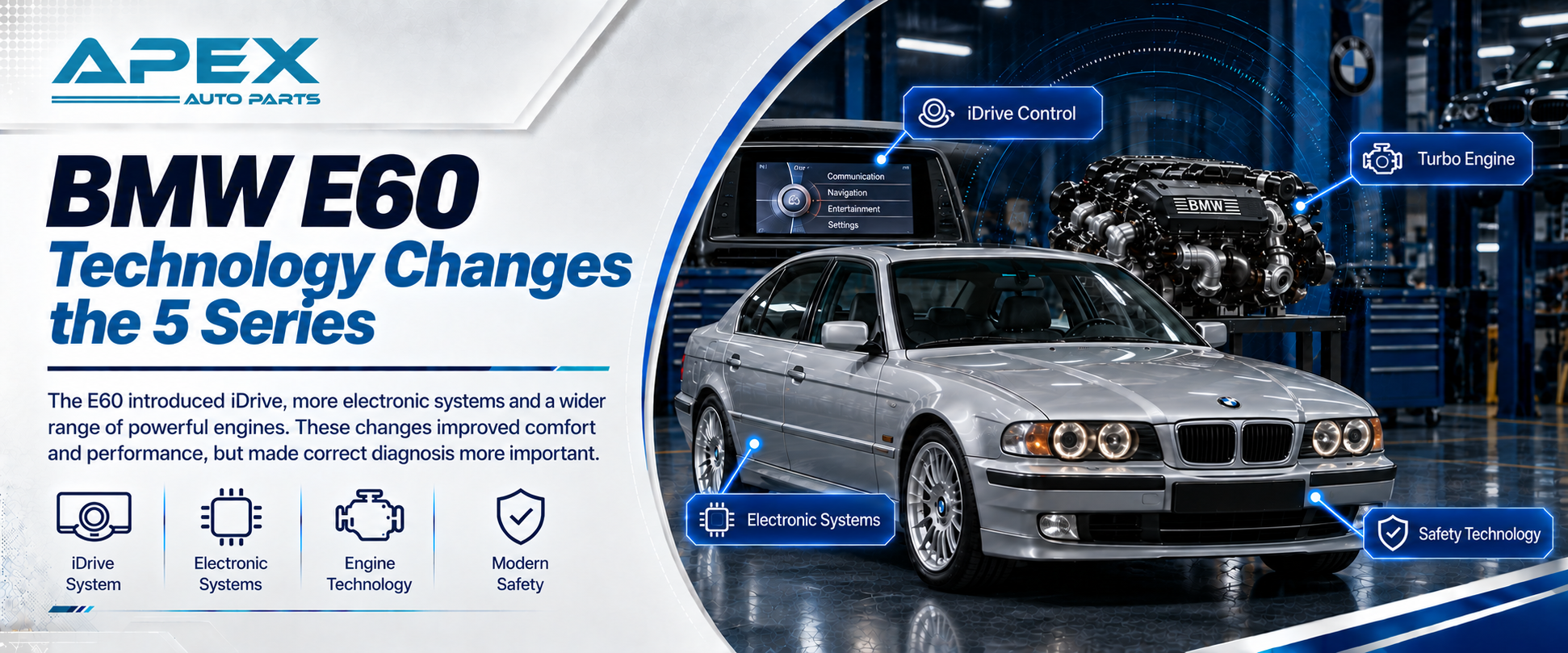
The E60 generation arrived in the early 2000s and represented one of the biggest changes in 5 Series history.
Its styling was much more modern, and the cabin introduced far more electronic control. BMW's XDrive system became a major part of the car, while engine management, safety systems and other vehicle functions became increasingly computer-controlled.
The engine range was also broad. Buyers could choose from four-cylinder and six-cylinder petrol and diesel engines, while high-performance versions used V8 and eventually V10 power in the M5.
For many UK buyers, six-cylinder diesel models became especially attractive because they combined strong motorway performance with reasonable fuel economy.
This generation also marks the point where BMW 5 Series engine problems became more dependent on exact engine code rather than simply the vehicle model.
Some petrol engines can suffer from oil leaks, ignition coil problems, cooling faults and increased oil consumption.
Diesel engines may develop turbocharger issues, injector problems, EGR faults or diesel particulate filter trouble, especially on cars used mainly for short journeys.
Swirl flap concerns on certain diesel engines also became widely discussed among owners and specialists.
The E60's extra electronics mean diagnosis becomes more important than it was on older generations.
A warning light should not automatically lead to parts replacement. Proper fault reading, live data, and mechanical testing are needed to identify the actual cause.
When buying an E60, service records are extremely important because neglected cars can quickly become expensive.
BMW F10 Turbocharging Becomes the Normal Approach
The sixth generation F10 arrived in 2010 and remained in production until 2017. The range included the F10 saloon, F11 Touring and F07 Gran Turismo. BMW offered petrol engines from models such as the 520i through to the 550i, while diesels included the 518d, 520d, 525d, 530d and 535d.
The F10 moved the 5 Series further into the turbocharged era.
Instead of larger naturally aspirated engines being the normal choice, smaller turbocharged units became much more common. Turbocharging allowed BMW to improve power and fuel economy, but it also meant oil quality and servicing became even more important.
BMW 5 Series engine reliability on an F10 can vary considerably depending on the engine.
Some four-cylinder diesel engines from this period became known for timing chain concerns, making service history and unusual engine noise particularly important when buying used.
Six-cylinder diesels can be very strong, especially for long-distance driving, but they still need correct oil servicing and healthy emissions equipment.
Petrol models may suffer from oil leaks, cooling issues, ignition faults or turbo-related problems depending on the specific engine.
The F10 also introduced more advanced automatic transmissions and electrical systems, so a problem that feels like an engine fault may sometimes come from the gearbox or another drivetrain component.
A proper test drive is essential.
The engine should start smoothly, produce strong power and reach normal temperature without warnings. Gear changes should also feel controlled.
BMW G30 Modern Engines, More Electronics and Hybrid Power
The G30 arrived in 2017 as the seventh generation of the 5 Series.
BMW reduced weight, increased technology and offered an even wider range of petrol, diesel and electrified models. The G30 range included vehicles such as the 520i, 530i and 540i, along with diesel models such as the 520d and 530d. Plug-in hybrid versions, including the 530e, also became important.
For many owners, the G30 represents a strong balance between current BMW technology and a relatively familiar engine layout.
Four-cylinder petrol engines such as the B48 and six-cylinder engines such as the B58 have generally built positive reputations when serviced properly. Diesel engines can also cover high mileage, especially when used for longer journeys.
However, good BMW 5 Series engine reliability still depends on maintenance.
Cooling system components, oil leaks, sensors, and turbo-related parts can eventually need attention.
Plug-in hybrid models add another layer of complexity because the petrol engine works alongside an electric motor, high-voltage battery and additional control systems.
On a hybrid, a warning may not come from the petrol engine at all.
This is why workshops need diagnostic equipment that can read the complete vehicle rather than only basic engine fault codes.
Diesel G30 models also use advanced emissions systems. EGR and DPF conditions should be checked, particularly on cars that have spent most of their lives doing short city journeys.
BMW G60 The Latest 5 Series
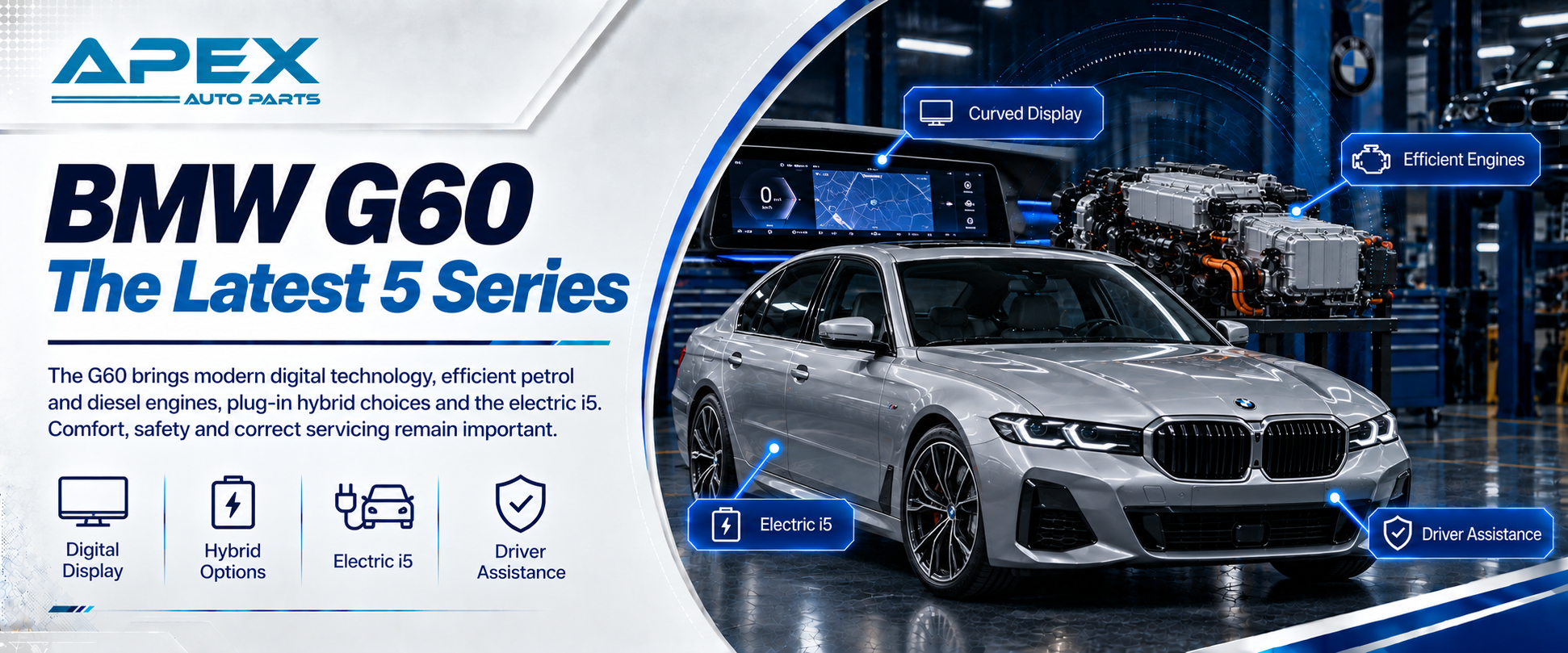
The G60 is the eighth and current generation of the BMW 5 Series. BMW introduced it in 2023, and it represents another major change because petrol, diesel, plug-in hybrid and fully electric power can all sit within the wider 5 Series family.
The G60 is larger and more technology-focused than earlier generations. BMW's current UK range includes conventional combustion-based models, plug-in hybrids such as the 530e and 550e XDrive, and fully electric i5 versions.
The current 520i uses a petrol engine supported by 48-volt mild hybrid technology. BMW lists the current model with combined output around 208 hp and 330 Nm, depending on specification.
The 530e combines a 1,998 cc four-cylinder petrol engine with an electric motor. BMW lists total system output at 299 hp in current UK technical data. The more powerful 550e XDrive combines a 2,998 cc six-cylinder petrol engine with electric assistance and produces a total system output of 489 hp.
This is a good example of how much the 5 Series has changed.
An E12 owner mainly had to think about fuel, spark, cooling, and mechanical condition.
A G60 plug-in hybrid owner may have a turbocharged engine, electric motor, high-voltage battery, several cooling circuits, and advanced software all working together.
That does not automatically make the G60 unreliable. It simply changes what reliability means.
BMW 5 Series engine problems on the G60 will also need more time before any long-term pattern can be judged properly. The generation is still relatively new, so it would be misleading to describe every early fault report as a proven common problem.
How BMW 5 Series Engine Reliability Has Changed Across Generations?
Comparing BMW 5 Series engine reliability across eight generations is difficult because the definition of reliability has changed.
The E12 and E28 were mechanically simple. If fuel, ignition, cooling, and lubrication were working correctly, there were fewer systems available to cause trouble.
However, those cars are now old enough that age itself creates problems.
- Rubber parts harden.
- Wiring becomes brittle.
- Metal corrodes.
- Fuel systems become dirty.
So although the original engineering may be simple, ownership can still require regular attention.
The E34 and E39 improved refinement while remaining reasonably straightforward to repair. This is one reason many enthusiasts still consider them attractive long-term ownership cars.
The E60 and F10 introduced much more electronic control and greater use of turbocharging.
That improved performance and fuel economy but made correct diagnosis more important.
The G30 and G60 take things further with advanced emissions equipment, mild hybrid technology, plug-in hybrid systems and full electric power.
There are now fewer situations where guessing at the failed part makes sense.
Common BMW 5 Series Engine Problems Across Different Generations
There is no single engine fault shared by every BMW 5 Series, but several general problem areas are worth checking when buying used.
Oil leaks are common on many older BMW engines as gaskets and seals age.
Cooling system faults also deserve attention across several generations. A leaking hose, expansion tank, thermostat or water pump can start as a relatively small repair but create major engine damage if overheating is ignored.
Turbocharger problems become more relevant in later generations where turbocharging is widely used.
Petrol cars may develop ignition coil or spark plug faults.
Diesels can experience injector, EGR, DPF or turbo issues.
Modern hybrid models bring electrical motors, batteries and additional cooling systems into the picture.
The exact engine code should, therefore, always be identified before researching BMW 5 Series engine problems.
Advice that applies to one generation may be completely irrelevant to another.
Cooling System Health Matters on Almost Every Generation
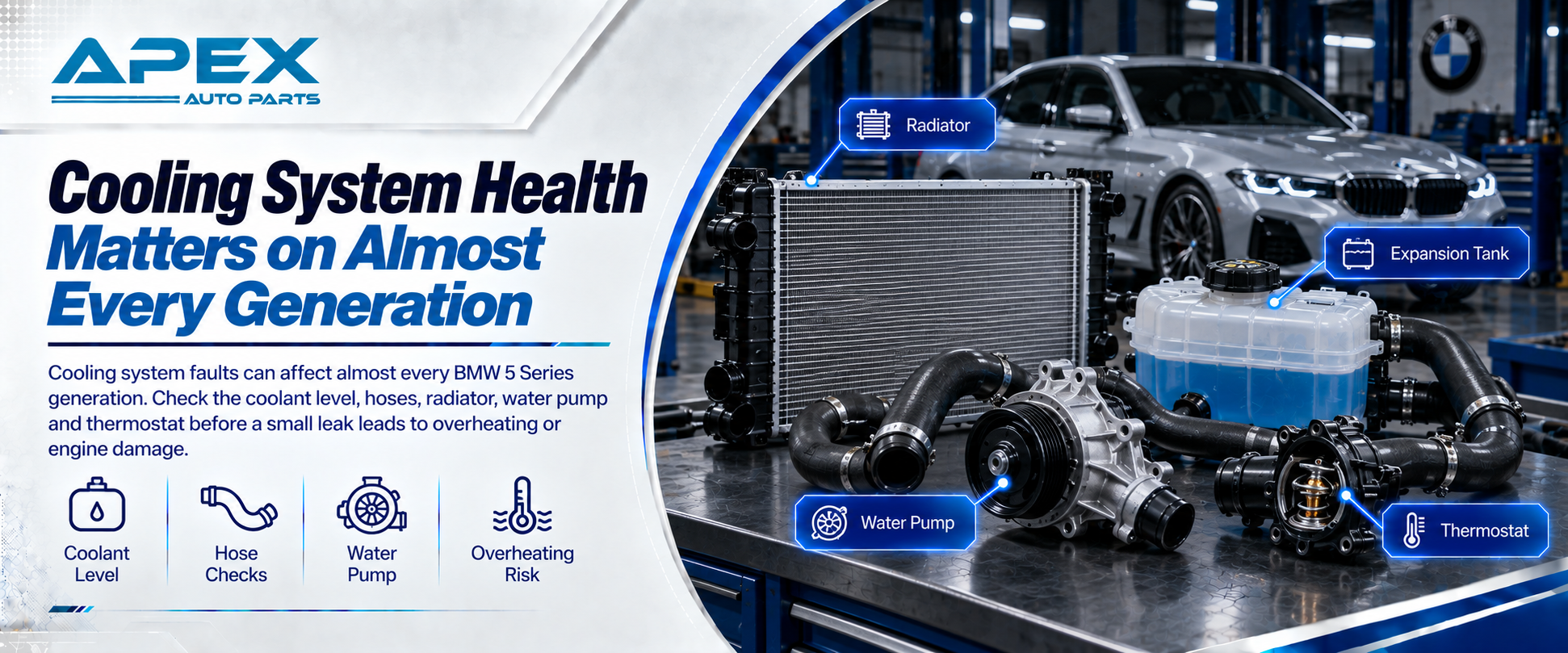
If there is one area that deserves attention on almost every used BMW, it is cooling.
Older cars may have brittle hoses, worn water pumps, or ageing radiators.
Newer models use more advanced cooling arrangements but still depend on stable coolant circulation.
Repeated coolant loss is never something to ignore.
If you need to top up the coolant regularly, find the leak.
Do not continue driving until the expansion tank is empty.
Overheating can damage cylinder heads, gaskets and other internal engine parts.
When inspecting a used 5 Series, check the coolant only when the engine is cold.
Look for dried coolant marks around connections and ask the owner whether any major cooling work has been completed.
A car with a recently renewed cooling system can sometimes be a better purchase than one still relying on very old original components.
Oil Servicing Is Critical on Turbocharged Models
Modern BMW engines rely heavily on good oil.
The oil lubricates the crankshaft and camshafts while also protecting the turbocharger.
Oil that has been left in the engine too long can become contaminated and less effective.
This is particularly important on turbocharged engines because turbo-bearings operate at extremely high speeds.
For used buyers, regular oil service history should therefore be one of the first things to check.
Long gaps in the maintenance record deserve caution.
If the engine has an oil leak, repair it rather than simply topping up the level indefinitely.
Good BMW 5 series engine reliability usually starts with basic lubrication and cooling maintenance.
Diesel 5 Series Problems Need the Right Type of Driving
Diesel 5 Series models became very popular because they combine strong torque with good motorway economy.
Engines such as the 520d, 530d and 535d have been widely used by business drivers and people covering high annual mileage.
Diesel engines often suit this kind of work very well.
Problems can begin when modern diesel versions are used almost entirely for short journeys.
The diesel particulate filter needs suitable operating conditions to clean itself.
EGR systems can also become dirty over time.
If the engine rarely reaches full working temperature, emissions problems can become more likely.
This does not mean diesel is unreliable.
It means the vehicle should match the type of driving you actually do.
Petrol 5 Series Engine Problems
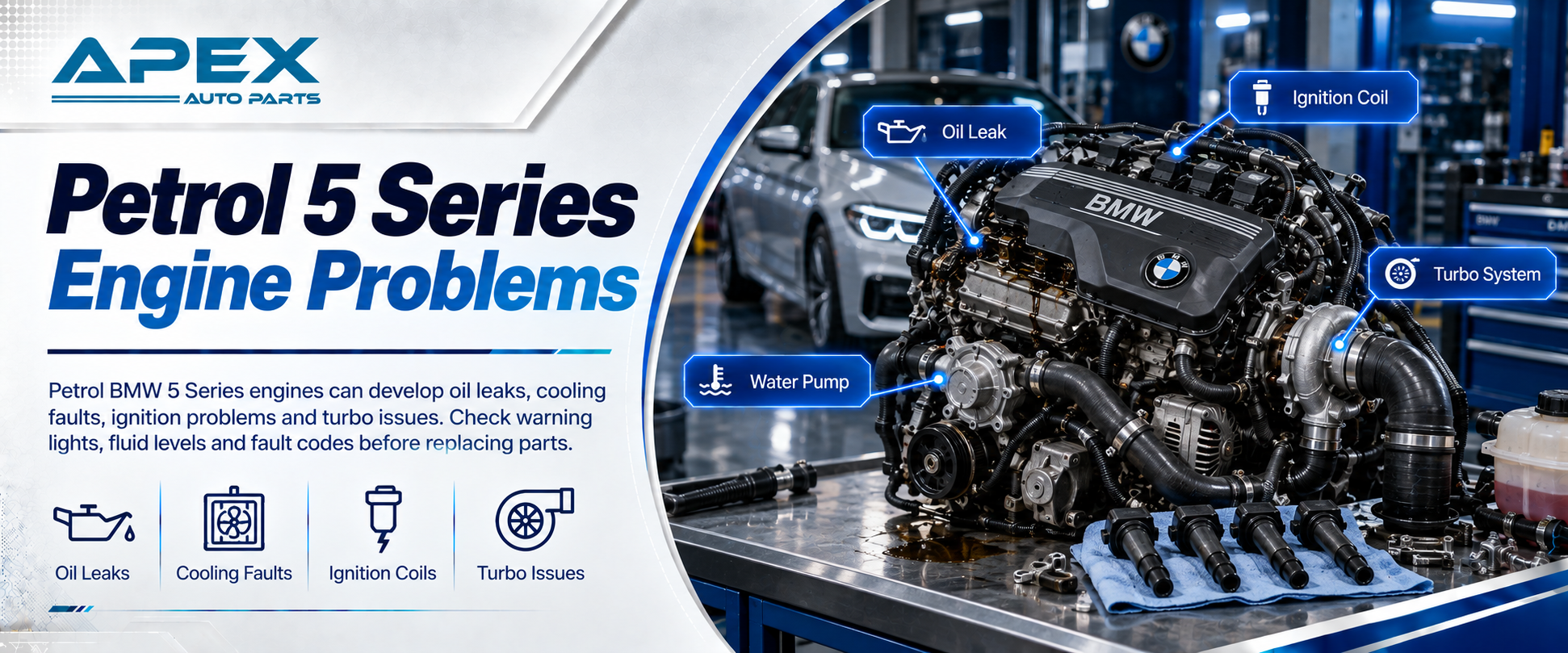
Petrol BMW engines have their own areas to watch.
Older engines may develop vacuum leaks, oil leaks or cooling problems.
Later turbo petrol engines can experience ignition faults, boost leaks, turbo issues or sensor problems.
Spark plugs and ignition coils are especially important because a single weak coil can cause a noticeable misfire.
Do not assume rough running means the engine is internally damaged.
The fault could be much smaller.
A mechanic should read the stored fault information, identify which cylinder or system is affected, and test the related components before expensive BMW 5 Series engine parts are ordered.
Hybrid 5 Series Models Change the Repair Process
Plug-in hybrid 5 Series models add another level of diagnosis.
A 530e or 550e does not simply have an engine and gearbox.
The powertrain includes an electric motor, high-voltage battery, control electronics and additional cooling equipment.
A loss of performance may therefore involve the petrol engine or the electrical system.
Workshop staff also need the correct training because high-voltage systems require additional safety procedures.
For owners, the normal petrol engine maintenance still matters.
The fact that the car can travel electrically does not mean the combustion engine can be ignored.
Oil quality, coolant and scheduled servicing remain important.
The Electric i5 Changes the Meaning of Engine Parts
The G60 generation is also the first 5 Series generation where fully electric i5 models sit directly alongside combustion-powered versions.
An i5 does not have traditional BMW 5 Series engine parts because there is no petrol or diesel engine.
There are no spark plugs, engine oil filters, injectors or conventional turbochargers.
Instead, the vehicle relies on electric motors, a high-voltage battery, power electronics and thermal management.
This is an important distinction for parts suppliers and workshops.
The phrase "5 Series parts" now covers vehicles that may have completely different power systems.
Accurate vehicle identification is more important than ever.
Buying BMW 5 Series Engine Parts
Buying BMW 5 Series engine parts should begin with identifying the exact vehicle.
Do not order using only the words "BMW 5 Series".
Across eight generations, BMW has used four-cylinder engines, straight-six engines, V8s, V10s, diesel engines, turbo petrol units, plug-in hybrids and fully electric systems.
Even the same badge can mean different things depending on the year.
Before ordering engine components, check:
- VIN
- Generation
- Model year
- Exact engine code
- Production date
- Fuel type
- Existing part number where possible
At Apex Auto Parts, matching the component to the correct vehicle specification can help prevent fitting problems and unnecessary returns.
This becomes especially important with sensors, gaskets, cooling parts, turbo components, crankshafts, cylinder heads and other engine parts where small specification differences matter.
Why Should Diagnosis Come Before Replacement Parts?
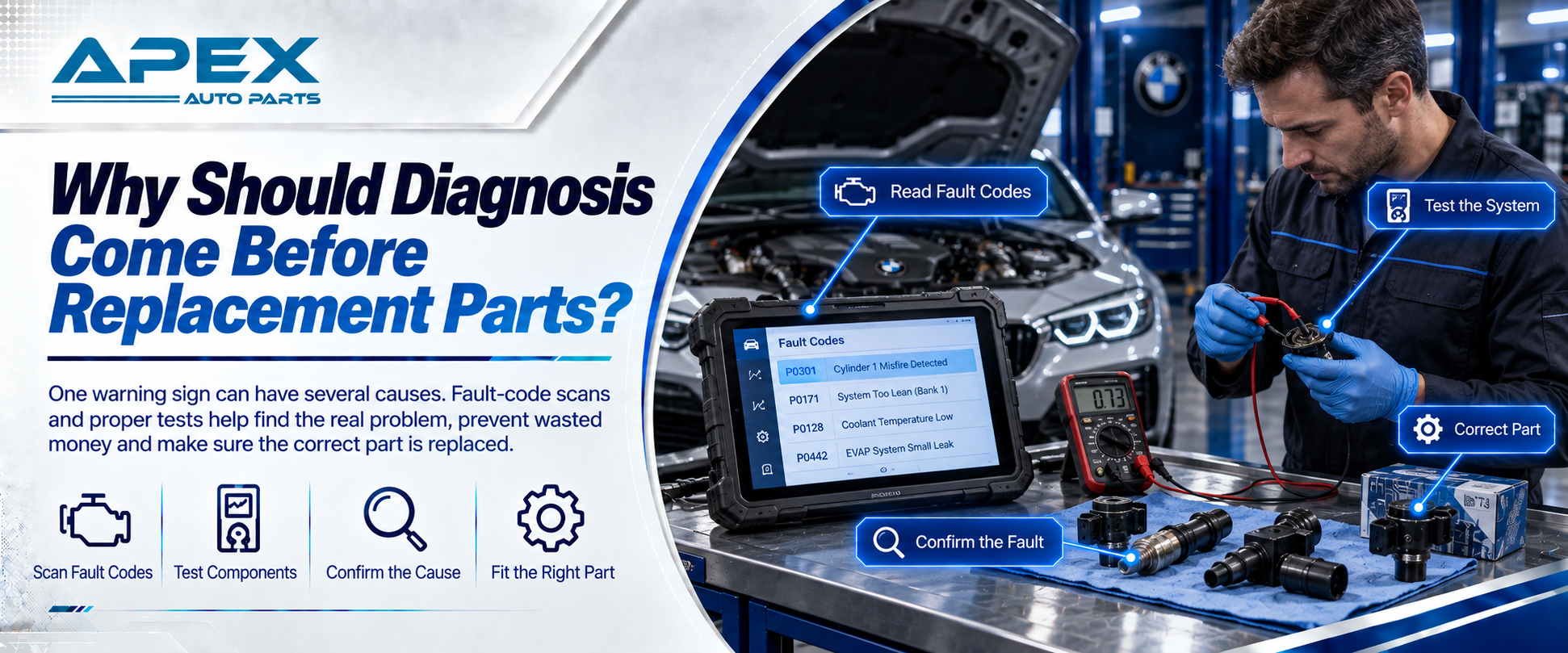
A modern 5 Series can display a warning for many different reasons.
A loss of power could come from a turbocharger, intake leak, sensor, fuel problem, or emissions fault.
Rough running could be caused by ignition, injection, or air supply.
Replacing parts one by one until the fault disappears is expensive.
A good mechanic should start with diagnosis.
Read the fault information.
Check live data.
Inspect hoses and wiring.
Measure pressures where necessary.
Then replace the part that has actually failed.
This is especially important on the E60, F10, G30 and G60 generations because their electronic systems are much more advanced than earlier cars.
What to Check Before Buying Any BMW 5 Series?
The exact inspection should change depending on the generation, but there are several basic checks that apply to most used examples.
Start the engine from cold whenever possible.
Listen for rattles, heavy knocking or uneven running.
Check the oil and coolant levels.
Look around the engine for visible leaks.
Take the car on a proper test drive and allow it to reach operating temperature.
Make sure the engine delivers power smoothly and that the gearbox changes correctly.
Check for warning lights.
After the drive, inspect underneath the car again.
Some leaks become easier to see once the engine is warm.
Service history is just as important.
A vehicle with 120,000 miles and detailed records can be a safer purchase than one with 70,000 miles and large gaps in its maintenance history.
Which BMW 5 Series Generation Is Best for Reliability?
There is no generation that is automatically best for every buyer.
An E39 may appeal to someone who values simple engineering and does not mind maintaining an older car.
An F10 may suit someone who wants modern comfort without moving into the most advanced hybrid technology.
A G30 offers newer engines, strong refinement and a wide choice of petrol, diesel and hybrid power.
The G60 provides the latest technology but is still too new for a full picture of long-term reliability.
The better question is which generation suits your budget and your ability to maintain it.
Older cars may be easier to repair but need more age-related work.
Newer cars may need less regular mechanical attention but can be more expensive when an advanced system fails.
Is a High-Mileage BMW 5 Series Worth Buying?
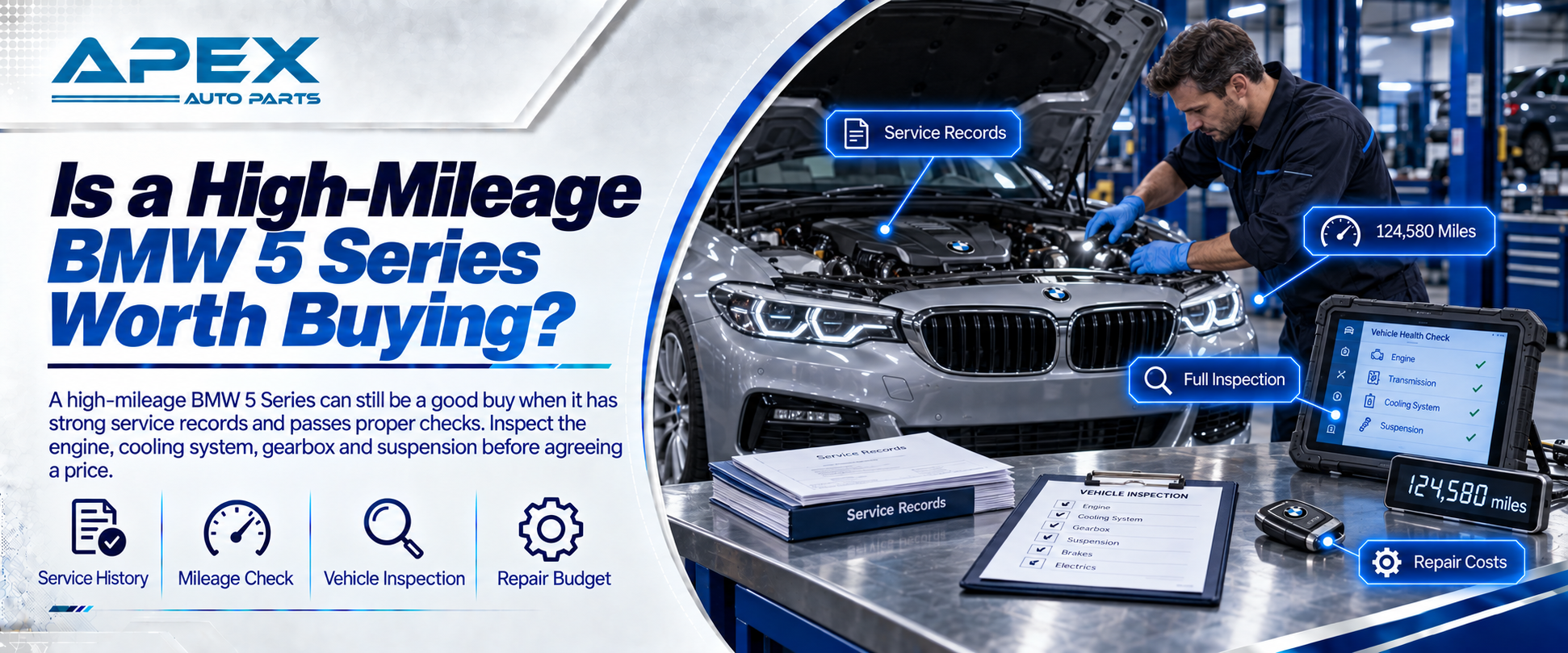
A high-mileage 5 Series can still be a good purchase.
These cars have always been popular for motorway travel, so some examples cover large distances quickly.
Motorway miles with regular servicing can sometimes be easier on the engine than years of short journeys.
Look at the service record.
Check whether important repairs have already been completed.
Inspect the cooling system and listen carefully to the engine.
For diesels, check the emissions system condition.
For hybrids, make sure the electrical powertrain works correctly as well as the engine.
Mileage should be part of the decision, but it should never be the only factor.
Final Thoughts
The BMW 5 Series has changed more than almost any other long-running BMW model.
The E12 started the story in 1972 with four-cylinder and six-cylinder petrol engines and relatively simple mechanical systems. The E28 introduced diesel power and the first M5.
The E34 expanded the range with more engine choices, Touring models and V8 power. The E39 improved refinement and became one of the best-loved 5 Series generations.
The E60 brought more electronics and a very wide engine range. The F10 pushed the 5 Series deeper into turbocharging, while the G30 added stronger hybrid choices. The current G60 now offers petrol, plug-in hybrid and fully electric i5 models within the wider 5 Series family.
BMW 5 Series engine reliability, therefore, depends heavily on which generation and engine you are talking about.
An E34 straight six cannot be judged by the same standards as an F10 diesel or G60 plug-in hybrid.
BMW 5 Series engine problems also vary by engine code. Oil leaks, cooling faults, turbo issues, ignition problems, emissions faults and hybrid system problems all belong to different parts of the 5 Series story.
The best way to avoid expensive repairs is to buy on condition rather than badge alone. Check the service history, identify the exact engine and diagnose faults before buying BMW 5 Series engine parts.
When replacement components are required, specialist suppliers such as Apex Auto Parts can help match parts using the correct vehicle, engine and production details.
The 5 Series has lasted for eight generations because the basic idea has remained useful: comfort for long journeys, enough performance to make driving enjoyable and a wide engine range for different owners. What sits underneath the bonnet has changed enormously, but buying a good one still comes down to the same thing. Find the right engine, check how it has been maintained and deal with problems before they become expensive.
FAQS
1. How many generations of the BMW 5 Series are there?
There are eight BMW 5 Series generations. They are the E12, E28, E34, E39, E60, F10, G30 and current G60. BMW launched the first 5 Series in 1972, while the eighth generation, the G60, entered production in 2023 and includes petrol, hybrid and fully electric power options.
2. Which BMW 5 Series generation is the most reliable?
There is no single generation that is automatically the most reliable. Older E34 and E39 models are mechanically simpler but now suffer from age-related wear. Newer F10 and G30 cars offer better technology but have more complex systems. Service history and engine condition matter more than generation alone.
3. Is BMW 5 Series engine reliability good?
The BMW 5 Series engine reliability can be very good when the correct engine is serviced properly. Regular oil changes, cooling system care, and early repair of leaks or warning lights are important. Reliability varies greatly between engine families, so the exact engine code and service history should always be checked.
4. What are the most common BMW 5 Series engine problems?
BMW 5 Series engine problems can include oil leaks, coolant loss, ignition faults, turbo problems, timing-related issues, and sensor failures. Modern diesel models may also experience EGR or DPF faults, while plug-in hybrids add battery and electrical systems. The exact problems depend on generation and engine type.
5. What was the first BMW 5 Series?
The first BMW 5 Series was the E12, introduced in 1972 as the replacement for BMW's New Class saloons. It used four-cylinder and six-cylinder petrol engines and helped introduce BMW's modern model naming system. Production continued until 1981, when the E28 replaced it.
6. Which BMW 5 Series introduced diesel engines?
The second-generation E28 introduced diesel engines into the 5 Series range. Models included the BMW 524d and the turbocharged 524td. The E28 was also important because it introduced the first BMW M5, making this generation significant for both economy-focused and high-performance versions.
7. What is the latest BMW 5 Series generation?
The latest BMW 5 Series is the eighth generation G60, introduced in 2023. It is available with combustion engines, plug-in hybrid systems and fully electric BMW i5 versions. Current UK choices include models such as the 520i, 530e, 550e XDrive and electric i5.
8. Are BMW 5 Series engine parts easy to find?
Many BMW 5 Series engine parts are widely available, particularly for popular E39, E60, F10 and G30 models. Older classic parts may require more searching. Always identify the VIN, engine code, production year, and existing part number before ordering because different generations can use completely different components.
9. Is a high-mileage BMW 5 Series worth buying?
A high-mileage BMW 5 Series can be worth buying when it has a detailed service history and has been maintained correctly. Check oil and coolant condition, engine noise, gearbox operation and previous repairs. A properly serviced motorway car can sometimes be a better purchase than a lower-mileage vehicle with poor maintenance.
10. Where can I buy BMW 5 Series engine parts?
You can source BMW 5 Series engine parts through specialist suppliers such as Apex Auto Parts. Before ordering, provide the VIN, generation, engine code, fuel type and existing part number where possible. Accurate matching is especially important because the 5 Series has used many different petrol, diesel and hybrid engines across eight generations.