
 info@apexautoparts.co.uk
 +44 203 915 7535
 Safe & Fast Shipping
 Whish List
 Compare
 Sign In

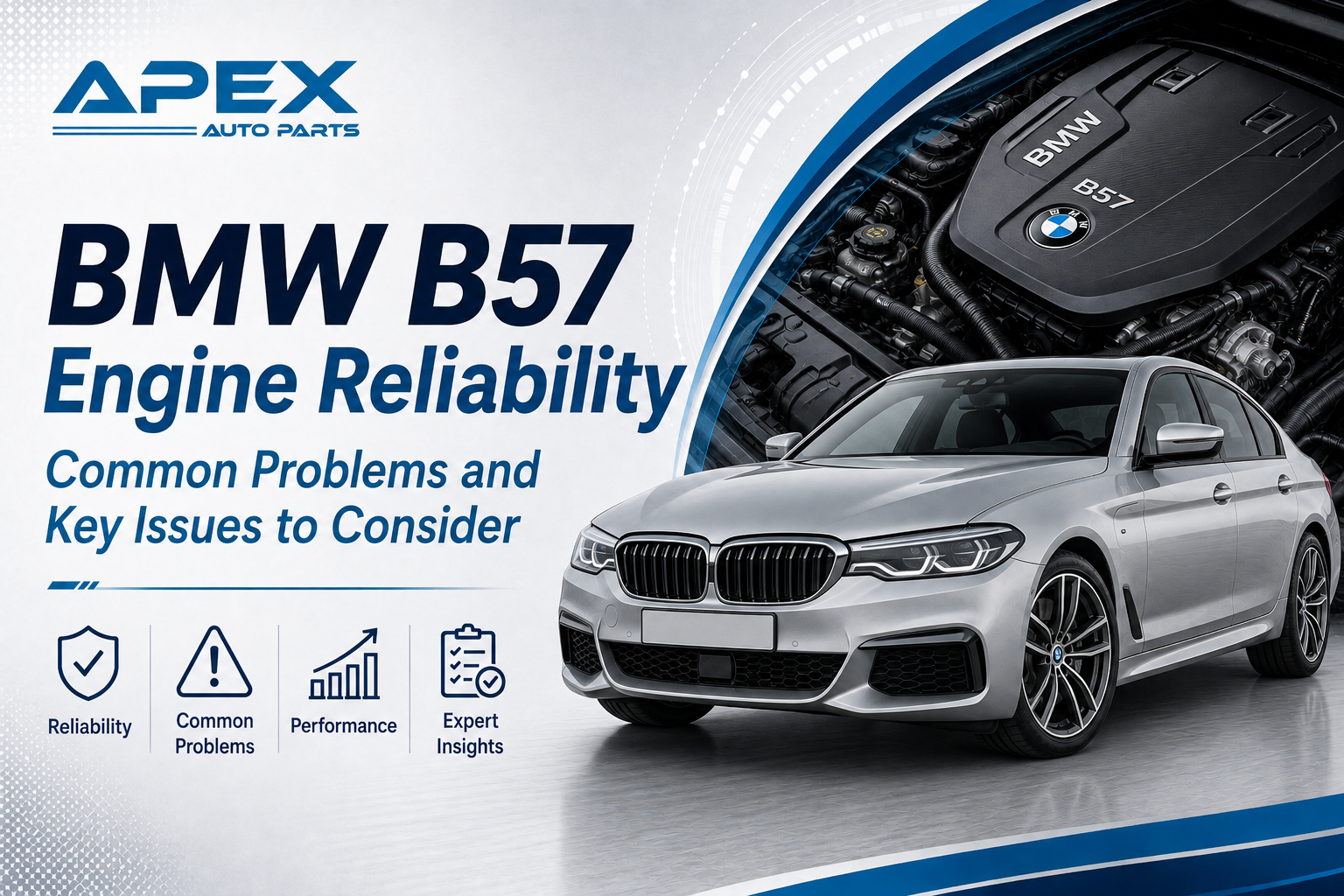
The BMW B57 engine is one of BMW's best-known modern diesel engines. It is a 3.0-litre, six-cylinder unit built for strong torque, smooth motorway driving, and good fuel economy. It has been used in several BMW cars and SUVs, including versions of the 3 Series, 5 Series, 7 Series, X3, X4, X5, X6, and X7.
Many owners see the B57 as a clear step forward from older BMW diesel engines. It feels smooth, pulls strongly at low engine speeds, and can cover high mileage with the right care. However, no modern diesel is free from problems. The B57 uses a turbo system, high-pressure fuel injection, an EGR cooler, a diesel particulate filter, AdBlue equipment on many versions, sensors, and electronic controls.
The first important point is that the B57 is an engine family, not one fixed unit. Different versions have different power outputs, turbo layouts, emissions systems, and software. A 530d, 540d, M340d, and M550d can all use engines from the B57 family, but they do not have the same setup.
An early BMW 730d using the new-generation 3.0-litre diesel produced 265 hp and 620 Nm. The original G30 530d used the same basic output. BMW later updated the 530d to 286 hp and 650 Nm, with mild-hybrid support and a newer two-stage turbo system. At the top of the family, the M550d produced 400 hp and 760 Nm using four turbochargers.
These differences matter when researching BMW B57 engine problems, buying replacement parts, or planning repairs. Advice for one version may not apply to another.
What Is the BMW B57 Diesel Engine?
The BMW B57 diesel engine is a 2,993 cc straight-six. Straight six means all six cylinders are aligned in a straight line. This design helps the engine feel smooth because the pistons' movement is naturally well balanced.
BMW uses common rail direct fuel injection. A high-pressure pump sends diesel to a shared fuel rail, and the injectors deliver carefully measured amounts into each cylinder. Modern versions can perform multiple injections during a single combustion cycle. This helps reduce noise, control emissions, and improve power delivery.
The engine also uses turbocharging. The exact turbo layout depends on the model and year. Some versions focus on normal road performance, while stronger versions use more complex turbo systems to produce greater power.
BMW's official UK parts listings identify the G30 530d as using the B57, while BMW's media information lists the original G30 530d at 265 hp and 620 Nm. BMW also published the B57D30T2 engine code for a later version of its six-cylinder diesel engine.
The B57 is normally paired with an eight-speed automatic gearbox. Depending on the vehicle, power may go to the rear wheels or through BMW x Drive to all four wheels.
Is the B57 a good engine?
For most owners, the answer to whether the B57 is a good engine is yes, provided it has been serviced correctly.
The basic engine is strong, smooth, and capable of high mileage. It produces useful torque without requiring very high engine speeds. This makes it well-suited to motorway travel, larger vehicles, and drivers who tow or carry loads.
The engine itself is only part of the reliability story. Modern diesel equipment around it can still become expensive. An EGR cooler, diesel filter, turbo actuator, injector, pressure sensor, or AdBlue part can fail even when the main block, crankshaft, and pistons remain healthy.
This is why the condition of the complete vehicle should be judged when assessing B57 engine reliability. A car with regular oil changes, stable coolant levels, completed recall work, and mostly longer journeys may be a much safer purchase than a lower-mileage example with a missing service history.
The B57 also needs a correct diagnosis. A low boost code does not always mean the turbo has failed. A diesel filter warning does not always mean the filter needs replacing. A long starting time does not automatically prove that the injectors are worn.
Good mechanics test before ordering parts.
Understanding the BMW 530d G30 engine B57?
The BMW 530d G30 engine, the B57, is one of the most common versions buyers will find on the used market.
When the G30 5 Series was introduced, the 530d used a 2,993 cc six-cylinder diesel producing 265 hp and 620 Nm. BMW listed a zero to 62 mph time of about 5.7 seconds for the Rear Wheel Drive car and 5.4 seconds for the x Drive version.
The updated G30 530d received a stronger version with 286 hp and 650 Nm. It also gained mild hybrid technology. BMW listed the torque as available from 1,500 to 2,500 rpm, helping the car deliver quick response without high revs.
The later engine also used two-stage turbocharging. BMW stated that this version had variable turbine control on the low-pressure side and fuel injection pressure reaching up to 2,700 bar.
Both versions are strong performers, but VIN and engine details should always match parts. A sensor, EGR component, turbo part, hose, injector, or gasket from one version may not fit another.
How do the B57 engine turbos differ?
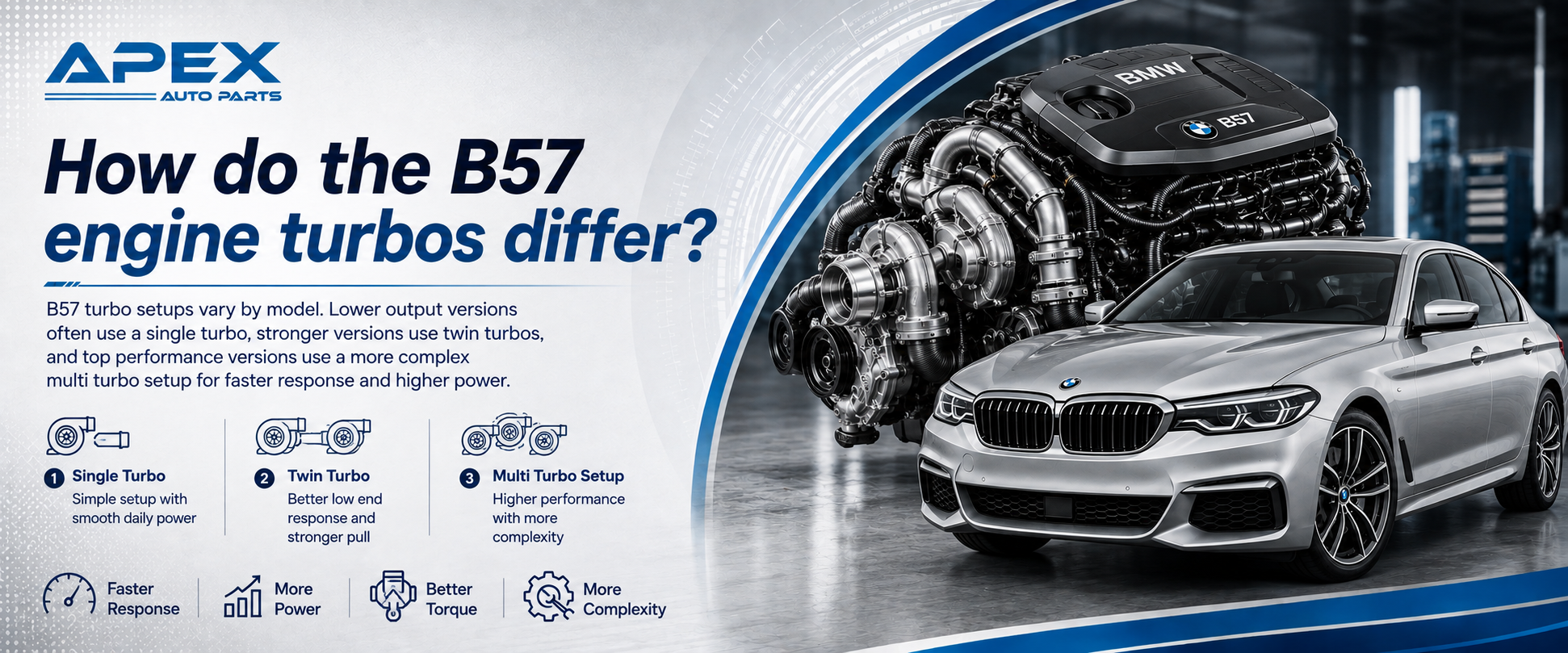
The phrase "B57 engine turbos" can be confusing because the B57 family uses several turbo arrangements.
An original 530d and a later 530d do not use the same setup. The updated 286 hp engine uses two-stage turbocharging. BMW designed the system to improve response at low engine speed while still supplying enough air at higher load.
The stronger 340-hp diesel used in models such as the M340d produces 700 Nm of torque. BMW combined the engine with mild hybrid support and Twin Power Turbo technology.
The most complex factory version was fitted to the M550d. It used four turbochargers and produced 400 hp with 760 Nm. BMW described it as the most powerful six-cylinder diesel engine available at the time.
More turbos do not automatically mean poor reliability. They do mean more pipes, actuators, bearings, seals, and controls. Diagnosis can also take longer because a boost problem may involve one part of a multi-stage system rather than the whole assembly.
A good workshop should check the requested boost, actual boost, airflow, actuator movement, pipe condition, exhaust pressure, and stored fault codes before recommending a turbo replacement.
Common BMW B57 engine problems
The following BMW B57 engine problems do not affect every vehicle. Some are linked to specific production dates or models, while others are normal risks found in complex modern diesel engines.
The safest approach is to diagnose the individual car rather than assume it faults because another owner reported one online.
EGR Cooler Leaks
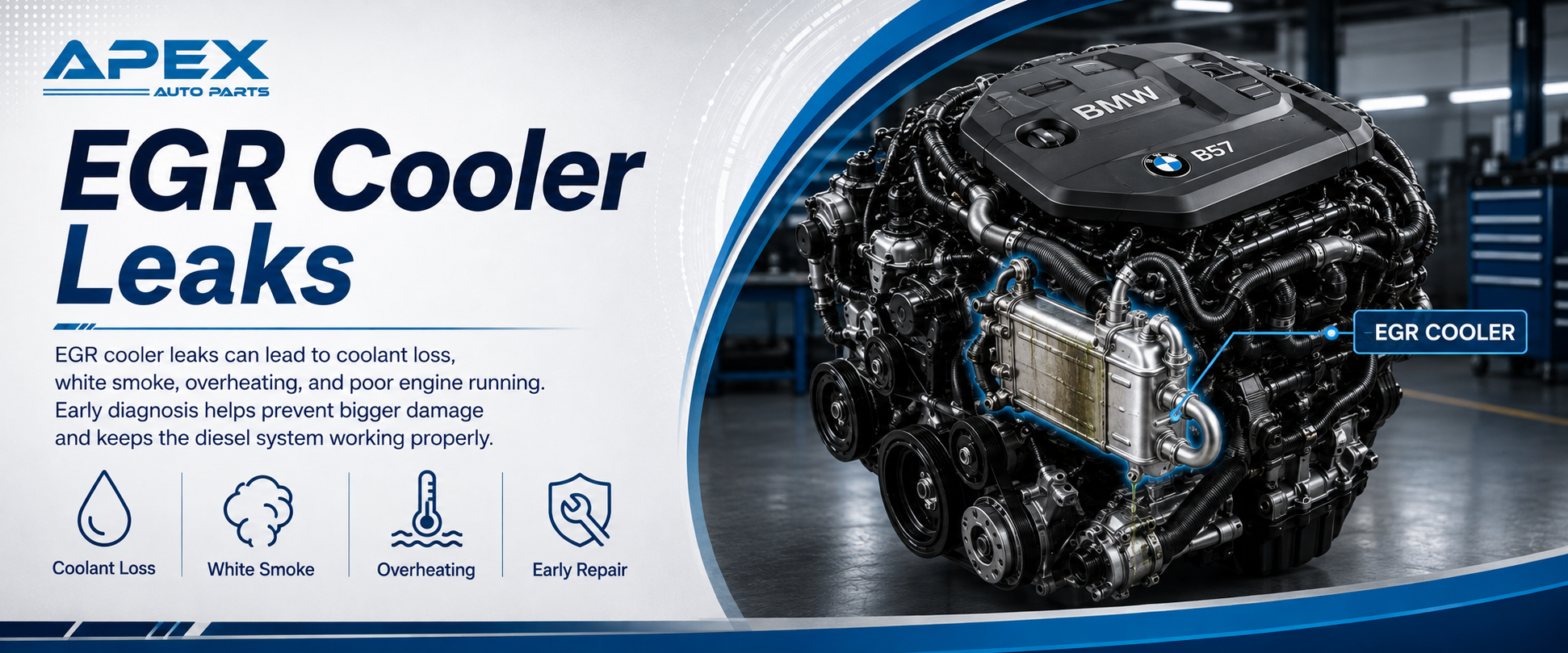
The EGR system sends a controlled amount of exhaust gas back into the intake. This helps reduce certain harmful emissions. Because the exhaust gas is hot, the system uses a cooler filled with engine coolant.
BMW issued a recall for certain B57-powered vehicles because an EGR cooler could leak internally. In the United States, a recall covered certain 2018 BMW 540d x Drive vehicles with the B57O engine. BMW said that coolant could mix with soot, damage the intake manifold, and, in rare cases, increase the risk of fire. The repair involved replacing the EGR cooler and checking the intake manifold.
This recall does not prove that every B57 has a bad EGR cooler. The VIN must be checked because recalls apply to defined vehicles and production dates. BMW provides a recall tool that uses the 17-digit VIN, and any open BMW recall or technical update listed there is carried out without charge.
Possible warning signs include coolant loss, an exhaust smell, smoke from the engine area, reduced power, an EGR warning, or an unusual noise.
If smoke appears from the engine bay, stop safely and do not continue driving.
Diesel Filter Problems
The diesel particulate filter traps soot from the exhaust. The car must regularly burn this soot during a process called regeneration.
Government guidance explains that failed or incomplete regeneration can allow soot to build up, reduce performance, and lead to costly repairs. It also confirms that removing a factory-fitted diesel filter can make a UK road car illegal and cause an MOT failure.
A blocked filter is often a symptom rather than the first fault.
The engine may not be reaching the correct temperature. An exhaust pressure sensor may be giving a false reading. An injector may be producing too much soot. An air leak, EGR fault, or boost problem may also interfere with regeneration.
A mechanic should check soot load, ash load, pressure readings, exhaust temperatures, coolant temperature, and regeneration history before recommending a new filter.
Cleaning or replacing the filter without fixing the cause often results in the same warning returning.
Oil Level Too High and Fuel Dilution
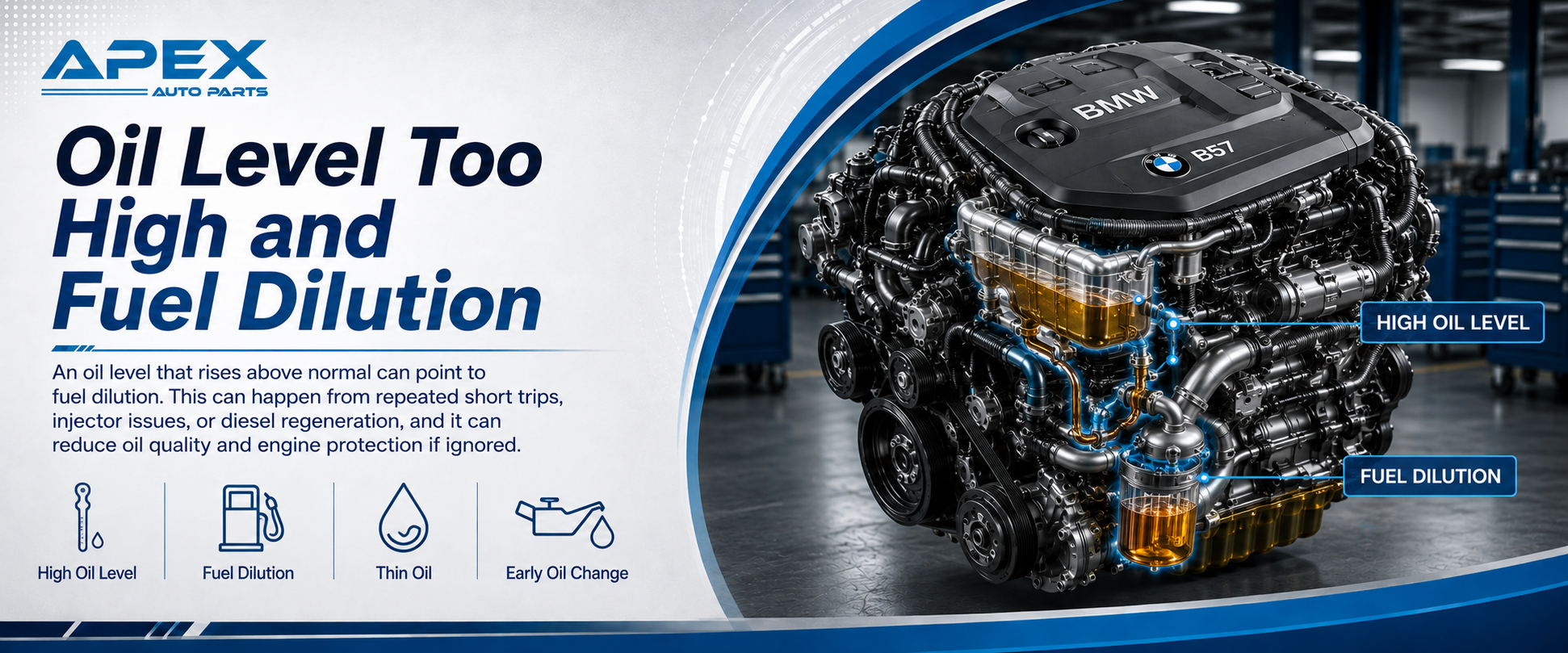
BMW issued a service bulletin for a B57-powered G30 540d in which the vehicle displayed an "engine oil level too high" warning. The stated cause was fuel entering the oil during the diesel filter regeneration strategy. BMW's repair included updated software and an oil change.
This bulletin covered a specific vehicle and market, so it should not be treated as proof that every B57 will dilute its oil.
However, a rising oil level should always be investigated. Diesel fuel mixed with engine oil can reduce the oil's ability to protect bearings, the timing system, camshafts, and turbo parts.
Do not drain a little oil and ignore the cause. The workshop should check whether regeneration is happening too often, whether the engine reaches normal temperature, and whether fuel or emissions faults are present.
Long Cranking Before the Engine Starts
Some B57 owners may experience a longer-than-normal starting time.
A BMW service bulletin for the B57O engine in the 540d covered occasional long cranking during hot or cold starts. BMW traced the specific condition in that bulletin to a fuel temperature and pressure sensor that could leak fuel into its electrical connector, causing an incorrect low-pressure reading.
This is a useful example of why diagnosis matters. A long start does not always require six new injectors or a high-pressure pump.
The mechanic should check the battery, cranking speed, fuel supply pressure, rail pressure, sensor readings, connector condition, glow system, and stored codes.
Changing expensive fuel parts without testing can waste a large amount of money.
Turbo and Boost Faults
Turbo problems can cause weak acceleration, reduced power, smoke, unusual noise, or boost-pressure codes.
The turbo itself may be worn, but several cheaper faults can create the same symptoms. Split air pipes, loose clamps, damaged seals, an intercooler leak, a weak actuator, faulty pressure sensors, or an exhaust restriction can all reduce boost.
A light turbo whistle may be normal. A new siren sound, scraping noise, heavy blue smoke, or rapid oil loss is more serious.
When turbo damage is confirmed, the oil feed and return system must be checked. The intake should also be inspected for broken parts or excess oil. A new turbo can fail again if the cause of the original damage remains.
Multi-stage versions need extra care because the workshop must identify which part of the system is not working correctly.
EGR Valve and Intake Deposits
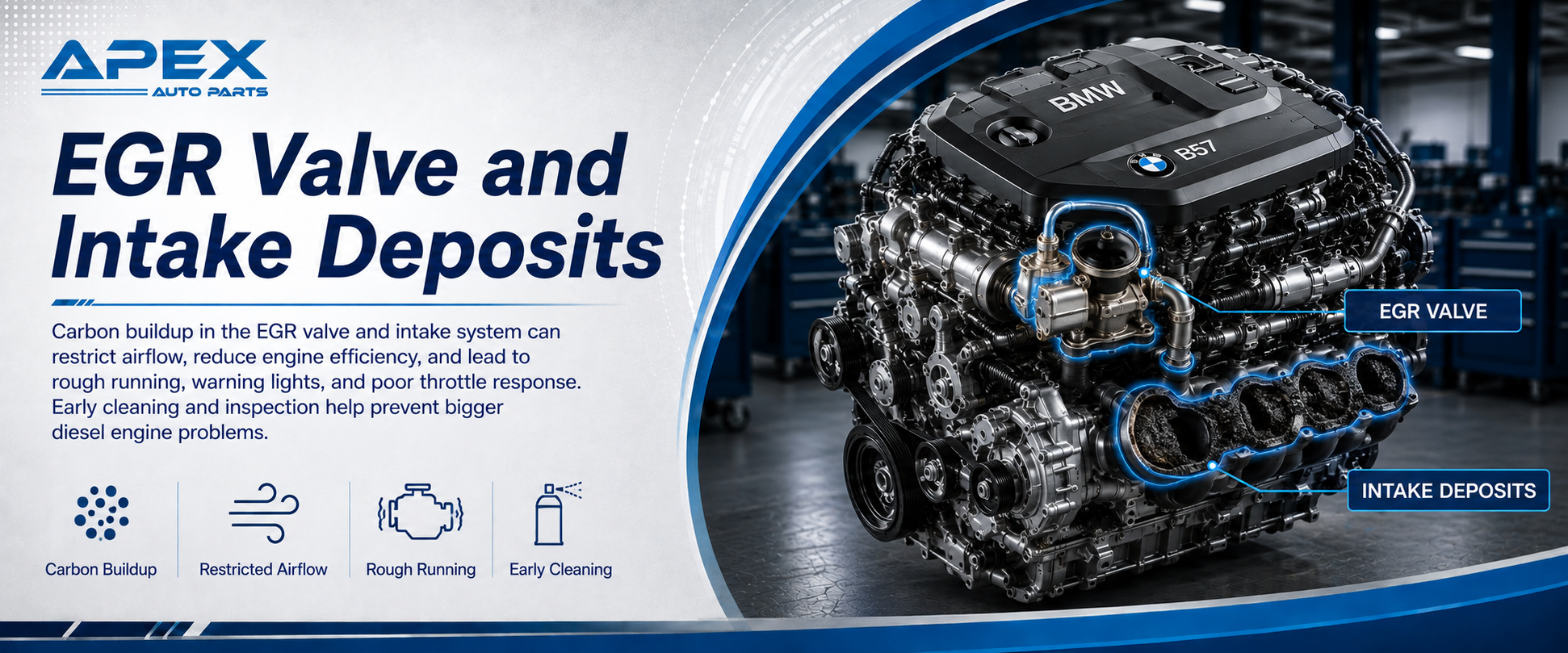
Soot from the EGR system can mix with oil vapor inside the intake. Over time, deposits may restrict airflow or affect flap movement.
Possible symptoms include rough running, delayed response, reduced power, higher fuel use, or an engine warning light.
Do not assume every EGR code means the valve is blocked. The fault may involve a temperature sensor, a pressure sensor, wiring, a cooler, an air leak, or software.
The intake should be inspected when the scan data and symptoms indicate it. Cleaning parts that are not causing the fault wastes time and money.
AdBlue and NOx Sensor Faults
Many B57 vehicles use selective exhaust treatment with AdBlue. This system adds a fluid to the exhaust to reduce harmful nitrogen oxides.
BMW's stronger B57 applications use a diesel filter, nitrogen oxide treatment, SCR equipment, and AdBlue injection as part of the exhaust system.
Low fluid, a failed heater, pump trouble, a blocked dosing injector, a tank sensor, wiring, or a nitrogen oxide sensor may cause an AdBlue warning.
Topping up the tank will not repair a faulty sensor.
Some vehicles may start a distance countdown when the system cannot control emissions correctly. The fault should be scanned and repaired before the countdown reaches zero.
Coolant Leaks
Not every coolant leak comes from the EGR cooler.
The water pump, thermostat, radiator, expansion tank, hoses, seals, and plastic connections can also leak as a vehicle ages.
A slow leak may only appear when the system is hot and under pressure. Dried white or coloured marks can help show where coolant has escaped.
Repeatedly topping up the tank is not a repair. Low coolant can cause overheating, and severe overheating can damage the cylinder head, gasket, pistons, and bearings.
A pressure test is often the best first step.
Oil Leaks
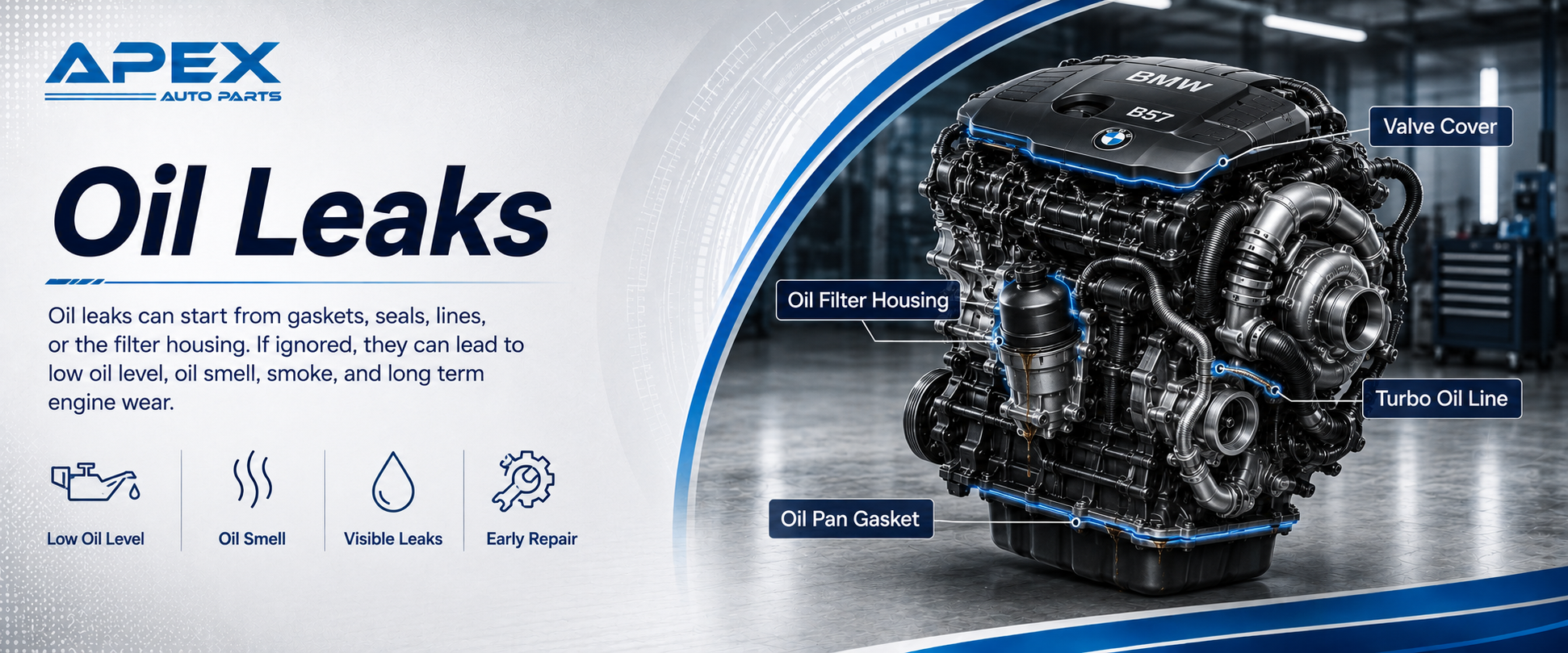
Oil may escape from covers, seals, the oil filter area, turbo oil pipes, or the sump. The exact leak points depend on the vehicle and B57 version.
Oil often travels across the engine while the car is moving. The lowest wet area is not always the source.
The workshop should clean the engine, run it, and inspect it again. Leak tracing dye may help when the source is hidden.
A small leak should still be repaired before the level falls. The B57 turbo system and internal bearings depend on a clean and stable oil supply.
Timing Chain and Engine Noise
The timing system keeps the crankshaft and camshafts moving in the correct relationship.
The B57 does not have the same reputation for widespread timing failure as some older BMW diesel engines. That does not mean every rattle is safe to ignore.
A metallic noise at cold start may come from the timing system. Still, it could also come from a belt tensioner, pulley, alternator, air conditioning compressor, or another moving part.
A mechanic should locate the source of the noise before ordering a chain kit. Timing values, oil condition, oil pressure, and stored camshaft codes may help.
Any loud rattle that changes with engine speed needs prompt attention.
Injectors and Glow Plugs
Common rail injectors work under very high pressure. Over time, an injector may develop poor spray, excessive return flow, or an electrical fault.
Possible symptoms include difficult starting, rough idle, diesel knock, smoke, and uneven power.
Injector correction values can provide clues, but they should not be used alone. Fuel pressure, return flow, wiring, and engine compression may also need to be checked.
Glow plugs support starting in cold weather. A failed plug or glow control unit may cause rough running after a cold start. Older glow plugs must be removed carefully because they can become tight in the cylinder head.
Warning Signs That Need Fast Attention
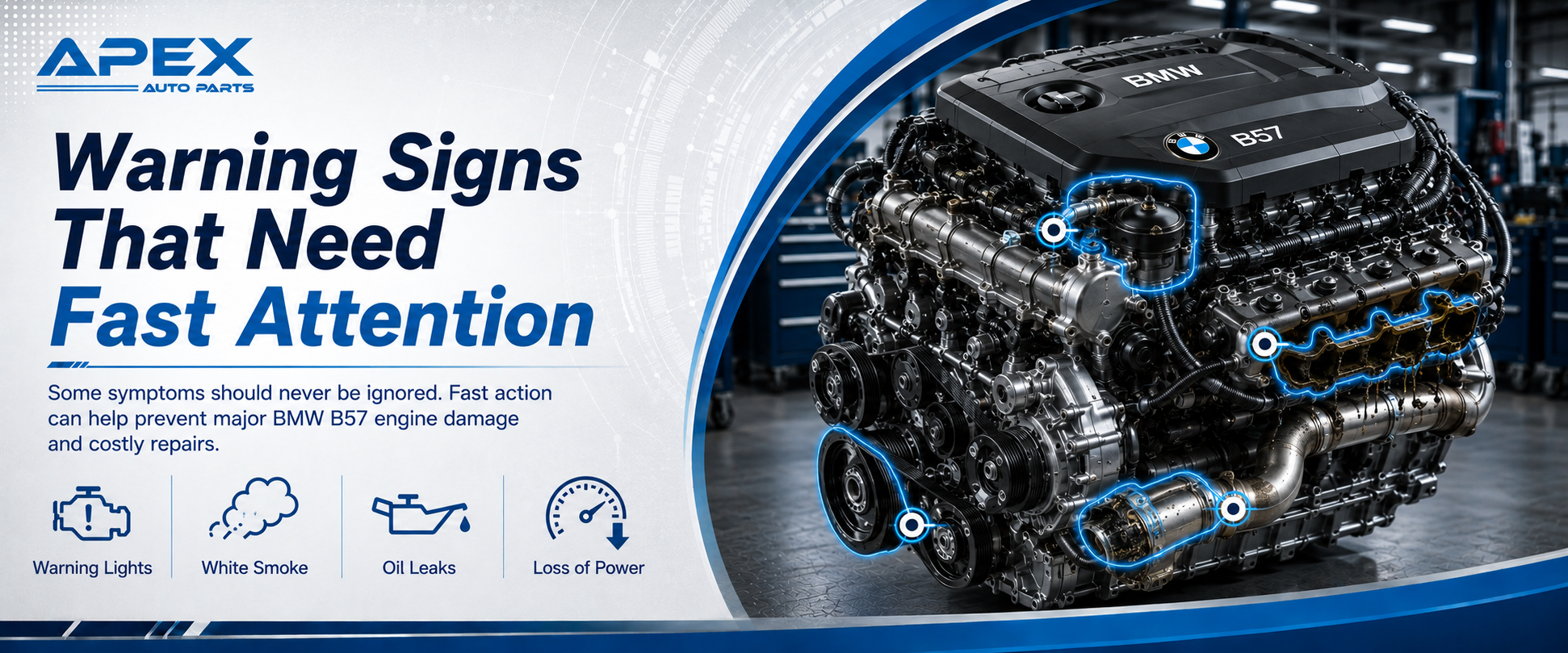
Some B57 engine problems begin with a small change in sound or fluid level.
Arrange a check quickly if you notice:
- A red oil pressure or temperature warning
- Coolant that keeps falling
- Smoke or a strong exhaust smell from the engine bay
- A rising engine oil level
- A loud rattle during a cold start
- Heavy blue or white exhaust smoke
- Sudden loss of power
- A long starting time that keeps returning
- A new siren sound from the turbo area
- An AdBlue message with a starting countdown
A red oil pressure warning is not a normal service reminder. Stop the engine safely. Driving with low oil pressure can quickly damage internal components.
How a Mechanic Should Diagnose B57 Faults?
A good diagnosis begins by listening to the owner.
The mechanic needs to know whether the fault appears when the engine is hot or cold, whether it happens under load, and whether any oil or coolant has been added. Previous repairs and tuning should also be discussed.
The first physical checks should cover the oil level and condition, coolant, battery voltage, intake pipes, wiring, visible leaks, belts, and loose connections.
A full scan should then be completed. Reading only the basic code description is not enough. Live data can show boost pressure, fuel pressure, coolant temperature, exhaust pressure, regeneration history, injector balance, airflow, and EGR readings.
The mechanic should compare what the control unit requests with what the engine actually produces.
A low boost code may come from a split pipe.
A diesel filter code may come from a thermostat problem.
A fuel pressure code may come from a sensor or connector.
An EGR code may come from a cooler or air leak.
Testing the system before buying parts is usually the cheapest method.
Is a High Mileage B57 a Bad Buy?
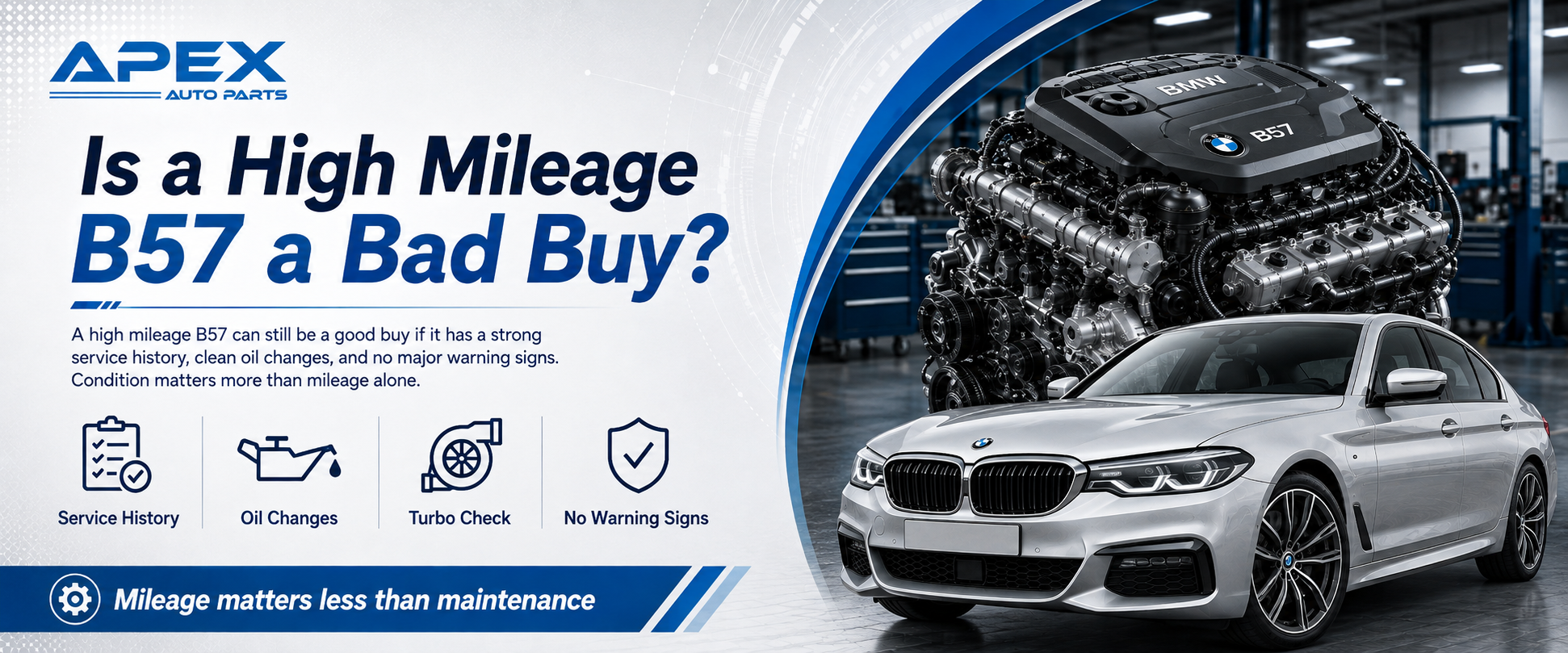
A high-mileage BMW B57 engine is not always a bad buy.
Many B57 vehicles are used for long motorway journeys. That type of driving allows the engine, oil, and exhaust system to reach normal working temperature. It also gives the diesel filter better conditions for regeneration.
A car with 120,000 miles and regular servicing may be safer than one with 70,000 miles, missing invoices, and years of short journeys.
Before buying, ask to see the vehicle from a cold start. A warm engine can hide starting noise, smoke, rough running, and slow oil pressure.
Check these areas:
- Full service invoices
- Oil and filter change history
- Coolant level and EGR recall status
- Diesel filter and regeneration data
- Turbo boost and air pipe condition
- AdBlue and emissions fault codes
- Injector readings and starting behavior
- Evidence of tuning or removed emissions parts
Use the VIN to check for open BMW recalls or technical updates. BMW's official checker uses the 17-digit chassis number and states that open recall work is completed free of charge.
How to Improve BMW B57 engine reliability?
The best way to improve the reliability of the BMW B57 engine is to maintain the entire system, not just the engine itself.
Use the exact oil specification required for the vehicle. Do not choose oil only by its thickness. The correct BMW approval matters because the oil must protect the turbo system, timing parts, bearings, and emissions equipment.
Change the oil and filter on time. Cars used for frequent short journeys or hard driving may need more frequent checks because their oil is exposed to greater contamination and heat.
Check the oil level regularly. A level that rises can be just as important as one that falls.
Check coolant only when the engine is cold. Any repeated loss should be pressure tested.
Give the diesel filter suitable conditions to regenerate. Government guidance confirms that soot must be burned away at high temperature and that failed regeneration can lead to poor performance and expensive repairs.
Allow the engine to warm through gentle driving before using full power. There is no need for long periods of idling. Normal light driving warms the engine and gearbox more evenly.
Investigate new noises early. A small air leak, a worn pulley, or a failing sensor is usually cheaper than the damage it may cause if ignored.
Should You Tune a B57?
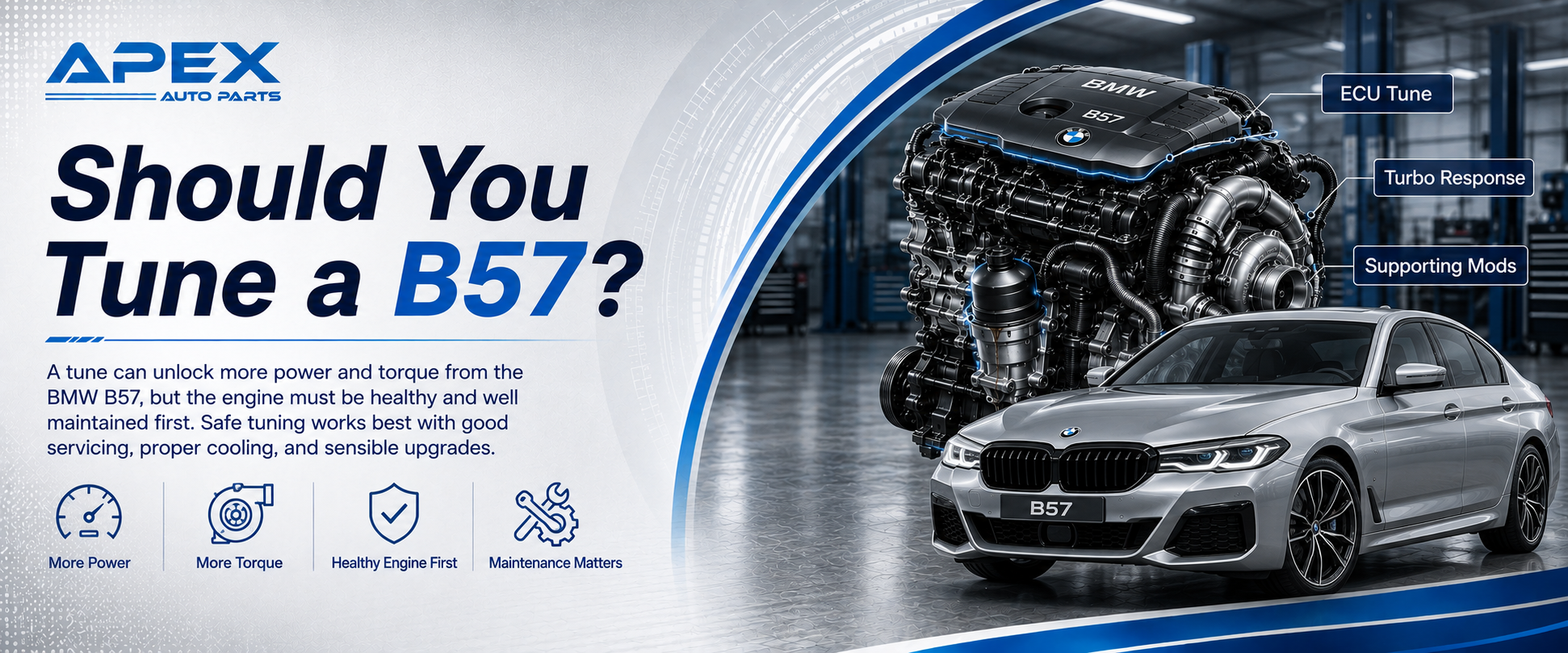
The B57 responds well to software tuning because the standard engine already produces strong torque.
That does not mean every car is ready for more power.
Before tuning, check the turbo system, cooling, fuel pressure, injectors, diesel filter, EGR equipment, gearbox, and stored fault codes. A car with coolant loss, poor regeneration, low boost, or long starting times should be repaired first.
Extra torque increases load on the gearbox, transfer case, driveshafts, engine mounts, turbo system, and cooling system.
The strongest possible map is not always the best choice for a daily car. A mild setup from a trusted specialist is normally kinder to the vehicle than chasing the highest number.
Removing the diesel filter or other emissions parts is not a proper tuning solution. A missing factory-fitted diesel filter will cause an MOT failure in the UK and can make the vehicle illegal for road use.
Ordering the Correct B57 Parts
B57 parts should be matched by VIN, model, year, engine version, and original part number.
A 530d, 540d, and M550d may all belong to the same broad engine family, but they can use different turbo parts, sensors, injectors, cooling parts, gaskets, and exhaust equipment.
BMW's own information shows how widely output and turbo design vary across the family, from the 265 hp 530d to the later 286 hp unit to the four-turbo 400 hp M550d.
When sourcing parts through Apex Auto Parts, provide the registration, full VIN, model year, and old part number where possible. This reduces the risk of ordering a component that looks similar but has a different connector, pipe position, software requirement, or internal design.
Quality matters most when labour is expensive. A cheap seal, sensor, or turbo part can lead to the same repair being completed twice.
Final Thoughts
Overall, the B57 engine is reliable when maintained and used correctly.
The B57 offers excellent torque, smooth running, and strong fuel economy for a six-cylinder engine. It is capable of high mileage and works especially well in vehicles used for regular longer journeys.
The main concerns often sit around the engine rather than deep inside it. EGR cooler leaks, diesel filter issues, oil dilution, sensors, AdBlue faults, air leaks, and turbo controls can all lead to costly issues.
The safest ownership approach is simple. Check recalls by VIN, properly service the engine, monitor oil and coolant levels, and diagnose warning lights before replacing parts.
A well-cared-for BMW B57 diesel engine can be a very strong used purchase. A neglected one with missing history and ignored emissions faults can become expensive, even when the basic engine is still mechanically sound.
FAQS
1. Is the B57 a good engine?
Yes, the B57 is generally a strong and reliable diesel engine. It offers smooth power, high torque, and good motorway fuel economy. Its long-term condition depends on correct oil servicing, cooling system health, diesel filter use, completed recall work, and fast repair of EGR, turbo, or emissions faults.
2. What are the most common BMW B57 engine problems?
Common BMW B57 engine problems include EGR cooler leaks, diesel filter blockage, oil dilution, boost leaks, turbo control faults, AdBlue warnings, injector problems, and coolant loss. Not every engine develops these issues. A full scan and physical inspection should be completed before parts are replaced.
3. How good is BMW B57 engine reliability?
BMW B57 engine reliability is generally good, especially in cars used for regular longer journeys. The main engine can handle high mileage, but the modern diesel components around it may need repairs. Service history, correct oil, stable coolant, healthy turbo operation, and proper diesel filter regeneration are all important.
4. Which BMW cars use the BMW B57 diesel engine?
The BMW B57 diesel engine has been used in several versions of the BMW 3 Series, 4 Series, 5 Series, 6 Series, 7 Series, X3, X4, X5, X6, and X7. Engine output and turbo design vary by model, year, and market, so parts must be matched by VIN.
5. Does the B57 have timing chain problems?
The B57 is not widely known for the same timing chain concern as some older BMW diesels, but wear is still possible. A metal rattle, timing code, or rough start should be investigated. Pulleys and belt components can sound similar, so the source of the noise must be located before a chain repair is approved.
6. What can go wrong with the B57 engine turbos?
The B57 engine turbos can suffer from actuator faults, air leaks, damaged hoses, oil supply problems, bearing wear, or control issues. Multi-stage versions are more complex. A boost code alone does not prove turbo failure, so requested pressure, actual pressure, pipework, sensors, and exhaust restriction should all be checked.
7. Is the BMW 530d G30 engine B57 reliable?
The BMW 530d G30 B57 engine is generally considered strong when properly serviced. Early models produced 265 hp, while later versions made 286 hp. Buyers should check EGR recall status, diesel filter data, coolant level, oil condition, turbo response, and service records before purchasing.
8. Was the B57 affected by an EGR cooler recall?
Certain B57-powered vehicles were affected by EGR cooler recalls, including some 2018 BMW 540d x Drive models. An internal coolant leak could mix with soot and damage the intake manifold. Not every B57 is affected, so owners should enter the vehicle's VIN into BMW's official recall checker.
9. How many miles can a BMW B57 engine last?
There is no fixed lifespan, but a properly maintained B57 can cover high mileage. Oil quality, coolant control, journey type, diesel filter health, turbo condition, and previous repairs all affect engine life. A high-mileage motorway car with full records may be safer than a lower-mileage car with poor maintenance.
10. What should I check before buying a used B57 BMW?
Check the cold start, service invoices, oil and coolant levels, EGR recall status, diesel filter data, turbo boost, injector readings, and stored fault codes. Confirm whether the car has been tuned. A proper pre-purchase inspection by a BMW diesel specialist can reveal problems that a short road test may miss.